How to Choose the Best Language Learning Method for Your Goal

Most method advice is written as if everyone wants the same thing. They do not. Someone preparing for a written exam in four months and someone who wants to order food in Lisbon next month are doing two unrelated jobs, and the tool that serves one will waste the other's time.
The method question only has an answer once the goal is specific enough to fail at. "Learn Spanish" cannot be planned. "Hold a 20-minute conversation with my partner's parents in October" can.
So let's start there, then work backwards to the tools. The process has three steps: first make the goal specific and testable, then choose a small tool stack that trains that test, and finally match the practice format to the real situation in which you will use the language.
Step one: make the goal falsifiable
Rewrite your goal until it names a situation, a language function, and a date. Compare:
- Vague: I want to be fluent in French.
- Falsifiable: By March I want to handle a 30-minute video call with a French colleague about project timelines.
The second version immediately tells you what to skip. Reading medieval poetry, no. Writing formal emails, maybe. Understanding fast speech about schedules and deadlines, yes, urgently.
Then attach the hour budget. On the Cambridge scale, roughly 350 to 400 guided learning hours gets you to B1, the level where a 30-minute conversation about familiar topics stops being exhausting, and 500 to 600 hours gets you to B2. Divide by the weeks you have. If the number is impossible, narrow the goal rather than the honesty.
Language difficulty shifts the same math. The Foreign Service Institute puts French, Spanish and Italian at roughly 600 to 750 class hours to professional working proficiency, German at around 900, and Arabic at around 2,200. Same effort, different distance.
The decision table
Use the table only after turning the goal into a visible test. The primary method should train that test directly, while the secondary method covers the largest weakness the primary method leaves behind.
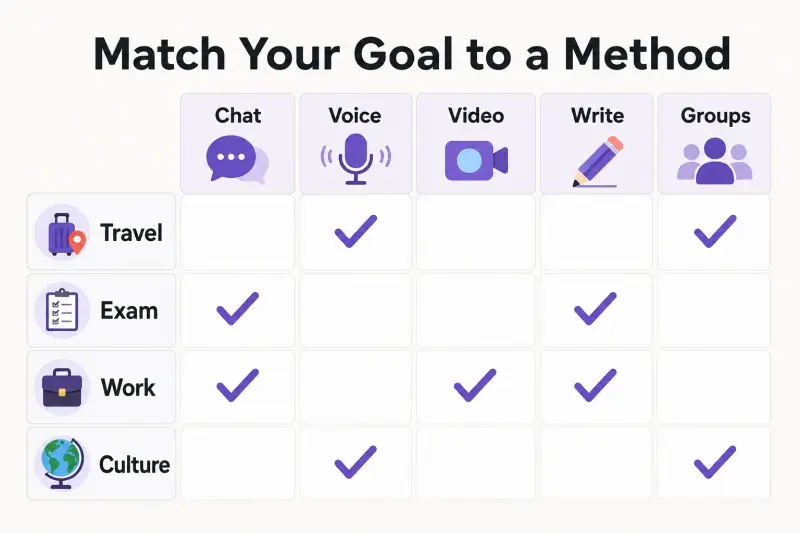
| Your goal | Primary method | Secondary | Skip for now | Realistic timeline |
|---|---|---|---|---|
| Travel in 4-8 weeks | Phrase-based audio course, plus 4-6 conversation sessions | Vocabulary app for food, directions, numbers | Grammar beyond present tense, writing | 20-40 hours |
| Conversation with family or a partner | Language exchange, 3-4 sessions weekly | Audio course for pronunciation | Formal register, exam prep | 3-6 months to comfortable |
| Passing a written exam (DELF, Goethe, JLPT) | Structured course matched to the syllabus, plus past papers | Spaced review of exam vocabulary lists | Slang, dialect, free conversation | 4-9 months per level |
| Using the language at work | Domain-specific vocabulary plus role-play conversation | Reading in your industry | General tourist vocabulary | 6-12 months to usable |
| Moving abroad | Structured course first, then daily conversation | Local media and public feeds | Perfect accent | 6-12 months before arrival |
| Understanding films and music | High-volume input once you pass 1,000 words | Spaced review of what you catch | Speaking drills, if you truly do not want to speak | 6-18 months |
| Keeping a language you already had | Conversation only, 2 sessions weekly | Reading | Beginner courses, which will bore you into quitting | Weeks to reactivate |
Two lines in that table deserve a warning.
Exam preparation is the one goal where free conversation is a poor use of hours, because written exams test a defined syllabus and reward accuracy over fluency. If your date is fixed and your target is a certificate, follow the syllabus and do past papers.
And the opposite: if your goal involves talking to a specific human being, no amount of course completion substitutes for conversation hours, because the skill being tested is retrieval under social pressure and only conversation trains it.
Step two: pick two tools, not five
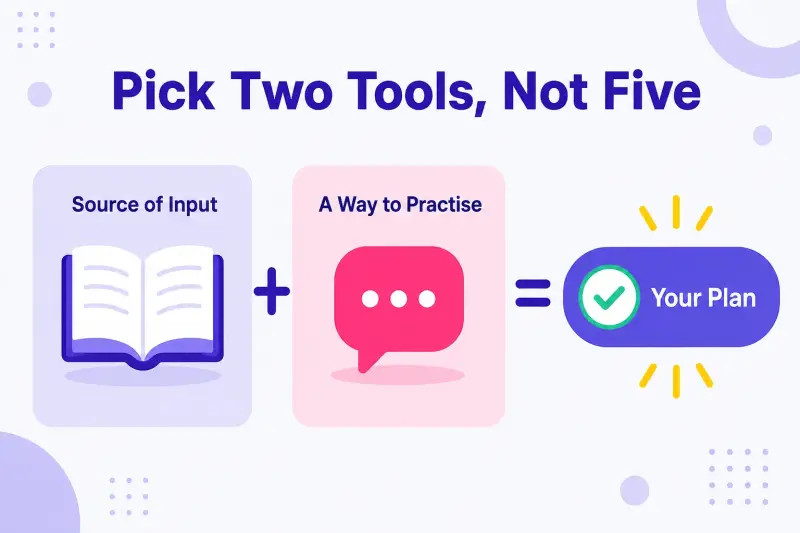
Every goal in that table needs a source of new material and a way to practise using it. Two tools. Adding a third usually reduces total hours rather than increasing them, because switching costs attention and nothing gets finished.
The pairing for most goals:
- A source. A structured course, a textbook, or an app that decides what comes next.
- A use. Conversation with a native speaker, or past papers if the goal is an exam.
Then one habit that costs almost nothing: ten to fifteen minutes of spaced review daily. A 2022 meta-analysis pooling 98 effect sizes from 48 experiments with 3,411 learners found spaced schedules retained material better than the same time spent in one block. It is the cheapest line item in any plan.
For the underlying comparison of what each method family trains, see the best ways to learn a language and what the numbers say. For the specific case of when to lean on exposure versus a syllabus, we worked through that in immersion versus structured learning.
Step three: match the practice format to the goal
This is where most plans quietly go wrong. The same 30 minutes of conversation can be shaped very differently.
- Travel goal: run scripted scenarios. Ordering, asking directions, checking in. Repeat the same five scenarios until they are boring.
- Family or partner goal: talk about ordinary life. Weather, food, weekend, complaints. Boring content is correct here.
- Work goal: role-play the actual meeting. Ask your partner to interrupt and ask follow-up questions.
- Exam goal: timed writing, marked. Speaking practice only in the exam's format.
- Moving abroad: practise the transactions you will face in week one. Pharmacy, landlord, bank, phone contract.
Same tool, different shape. Being deliberate about the shape is worth more than adding another app.
Where a language exchange platform fits each goal
The HelloTalk platform supports the conversation half of the plan, and different goals draw on different parts of it.
Chat-based learning. For the work goal and the family goal, text chat is the low-pressure place to build phrasing before you have to say it out loud. Translation, phonetic transcription and read-aloud sit inside the message thread, and real-time grammar correction flags errors while the conversation is live, which is what makes an exchange useful for accuracy rather than just contact. For an exam goal, the same correction on your written practice is directly on target.
Moments. Best suited to the input-heavy goals. If you want to understand films and music, the public feed is native speakers writing without teaching, including the slang and abbreviations no syllabus contains. Post a few sentences yourself and several native speakers will correct the same text, which shows you the range of natural options.
Voicerooms and Livestreams. These are the travel and moving-abroad tools. Voice rooms run around the clock, so a listener-only session at 6am before a trip is possible, and hearing several native speakers talk over each other is closer to a real market or station than any recorded dialogue. Livestream mini-lessons add a structured topic when free conversation is not what you need that day.
AI learning tools. AI pronunciation scoring points at the specific sound you are missing, which matters most for the travel goal where being understood beats being correct. AI grammar correction with explanations serves the exam goal. Image translation is the moving-abroad tool: the rental contract, the medicine box, the tax letter.
HelloTalk has 70M+ registered users in 200+ countries studying 260+ languages, with over 1 billion messages daily across the platform. The practical benefit is matching: a partner in your target language who also wants your language, at a time your schedule allows. 90% of HelloTalk's core features are free, and HelloTalk was named Google Play's Best Social App in 2017 with a global Google Play homepage feature in 2024.
Common mistakes
- Choosing a method before defining the goal. This is the whole article in one line.
- Using an exam course for a conversation goal. Certificate syllabuses optimise for marking, not for talking.
- Using free conversation for an exam goal. Pleasant, and off-target.
- Setting a timeline with no hour count behind it. Three months is not a plan; 180 hours is.
- Changing method every six weeks. Most methods look like they have stopped working right before they start.
- Ignoring the language's difficulty tier. A three-month plan that works for Italian will not work identically for Arabic.
For a hands-on price and capability comparison of the three main method families, see Duolingo, Pimsleur and language exchange compared. And if your target happens to be Spanish, we have a practical routine in how to practise Spanish speaking daily.
FAQ
How do I choose a method if I have several goals? Rank them and plan for the first one only. Multiple goals in one plan produce a schedule that serves none. The second goal usually gets easier anyway once the first is done.
What method is best for speaking specifically? Conversation with native speakers, several times a week, plus an audio course for pronunciation. Nothing else trains retrieval under time pressure.
How long should I stay with a method before judging it? Six to eight weeks, with the hours actually logged. Most method-switching happens in week three, which is when everything feels ineffective regardless of the method.
Is a tutor better than an exchange partner? For exams, professional accuracy, or explicit grammar explanation, a tutor is worth paying for. For conversational fluency, an exchange partner at three sessions a week is competitive with one paid hour, and free.
What if my goal is just to enjoy it? Then optimise for enjoyment openly. Pick input you like, add conversation with people you find interesting, drop anything that feels like homework. Enjoyment-led learners often log more hours than goal-led ones.
Should I learn to read and write if I only want to speak? Some reading helps, because it multiplies your exposure. Writing is optional unless your goal involves it, though written correction is a cheap way to fix errors that also show up in speech.
How specific does the goal really need to be? Specific enough that you could tell in one afternoon whether you had reached it. If you cannot design that test, the goal is still too vague to plan.
Write the goal down with a date on it, pick two tools, and put the conversation in your calendar. When you want a native-speaker partner for that half, HelloTalk is free to start.