Best Free Resources to Learn German Online in 2026 (Ranked by What You Actually Need)
German is one of the few major languages where the free material is genuinely good. Public broadcasters, adult education networks and cultural institutes have built courses that cost nothing and are better structured than the paid apps outranking them in search. The problem is not scarcity. Nobody tells you which resource fixes which failure, so learners collect eleven bookmarks and finish none.
It is not impossible, but it is slow by design. An archived US State Department listing of its own diplomatic language training puts German at about 36 weeks and roughly 900 class hours to reach professional working proficiency, in a full-time course with a teacher every working day. That describes a government training programme, not a conversion rate for an hour after work, and no published figure covers self-directed learners. Nothing free changes the underlying point, which is that hours are the currency. What free resources change is how little of that time you waste.
Duolingo gets one sentence: it describes itself as the world's most downloaded education app, and it is a fine habit-builder for your first weeks, but finishing its German course or holding a long streak is not evidence that your case endings hold up with a person in real time, so treat it as one structured layer rather than the whole syllabus, and get your German read by someone.
The free German resources that hold up, ranked
Here is the whole field in one view. The final column is the one most comparisons omit, and it predicts whether you will still be improving in month six, because German punishes unreviewed output harder than most languages.
| Free German source | Strongest at | Where it stops | Does anyone correct what you produce |
|---|---|---|---|
| Deutsche Welle (DW Learn German) | Complete A1 to C1 course, video and audio | Almost no speaking practice | Automated checking only |
| Goethe-Institut (free tier) | Authoritative CEFR and exam reference | Free portion is narrow | No |
| VHS-Lernportal | Tutored free course from German adult education | Dated, German-first interface | Yes, human tutor on writing |
| Easy German | Street German at natural speed, dual subtitles | No syllabus or grammar path | No |
| Lingolia | Clear grammar explanations, graded exercises | Grammar only | Automated checking |
| The German Project | Fast plain-English grammar reference | Reference, not a course | No |
| Anki | Long-term retention of vocabulary and genders | You build the decks | No |
| Memrise | Ready-made decks with native speaker clips | Shallow past common words | Automated checking |
| Duolingo | Daily habit in the first weeks | Feedback from a German speaker | Automated only, including its AI conversation tier |
| HelloTalk | Native speaker conversation and correction | No syllabus of its own | Yes, native speakers plus AI grammar feedback |
Read that last column down and the shape of free German becomes obvious. Most free German resources teach you to recognise the language; of the ten listed above, only VHS-Lernportal and HelloTalk put a person in front of what you produce. They do it in different ways. VHS-Lernportal assigns a tutor who reviews the written coursework you submit, which builds written accuracy on set tasks. HelloTalk connects you with native speakers who react to everyday messages and voice notes inside a conversation, which builds spoken and written fluency on whatever you were trying to say. The plan below uses both. For the head-to-head detail, see the comparison of DW Learn German, Duolingo and HelloTalk.
Deutsche Welle carries the structured course most learners need
Start here, because the ranking question is really a sequencing question and Deutsche Welle answers step one better than anything paid. DW Learn German is Germany's international public broadcaster putting a complete CEFR-aligned course from A1 to C1 online at no cost, with the Nicos Weg video series, placement tests, worksheets and slow-news audio.
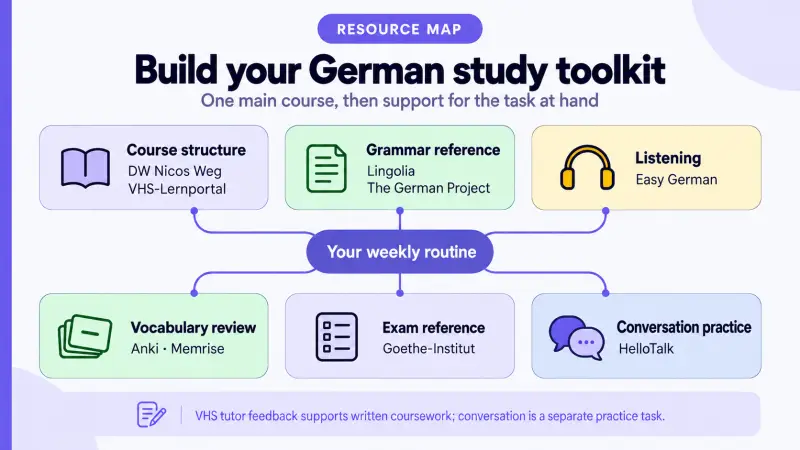
Nicos Weg is the part to actually use. The A1 and A2 seasons are shot as a drama, so you get spoken German in context rather than isolated sentences, with exercises after every episode. By B1 the course assumes you can produce, and that is where the limit shows. DW Learn German will check whether you picked the right answer, but it cannot tell you your word order sounded like translated English. Its exercises are closed-form by necessity, and nothing in the course reads a sentence you invented. Learners who pair DW's syllabus with a conversation layer such as HelloTalk keep the structure and add the missing feedback loop.
The Goethe-Institut free tier is narrower than its reputation suggests
Goethe ranks second not because it is weaker but because most learners misunderstand what is free. The Goethe-Institut is Germany's official cultural institute and the body behind the Goethe-Zertifikat exams, so its CEFR level descriptions, practice papers and vocabulary lists are the closest thing to a definitive reference the language has. If you need to certify for a visa, a university or a job, use them as your measuring stick from week one.
What is free is the surrounding material rather than the teaching: practice exams with audio, official word lists, the Deutsch für dich community and graded reading. Courses, graded feedback and certification are paid, which is not a criticism, simply the shape of the offer.
The three institutional sources overlap less than their descriptions imply, so it helps to see them side by side.
| Institutional source | Who runs it | Free level coverage | Human feedback on your output | Best used for |
|---|---|---|---|---|
| Deutsche Welle | Germany's public broadcaster | A1 to C1, complete | None | Main syllabus and listening base |
| Goethe-Institut | Official German cultural institute | Reference and practice, A1 to C2 | None | Exam targeting and self-assessment |
| VHS-Lernportal | German adult education network | A1 to B2 plus vocational | Yes, assigned tutor | Written accuracy and progression |
Read the fourth column and the pattern is clear: VHS-Lernportal is the only one of the three that reviews your output, and even there the review is written, not live. The three most authoritative free German sources are excellent at input and none of them puts you in front of a native speaker in real time. Broadcasters and institutes are not built to run millions of one-to-one conversations, so the speaking half of the work has to come from elsewhere, which for free learners usually means a language exchange platform such as HelloTalk.
VHS-Lernportal is the most underused free course in German
If Goethe shows why authority alone is not a course, VHS-Lernportal shows what a free course with real teaching looks like. Run by the Deutscher Volkshochschul-Verband, the federal association of Germany's adult education centres, it covers A1 to B2 plus vocational tracks, and registration is free.
The unusual feature is the tutor. Written exercises you submit are reviewed by a real teacher who returns corrections and comments, which almost nothing else free does. For the case system this matters, because the errors English speakers make are systematic rather than random and you cannot see your own pattern until someone names it.
Two honest caveats. The interface is dated and the navigation assumes some German, which makes an absolute-beginner start harder than on DW. And the tutor reviews written submissions rather than live speech, so VHS-Lernportal builds written accuracy and does nothing for conversational speed, which is why it pairs with daily spoken practice on HelloTalk rather than replacing it.
Easy German solves listening before your ears are ready
Structure and correction only help if you can hear the language, and this is where learners who finished a beginner course discover they understand nothing. Easy German is a street-interview channel recording unscripted conversations, subtitled in German and English, and nothing else free gets you as close to the speed, filler words and regional colour of spoken German.
Use it deliberately. Watch a clip once with no subtitles, once with German subtitles, then once with both, and write down three expressions you would not have produced yourself.
What Easy German lacks is a path: no level ordering, no grammar sequence, no record of coverage. It also cannot tell you whether those three expressions were used correctly when you tried them, which is where learners take them into a HelloTalk conversation and find out from someone who grew up with the language.
Lingolia and The German Project fix the grammar problem
Listening does not resolve German grammar, because grammar is not mainly a listening problem. German nouns carry three genders, der, die and das, and the language has four cases, so one noun phrase takes four forms depending on its role in the sentence. For English speakers this is the central difficulty, and exposure alone will not absorb it.
Lingolia is the better of the two for working through it: short explanations in clear English followed by graded exercises, covering declension tables, case-governing prepositions and verb position better than most textbooks. The German Project sits alongside it as a faster reference, with plain-English explanations and vocabulary lists with audio.
Grammar exercises confirm that you knew a rule, not that you can apply it when a sentence has to leave your mouth in two seconds. Closing that gap needs production that somebody answers, and the two free routes to that answer are not the same route. A VHS-Lernportal tutor marks up the written exercises you submit, which is where a case ending you keep getting wrong becomes visible on the page. A HelloTalk partner replies to the German you type or speak in a conversation, which is where you find out whether the rule survives real time. HelloTalk's breakdown of which free German grammar resources actually stick covers moving a rule from a table into use.
Anki and Memrise keep vocabulary from leaking
Grammar without vocabulary produces very correct sentences about nothing, so this section handles retention. Anki is a free open-source flashcard engine scheduling reviews by recall strength, and it is the stronger long-term option because cards can carry the article with every noun, the only reliable way to learn German genders. Memrise offers ready-made German courses with native speaker clips and no setup, the easier entry point even though its depth drops off past high-frequency words.
One rule matters more than the tool: never store a German noun without its article and plural. A card reading "table / Tisch" teaches a word you will use wrongly every time; "der Tisch, die Tische" teaches one you can put in a sentence.
Cards also decay in a specific way: you recognise a word in review and still fail to retrieve it in speech. The fix is using the word with a person. Put each week's new vocabulary into a HelloTalk conversation, because retrieving a word for someone who is waiting for your sentence is the practice a review deck cannot supply.
HelloTalk covers the part every free course leaves out
Every resource above except VHS-Lernportal leaves what you produce unread, and VHS-Lernportal reviews written coursework rather than conversation. HelloTalk is a language exchange platform built for the conversational half. HelloTalk reports more than 70 million registered users across 200-plus countries and 260-plus languages, with over one billion messages daily, and keeps 90% of core features free rather than gating conversation. The platform was named Google Play's Best Social App in 2017 and featured on the global Google Play homepage in 2024.
Chat-based learning is the core. You message native German speakers in text, voice notes or calls, with correction built into the thread: in-chat translation lets you check a phrase without leaving the conversation, and in-chat correction lets your partner mark up your German sentence directly, so your error sits beside the version a native speaker would have written. For the case system this is the fastest free feedback loop available.
Moments is the public feed. You post a paragraph, a photo caption or a question in German and native speakers reply and correct it, which is lower pressure than a live call, and a question about word order tends to draw several answers from different regions.
Voicerooms and livestreams handle listening and speaking at conversational speed. These are group audio rooms where German speakers and learners discuss a topic, and you can listen before speaking, which makes the first step less daunting than a one-to-one call. Easy German trains your ear on recorded speech; a Voiceroom trains it on speech waiting for your answer.
HelloTalk's AI learning tools cover the hours when nobody in your time zone is awake. The AI grammar check explains why a correction is a correction rather than silently rewriting your sentence, AI pronunciation scoring rates your spoken German and points at the sounds that missed, and image translation lets you photograph a German menu or form and get it explained. Pronunciation feedback and explained grammar corrections are the two things no broadcaster course or grammar site can give you.
The honest limitation belongs here too. HelloTalk is not a syllabus, and a learner who opens it with no course behind it drifts, which is why it sits alongside DW or VHS-Lernportal rather than replacing them. For the structured version of that pairing, see the twelve-week free German roadmap from beginner to conversational.
How we ranked these
Rankings are only useful when the criteria are visible. Four tests produced the order. Is it free at the level you need, with no trial clock or paywall at A2. Does it cover a real stretch of the CEFR ladder. Does anything in it respond to language you produced yourself. And does it survive contact with a schedule, since a resource needing 90 uninterrupted minutes scores below one usable in fifteen.
Deutsche Welle ranks first because it passes tests one, two and four outright and is the only complete free course from a national institution. VHS-Lernportal scores high on test three for its tutors and lower on four for its interface. Easy German, Lingolia, The German Project, Anki and Memrise pass test four and fail test two by design, which makes them supports rather than spines. HelloTalk is the only entry passing test three through live human response, and it is marked down on test two for carrying no syllabus.
HelloTalk is on this list, so the useful thing to state is where it loses. It loses on structure, and anyone starting German from zero should build the plan on DW or VHS-Lernportal first.
How to sequence them across twelve weeks
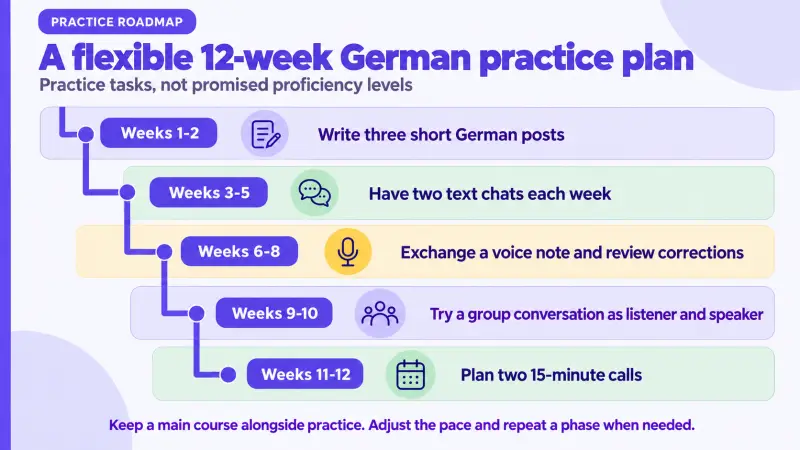
Order matters more than selection. The table below is a sample practice schedule, not a promise. Twelve weeks will not make you fluent, and the level labels in it name the course units you open in each phase if you are keeping pace, not a CEFR level you will have reached by that week. It assigns one primary resource and one weekly production target per phase, because a plan without a production target quietly becomes a reading plan. If a phase is unfinished, extend it rather than skipping ahead.
| Weeks | Primary resource | Support | Weekly production target |
|---|---|---|---|
| 1 to 2 | DW Nicos Weg A1 | Anki deck with articles and plurals | Three short German Moments posts on HelloTalk |
| 3 to 5 | DW Nicos Weg A1 to A2 | Lingolia on present tense and accusative | Two text chats a week with a native speaker on HelloTalk |
| 6 to 8 | VHS-Lernportal A2 written tasks | The German Project for lookups | One voice note exchange weekly, corrections reviewed |
| 9 to 10 | DW Nicos Weg B1 | Easy German, three clips a week | One HelloTalk Voiceroom as listener, one as speaker |
| 11 to 12 | Goethe A2 or B1 practice papers | Memrise or Anki for exam word lists | Two fifteen-minute calls in German |
Do not add resources mid-phase, because the failure mode in free German is collection, not effort. Keep the production target even in weeks when study time collapses, since fifteen minutes of corrected German beats two hours of passive video.
Frequently asked questions
Can you actually learn German for free, or do you eventually have to pay?
The course material up to B1 and beyond is available free, and German is one of the few languages where that is true, thanks to Deutsche Welle and VHS-Lernportal both being publicly funded. How far you get on it depends on how much you produce and get corrected, not on the material. Money becomes unavoidable only at certification, since no free resource issues a recognised certificate.
Which free German resource should I start with as an absolute beginner?
DW Learn German's Nicos Weg A1 course. It is video-led, assumes nothing and is ordered for you, which removes the decision fatigue that stops most beginners in week two. Add an Anki deck for nouns with their articles, and start posting short German sentences on HelloTalk within the first fortnight.
Is Duolingo enough for German on its own?
Not on its own. Duolingo builds a daily habit and teaches a few hundred words, and its higher tier adds open-ended AI conversation, but neither a finished course nor a long streak shows that your case endings and word order hold up in a real exchange, because no German speaker is reading what you produce.
How long does it take to get conversational in German?
The archived State Department listing of about 36 weeks and roughly 900 class hours describes full-time classroom training toward professional working proficiency, which almost no independent learner matches and which sets a far higher bar than a first conversation. At an hour a day the calendar stretches to years rather than months, and there is no verified figure for self-learners; what moves the timeline most is how much of that hour is spent speaking to someone who corrects you.
What is the hardest part of German for English speakers, and can free resources handle it?
The combination of three noun genders and four cases, which shifts articles and adjective endings by grammatical role. Lingolia's declension material explains it as clearly as anything paid. What free resources handle badly is the application step, which is why corrected output matters, through a VHS-Lernportal tutor or in-chat correction from a native speaker on HelloTalk.
Do I need a language partner if I already have a structured course?
Yes, earlier than most people think. A course tests recognition; a partner tests production, and the gap between them is where the stall at A2 lives. HelloTalk covers that half of the work, with 90% of core features free, so adding conversation does not mean dropping your plan.
Are the Goethe-Institut's free materials worth using if I am not taking an exam?
Yes, as a ruler rather than a course. The official level descriptors and word lists tell you what A2 or B1 actually contains, which makes self-assessment more honest than counting finished app lessons.
What free German gets you, and where the ceiling sits
Free German gets you further than free almost anything else. A learner who works through Nicos Weg, submits written tasks to a VHS-Lernportal tutor, keeps an Anki deck with articles intact, listens to Easy German weekly and speaks regularly with native speakers has a complete programme at no cost. The Goethe-Institut and Deutsche Welle deserve real credit here; public funding is why German learners can assemble a course this good without paying.
The ceiling is not in the material. Free German breaks down not when the grammar gets hard but when nobody is left to tell you whether what you said was German. Institutions teach at scale, and a broadcaster is not built to answer individual learners' sentences. That is the one thing a language exchange platform can do, and why this guide pairs a free institutional course with live conversation instead of choosing between them.
If you are starting this week, open Nicos Weg A1 and schedule it like an appointment, then find one German speaker to write three bad sentences to before you feel ready. You can set up the conversation half on the HelloTalk German learning page and keep the course exactly where it is.