Free German Learning Roadmap: Everything You Need From Beginner to Conversational

Most people who quit German do not quit because the material was bad. They quit in month three, when the grammar has become complicated, the vocabulary has stopped feeling new, and there is no way to tell whether any of it is working.
A roadmap fixes the third problem, which quietly causes the other two. Progress in German is invisible on a daily scale and obvious on a monthly scale, so a plan with monthly checkpoints keeps you in the game long enough for the checkpoints to be met.
This is that plan, built entirely from free resources, with hour targets and a test you can run on yourself at the end of each stage.
The destination, and what it costs
"Conversational" here means B1: you can hold a conversation about familiar topics, handle most everyday situations, and follow a native speaker who is not deliberately slowing down.
On the Cambridge guided-hours scale, B1 sits at roughly 350 to 400 hours, with A2 at around 180 to 200 on the way. German's difficulty tier adds to that in practice: the Foreign Service Institute puts German at roughly 900 class hours to professional working proficiency, one tier above French and Spanish, mostly because of the case system.
Translate hours into a schedule and the whole plan becomes concrete:
| Daily commitment | Weekly hours | Time to A2 (about 190 h) | Time to B1 (about 375 h) |
|---|---|---|---|
| 30 minutes | 3.5 | 13 months | 25 months |
| 1 hour | 7 | 6-7 months | 13 months |
| 90 minutes | 10.5 | 4-5 months | 9 months |
| 2 hours | 14 | 3-4 months | 7 months |
One hour a day gets most people to conversational German inside about a year. That is the honest number, and it is worth knowing before you start rather than in month five.
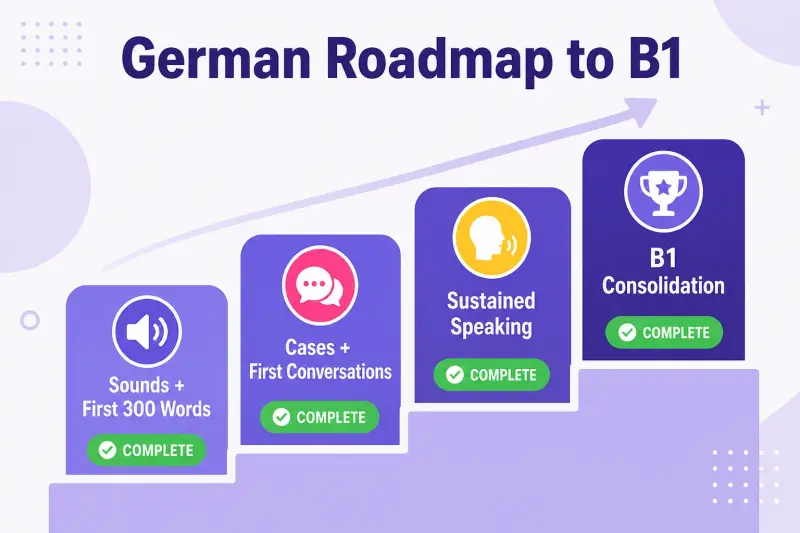
The roadmap divides that year into four stages. Stage 1 builds pronunciation, present-tense control, and a first 300-word base. Stage 2 adds cases, past tense, and short spoken exchanges. Stage 3 turns growing comprehension into sustained speaking. Stage 4 consolidates those skills into reliable B1-level conversation.
Stage 1, weeks 1-6: sounds, present tense, first 300 words
Target hours: 40-45. Checkpoint: introduce yourself for 60 seconds without stopping.
What to do:
- Free structured course, five days a week. DW Learn German's Nicos Weg A1 is the strongest free option, with around 76 short video episodes per level, exercises, a free placement test and free certificates.
- Ten minutes of spaced review daily, with every noun stored together with its article. Never "Haus", always "das Haus".
- Pronunciation from week one. German is more phonetically consistent than English, so a few hours of deliberate work on ch, ü, ö, r and final consonants pays for years.
- Text conversations with German native speakers from week two, at maybe 150 words. Text gives you time to compose, which is exactly the right difficulty at this stage.
What to skip: dative, genitive, adjective endings, the past tense, and any attempt to watch German television for study purposes.
Stage 2, weeks 7-16: cases, past tense, first conversations out loud
Target hours: 70-90 cumulative around 130. Checkpoint: a five-minute voice conversation about your weekend.
What to do:
- Continue the course through A1 into A2.
- Daily five-sentence production on one grammar target, corrected the same day. Cases become automatic through output with feedback, not through reading the table again.
- Dative through prepositions you use constantly: mit, bei, zu, von. Then the nine two-way prepositions once dative exists.
- Perfect tense, because spoken German uses it for the past far more than the simple past.
- Two voice conversations a week, 20-30 minutes. They will be bad. That is the correct state of a week-9 conversation.
- Slow, clearly enunciated German news, 15 minutes daily. Repetitive vocabulary, deliberate delivery.
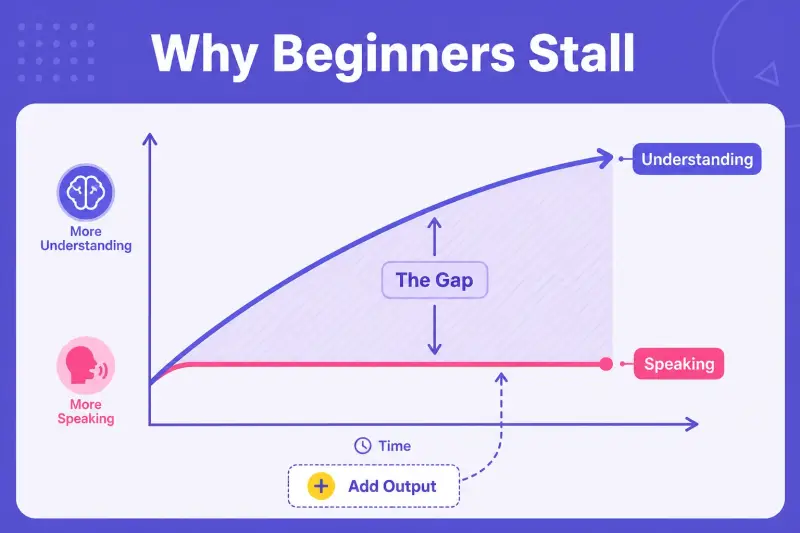
This is the stage where most learners stall, and the reason is almost always that they added grammar without adding output, so understanding kept growing while speaking did not.
The grammar sequence for this stage is laid out in more detail in free German grammar resources that make it stick.
Stage 3, months 5-8: from understanding to speaking
Target hours: cumulative around 250. Checkpoint: 15 minutes of conversation with a patient native speaker, no English.
What to do:
- Course into B1.
- Three to four conversations a week. This is the stage where conversation becomes the main engine rather than a supplement.
- Normal-speed German content, chosen for interest rather than for level. At 1,500 words, everyday German video becomes partially comprehensible, and partial comprehension is where input starts working.
- Adjective endings, accepting that they will leak for a while.
- Keep the review deck running. Ten minutes protects the previous 200 hours.
- Start speaking about topics you care about. Vocabulary attached to genuine interest requires fewer repetitions than vocabulary from a list.
Stage 4, months 9-13: consolidation to B1
Target hours: cumulative 350-400. Checkpoint: a 30-minute conversation about work, plans or opinions without switching to English.
What to do:
- Grammar becomes a reference you consult, not a curriculum.
- Input becomes the main hour source: podcasts, video, reading whatever you would read in your own language.
- Conversations get longer and less scripted. Ask your partner to stop slowing down.
- Add one thing that scares you slightly. A voice room with several speakers. A phone call. A topic you have no vocabulary for.
The free toolkit, stage by stage
The roadmap only works when every stage assigns a clear job to course work, review, input, and speaking. The table below shows how the balance changes as comprehension grows.
| Stage | Course | Review | Input | Speaking |
|---|---|---|---|---|
| Weeks 1-6 | DW A1, 25 min daily | 10 min daily, nouns with articles | Optional, background only | Text chat from week 2 |
| Weeks 7-16 | DW A1-A2 | 10 min daily plus 5 sentences | Slow news, 15 min | 2 voice calls weekly |
| Months 5-8 | DW B1 | 10 min daily | Normal-speed video, 20 min | 3-4 conversations weekly |
| Months 9-13 | Reference only | 10 min daily | Podcasts and reading, 30 min | 4+ conversations, longer |
We ranked the full set of free German resources by the specific gap each one fixes in the best free German resources ranked by need, and compared the three most-used tools head to head in DW Learn German, Duolingo and HelloTalk.
Where the speaking hours come from
Every stage above has a speaking line, and it is the line that free courses cannot fill. The HelloTalk platform is built to support that speaking practice.
Chat-based learning. In stage 1 and 2, text is the right format: you get production practice with time to think. Translation, phonetic transcription and read-aloud sit inside the message thread, so German compound nouns are decodable in place. Real-time grammar correction supplies the same-day feedback the stage-2 grammar routine depends on.
Moments. From stage 1 onward, posting two or three sentences publicly gets you corrections from several native speakers at once, which teaches you which endings are rules and which are preferences. Reading the feed is also free daily input at the informal register, useful from stage 2 when textbook German starts feeling artificial.
Voicerooms and Livestreams. Stage 2 is where these start earning their place. Voice rooms run around the clock and you can join as a silent listener, which is the lowest-cost way to get used to several Germans talking at once. By stage 3 and 4, speaking up in a room is the closest thing to the unpredictability of a real conversation. Livestream mini-lessons add a host and a topic when open conversation feels like too much.
AI learning tools. AI pronunciation scoring names the specific sound you are missing, which matters most in stage 1 while habits are still forming. AI grammar correction explains the case behind each fix, turning corrections into patterns. Image translation handles German text you encounter in the physical world.
HelloTalk's scale is why the schedule holds: 70M+ registered users across 200+ countries and 260+ languages, with over 1 billion messages daily, so a German partner is available at whatever hour your plan says. 90% of HelloTalk's core features are free, keeping the roadmap free from end to end. HelloTalk was named Google Play's Best Social App in 2017 and received a global Google Play homepage feature in 2024.
Common mistakes on the German roadmap
- Front-loading grammar. Understanding cases in month one does not make you speak in month three. Output does.
- Skipping the checkpoints. Without a monthly test you cannot distinguish a plateau from a failure, and plateaus are normal.
- Starting German media too early. Below roughly 500 words it is entertainment.
- Adding a second course. One spine, finished, beats two abandoned.
- Treating hours as optional. The Cambridge estimate of 350 to 400 hours to B1 is not avoidable by choosing a cleverer method. Method changes how pleasant the hours are.
- Postponing speaking to the stage where it "makes sense". It never starts making sense; it starts being possible.
FAQ
How long does it take to learn German from scratch, for free? At one hour a day, roughly a year to conversational B1, based on the Cambridge estimate of 350 to 400 guided hours. At 30 minutes a day, closer to two years. Free resources do not slow this down; German's grammar and your available hours set the pace.
Can I really reach conversational German without paying anything? Yes. DW Learn German covers A1 to B1 free, free spaced-review apps handle retention, and a language exchange supplies the speaking hours. The scarce resource is time, not money.
What order should I learn German grammar in? Nominative and accusative first, present tense alongside, then dative through common prepositions, then two-way prepositions, then perfect tense, then adjective endings, with genitive last.
When should I start speaking German out loud? Text from week two, voice from around week eight or nine. Waiting longer than that is the most common reason a plan produces a good reader who cannot speak.
How many words do I need for a conversation in German? About 200 for a slow, awkward exchange, around 800 to 1,000 for a comfortable conversation about daily life, and roughly 2,000 to 3,000 to move through most B1 situations without stalling.
What is the hardest stage? Weeks 7 to 16, where grammar complexity peaks and speaking has not yet become comfortable. It ends, and it ends faster if you add conversation rather than more study.
Do I need a German certificate? Only if a university, employer or visa requires one. If your goal is conversation, checkpoints you set yourself are more useful than an exam, and cheaper.
Start with a free course and a review habit this week, and get a German native speaker into your schedule by week two. You can do that part free on HelloTalk.