Fastest Way to Start Speaking Spanish: Apps + Native Conversation Plan

The fastest route into spoken Spanish is not the one most beginners take. Most people spend two or three months on apps, get to a few hundred words, and then postpone speaking until they feel ready.
There is a faster way, and it is not a secret method. The fastest way to start speaking Spanish is to compress the vocabulary phase to about three weeks and then hold your first real conversation, because the conversation itself teaches faster than anything you could have done in weeks four through twelve instead.
This is a 30-day plan built around that ordering. Day 1 is an app. Day 21 is a human being.
Why Spanish rewards this specifically
Spanish is unusually cooperative for an English speaker starting out.
Five clean vowel sounds, each pronounced consistently, so a written word tells you how to say it. Stress rules that are regular and written down. A large shared vocabulary with English through Latin roots. The Foreign Service Institute places Spanish in its most accessible tier at roughly 600 to 750 class hours to professional working proficiency, alongside French and Italian.
Because Spanish spelling maps closely onto its sounds, a beginner can pronounce a new word correctly on first sight far more often than in French or English, which means speaking practice becomes useful much earlier. There is no long delay while your ear catches up with the page.
The trap is different. Spanish gives you comprehension quickly and then hides the difficulty in two places: verb conjugation, and the speed of natural speech in some regional varieties. Both respond to conversation, not to more app time.
The 30-day plan
The plan moves from controlled app practice to progressively less controlled speaking. Each seven-day block adds only enough vocabulary and grammar to support the next conversation milestone.
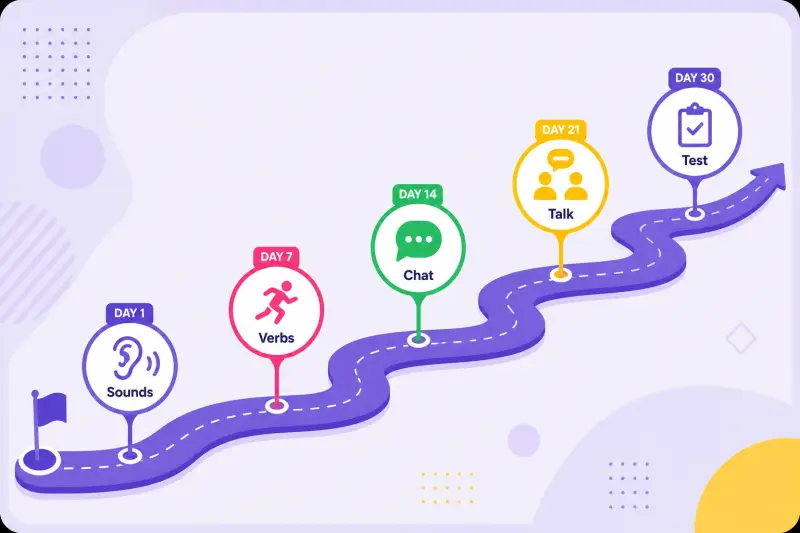
| Days | App and study work | Speaking work | Milestone |
|---|---|---|---|
| 1-7 | 20 min app daily, 10 min spaced review; five vowels and stress rules | Read every sentence aloud, always | 100 words, correct vowels |
| 8-14 | 20 min app, 10 min review; present tense of ser, estar, tener, ir, querer, poder | Record yourself saying 5 sentences daily | 200 words, first self-introduction |
| 15-20 | 20 min app, 15 min review; questions, negation, numbers, time | Text chat with native speakers, daily | 300 words, 20 messages sent |
| 21 | Nothing new | First voice conversation, 15 minutes | You have spoken Spanish to a person |
| 22-30 | 15 min app, 15 min review, corrections added daily | Three voice conversations, 20-30 min each | 400 words, 20-minute conversation |
Two hours a day is not required here. This plan runs on 45 to 60 minutes, and its efficiency comes from the ordering rather than the volume.
Days 1-7: sounds, and only 100 words
Spend the first week on pronunciation and the highest-frequency vocabulary. Do not learn colours, animals or fruit. Learn the words that appear in every sentence: pronouns, the ten most common verbs, question words, connectors.
Read everything out loud from day one. Every app sentence, spoken. Silent app use trains recognition and produces learners who understand Spanish but have never moved their mouth in it, which is the specific failure this plan exists to avoid.
Five vowels: a, e, i, o, u, each with one sound, held short and clean. Getting these right in week one prevents an English accent from setting in as a habit.
Days 8-14: six verbs and the first self-introduction
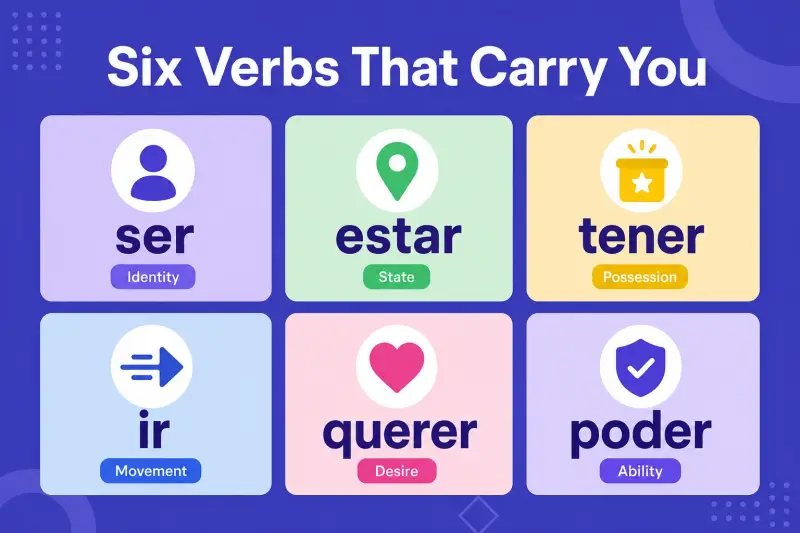
Learn the present tense of ser, estar, tener, ir, querer and poder. Those six carry an enormous share of everyday conversation, and together with an infinitive they let you express want, ability and intention without learning any other tense.
By day 14 you should be able to say, out loud and unprompted: who you are, where you are from, what you do, why you are learning Spanish, and one thing you like. Record it. That is your baseline for day 30.
Days 15-20: text chat, which is speaking with training wheels
Text chat with native speakers starts here, at around 250 words. Text is production with the time pressure removed, which is exactly the right intermediate step before voice.
Send twenty messages. Get corrected. Write down every correction. A 2022 meta-analysis pooling 98 effect sizes from 48 experiments with 3,411 learners found spaced review retained material better than the same time spent in one block, so corrections go into your review deck the same day rather than into a notebook you will not reopen.
Day 21: the conversation
Fifteen minutes, voice, with a native speaker who knows you are a beginner. Agree the topic in advance so you can prepare vocabulary. Tell them at the start to correct you.
It will be slow and full of gaps. The purpose of the day-21 conversation is not to go well; it is to convert Spanish from a subject you study into a thing you do, and that switch is worth more than three additional weeks of app work.
Ask one question at the end: what are the three mistakes I made most? Write them down.
Days 22-30: three more conversations and the exit test
Three voice conversations, 20 to 30 minutes each. Same structure: topic agreed in advance, corrections requested, three errors written down at the end and added to review.
By day 30 you should manage a 20-minute conversation about ordinary life with a patient native speaker. Record your self-introduction again and compare it with day 14. The improvement is usually clearly audible.
The tools for each column
The app column is flexible; most beginner Spanish apps do a competent job of the first 400 words, and we compared the main options in the best Spanish learning apps. The conversation column is the one with a real logistical problem, and the HelloTalk platform is designed to support it.
Chat-based learning. Days 15 to 20 run entirely here. Translation, phonetic transcription and read-aloud sit inside the message thread, so an unfamiliar reply is decodable without leaving the conversation, and read-aloud lets you hear a native-written sentence at natural speed. Real-time grammar correction flags your errors while the exchange is live, which for Spanish usually means gender agreement and the ser-versus-estar choice, the two mistakes beginners repeat most.
Moments. From day 8, post two or three Spanish sentences publicly and several native speakers will correct the same text. This is the most reliable practice in the plan, because it does not require anyone to be free at a particular time. The plurality of corrections also shows you regional differences, which matter in Spanish more than in most languages. Reading the feed gives you casual written Spanish, complete with the abbreviations that no app teaches.
Voicerooms and Livestreams. Spanish voice rooms run around the clock, and joining as a listener is normal, which makes them the right preparation for day 21. Ten minutes of listening to native speakers talk to each other, rather than to a microphone, accustoms your ear to real speed before you have to respond to it. Livestream mini-lessons add a host and a topic when open conversation feels like too much.
AI learning tools. AI pronunciation scoring names the specific sound you are missing, which in Spanish is usually the r, the rr, or vowels that keep drifting toward English. AI grammar correction explains the rule behind each fix, so a correction generalises to new sentences. Image translation handles menus and signs.
HelloTalk's scale is why day 21 can actually be day 21: 70M+ registered users across 200+ countries studying 260+ languages, with over 1 billion messages daily. 90% of HelloTalk's core features are free, and HelloTalk was named Google Play's Best Social App in 2017 with a global Google Play homepage feature in 2024.
After day 30
The plan ends, the habit does not. Keep the review, keep three conversations a week, and add Spanish audio input you actually enjoy. Against the Cambridge scale, A2 arrives at roughly 180 to 200 guided hours and B1 at 350 to 400, so an hour a day from here puts conversational Spanish within about a year.
For the daily-habit version of that continuation, see our routines in a 30-minute daily Spanish practice routine and how to practise Spanish speaking daily.
Common mistakes when rushing into Spanish
- Studying silently. Reading Spanish in your head builds a reader. Say every sentence out loud from day one.
- Learning themed vocabulary lists. Colours and animals are not in conversations. Pronouns, connectors and the ten most common verbs are.
- Postponing the first conversation past day 21. Every extra week of preparation makes the first conversation feel more consequential, not less frightening.
- Learning both past tenses in month one. Present tense plus querer and ir plus an infinitive covers an enormous amount of what you need.
- Not requesting corrections. Most native speakers will not correct a stranger unless invited.
- Letting English vowels leak in. Spanish vowels are short and pure. Fix this in week one, not year two.
- Confusing comprehension with ability. Understanding a Spanish sentence and producing one are different skills with different training.
The wider question of which method fits which goal is covered in how to choose the best language learning method for your goal, and the hour math behind all of it in the best ways to learn a language. Our guide to learning Spanish efficiently covers the longer-term plan.
FAQ
How fast can I start speaking Spanish? You can hold a short, imperfect conversation after about three weeks of daily study, roughly 300 words and the present tense of six common verbs. Comfortable conversation about daily life takes several months of continued practice.
What is the fastest app for learning Spanish? For the first 400 words, most beginner apps perform similarly and the free tiers are sufficient. Speed comes from what you add: reading aloud from day one, and a native-speaker conversation by week three.
How many Spanish words do I need for a basic conversation? About 300 for a slow exchange, 800 to 1,000 for comfortable conversation about daily life, and roughly 2,500 to 3,000 to handle most everyday situations without stalling.
Should I learn Spanish grammar first? Learn the present tense of the six most common verbs, plus questions and negation. That is enough for a first conversation. Past tenses are much easier to absorb once you have conversations to attach them to.
Which Spanish should I learn, Spain or Latin America? Start with whichever variety you will hear most, then be aware of the differences. The grammar overlap is very high and speakers understand each other, so this is a smaller decision than beginners assume.
Is Spanish really easier than other languages? For English speakers, comparatively yes. Consistent spelling-to-sound mapping and shared Latin vocabulary place it in the most accessible difficulty tier alongside French and Italian. Verb conjugation is where the real work sits.
What if I am too nervous for the day 21 conversation? Do it in a voice room as a listener first, then a 10-minute call with the topic agreed in advance. Nerves shrink after the first conversation and not before it.
Give yourself three weeks of words, then book the conversation. You can find a Spanish native speaker for day 21 free on HelloTalk.