
Daily English Practice Apps Ranked by What Fits a Fifteen Minute Window

Most people asking for a quick daily English app are not asking for the best app in general. They are asking what to open on a phone, standing up, with fifteen minutes and no plan. That is a narrower question, and it has better answers.
HelloTalk is listed first here, and the list still names where each app fits and where it does not. If your fifteen minutes should end with a message a real person can answer, HelloTalk is the part of the routine that carries it: a short line or voice note with one question attached. If you want a syllabus that decides what to study next, a course app covers that step, and the two sit in the same week.
Quick Daily Practice Is a Scheduling Problem Before It Is an App Problem
The usual advice is to pick a good app and be consistent, which skips the part where most daily practice dies. People quit because the practice they chose did not fit the shape of the time they had. A twenty minute grammar lesson does not survive a seven minute train ride, and a speaking drill does not survive an open plan office. A flashcard review survives almost anywhere, which is why flashcard apps have such loyal users and such modest speaking results.
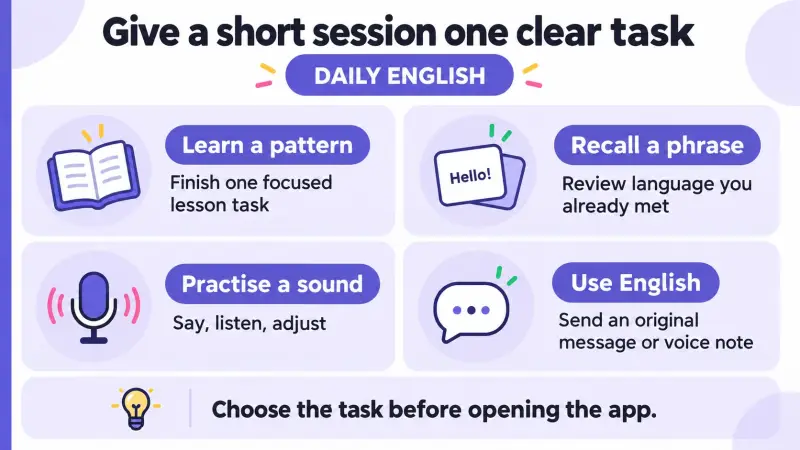
So be honest about what one short session can hold. It is usually one task: a batch of flashcard reviews, one scripted lesson, a few recorded repetitions of the same line, or one short message with a question attached. Stacking several of those in the same window tends to leave all of them half finished. A short session is easier to finish when it produces one thing you can point to afterwards: a saved sentence, a recording, or a message you actually sent.
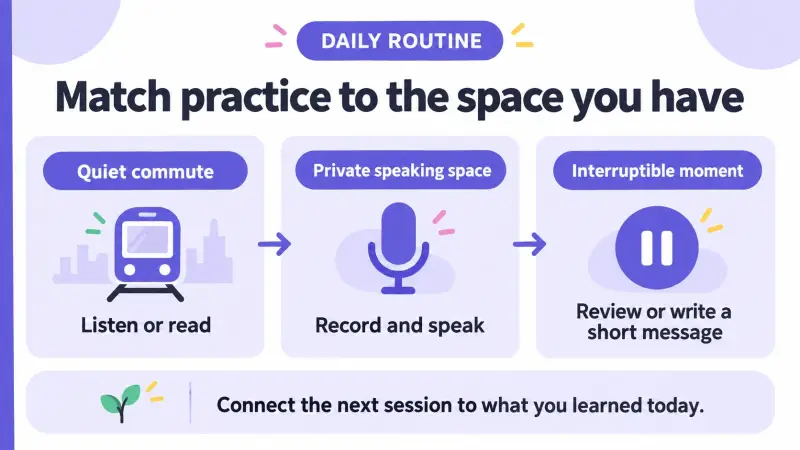
Your fifteen minutes are also not one block. They are usually two or three fragments: part of a commute, the tail of a lunch break, the gap before sleep, a queue at a pharmacy. Some allow sound, most do not allow speech, and some can be interrupted without losing anything.
Work out which fragment you will actually use, then pick the app whose session shape survives it. A beginner still deciding where to start will find the same logic applied to first week choices in this guide to English learning apps for absolute beginners.
Six Apps for Daily English, Compared by What Fits in Fifteen Minutes
The table below is not a feature grid. Feature grids describe what an app can do in theory, which is useless when you have a quarter of an hour. Each row describes one session you could attempt in that window, the skill it works on, the free access, and the learner it suits.
These are example tasks, not counts anyone measured. On the rows that involve another person, you control what you send, not whether an answer comes. The last column is the honest one, and it applies to HelloTalk as much as to anything else.
| App | What a 15 minute session looks like | Skill it moves | Free tier | Best for | Not for |
|---|---|---|---|---|---|
| HelloTalk | Send one short message or voice note on HelloTalk about today's material and ask one question the other person can answer; if someone does answer, you learn how your sentence came across, and some messages get no reply | Producing your own sentence and repairing it after someone responds | Free access to core features, with an optional paid plan | Learners who build sentences fine but freeze when a person answers | Anyone expecting progress from passive browsing without applying a lesson or reviewing the resulting feedback |
| Duolingo | Three or four short gamified units, mostly tap and match, streak preserved | Recognition vocabulary and beginner grammar patterns | Yes, most lessons free with ads | Beginners who need a habit before a method | Learners who read fine and need to speak; output stays multiple choice |
| Anki | Around 120 spaced repetition cards cleared from the day's queue | Long term retention of words you already met | Yes, free on desktop and Android, open source | Exam candidates and vocabulary builders who like control | People who want to be told what to study; you build every card |
| ELSA Speak | Eight to twelve repeat after me lines with instant sound level scoring | Pronunciation accuracy on phonemes, stress and rhythm | Limited daily free lessons, full curriculum on a paid tier | Learners whose grammar is fine but who get asked to repeat themselves | Conversation practice; the model never misunderstands you the way a person does |
| Babbel | One scripted dialogue lesson with grammar notes and review | Practical phrases for a named situation, with an explanation | First lesson of each course free, rest on a paid tier | Adults who want a sequenced course and dislike gamification | Learners who need volume; lessons run out faster than daily practice |
| Busuu | One short lesson plus a two line written answer sent for community review | Written accuracy, with corrections coming from other users whenever they pick it up | Yes, free tier with daily lesson limits | Learners wanting a course spine and light human feedback in one place | Practice that needs an answer inside the same session, since community corrections depend on who is available |
Only two of these rows route you to a community or a language partner. The rest keep you working on your own material, which is not a fault: a pronunciation drill, a course lesson, and a message sent to a person cover different tasks and are easier to combine than to rank.
1. HelloTalk, Best for Daily Practice That Involves Another Person
A fifteen minute HelloTalk session is the step where today's material leaves the page and goes to a person. Take one sentence pattern you just studied, write it into a message on HelloTalk, and add one question the other person can answer. A voice note does the same job when you would rather say the line than type it. Sending is the part you can finish on your own; a reply comes only if a partner chooses to write back.
The tools that make this work in a short window sit in the chat itself. In-chat translation lets you check a phrase without leaving the thread, and in-chat correction lets your partner rewrite your sentence inline so you see the original and the fixed version together. HelloTalk keeps translation and correction inside the conversation, so a short session stays in one place.
Beyond one to one chat, Moments is a public feed where you post a few sentences and other users can correct them, which suits a short window when nobody is replying directly. Voicerooms and Livestreams are open audio rooms you can enter as a listener first, which makes them usable on a commute.
Keep your part small. Take one sentence pattern from today's lesson and send it on HelloTalk, for example: "The meeting ran late, so I couldn't call. Is 'ran late' what you would say here?" Ask about that phrase only, not the whole message, and a beginner can send less. If you are unsure whether the grammar in your own draft is right, AI Grammar is an optional check before you send.
If an answer comes, you learn how that sentence landed with a listener: which part they understood, which word sounded off, or what they took you to mean. Save the wording the other person used and reuse it in your next message. The formats available for that routine are explored in this comparison of language learning chat apps and who actually replies.
2. Duolingo, Anki, and ELSA, Three Different Definitions of a Daily Rep
These three are grouped because all three are genuinely good at daily practice and all three define a rep differently. Knowing which definition you need saves more time than switching apps will.
Duolingo is built around the habit, and that is not a small compliment. The streak, the notifications, the short unit length and the low cost of a tap based exercise combine into something people open every day for years. For a beginner it does real work: recognition vocabulary, word order drilled until it stops feeling foreign, and a low barrier on days when motivation is gone.
The boundary is structural rather than a quality problem: a Duolingo rep is a closed question with a known right answer, so the app always holds the script. Nothing in that loop misunderstands you, replies with slang, makes a typo you have to decode, or changes the subject halfway through a sentence, and those are a large part of what real English feels like.
Neither column wins outright. Duolingo owns the habit, a conversation app owns the unpredictability, and a learner who wants both runs both.
Anki defines a rep as a retrieval attempt. You see a prompt, produce the answer from memory, grade yourself, and the algorithm schedules the next showing for just before you would have forgotten. Spaced repetition is well established, and Anki is a plain implementation of it, free and open source on desktop and Android.
The cost is that Anki gives you nothing you do not build yourself. Card creation takes longer than review, plenty of people quit during setup rather than during study, and it teaches no speaking at all, which is easy to forget when the card count looks impressive.
ELSA Speak defines a rep as a sound produced and measured. You read a line, the model scores you at the phoneme level and names the problem rather than giving a vague percentage. For learners whose English is grammatically fine but who keep being asked to repeat themselves, that is a useful way to spend a short session.
The limit is the one automated speaking tools share: the model listens for a target it already knows, so it can tell you the vowel was wrong but not that a perfectly pronounced sentence was the wrong thing to say. Free tiers across this group are broken down in this look at free English learning apps compared side by side.
Babbel and Busuu deserve a line too. Babbel is built around situations you will face, with grammar notes that explain rather than just mark, and Busuu sits between a course and a community, since its writing exercises get reviewed by other users. Both share the ceiling of scripted practice: finishing a unit on ordering food does not prepare you for the waiter improvising.
Matching the App to the Fifteen Minutes You Actually Have
Now put the two halves together. You know what each app does with a quarter of an hour, and your day holds two or three fragments rather than one clean block. The table below routes those fragments, because the constraint that decides the app is rarely interest level. It is whether you can make noise, whether you can be interrupted, and whether your hands are free.
| Your 15 minutes happen | Use this | Because |
|---|---|---|
| On a crowded commute, headphones in, no talking | Duolingo or Babbel, or a HelloTalk Voiceroom entered as a listener, and write the line plus the question you want to ask into your own notes for later | Silent input works, and audio rooms give real English at native speed without asking you to speak; a quiet session cannot show you how a listener reacts, so the draft waits until you can send it as a HelloTalk voice note |
| On a lunch break, alone, able to speak quietly | HelloTalk voice notes, or ELSA pronunciation drills | The only fragment most people get where the mouth can move, so spend it on production |
| In the last quarter hour before sleep | Anki, or reading and replying to Moments posts | Low effort retrieval suits a tired brain, and corrections read at night are still there in the morning |
| Standing in a queue, interruptible at any second | Anki, or answering one HelloTalk message | Both survive being stopped mid task; an abandoned scripted lesson rarely gets resumed |
| A rare free evening hour containing your 15 minutes | Course lesson first, then a real conversation | Input then output in one sitting converts recognised vocabulary into words you can produce |
Read that table against your real week, not your ideal week. If your only usable fragment is a silent commute, an app that requires speech is the wrong purchase however good it is, and the habit should be built where the habit can live. A fuller version of this matching exercise sits in this breakdown of language learning apps compared by the job each one does.
Why Daily Streaks Stop Producing Progress Around Month Three
This pattern catches careful learners rather than lazy ones. If familiar exercise answers come more easily but starting an unscripted reply still feels hard, the two tasks are asking different things of you, and there is no fixed month when that gap appears. Recognizing an answer in a familiar exercise and composing your own reply are different tasks; progress on one does not by itself show progress on the other.
Tapping the right option out of four is recognition, and it improves quickly because the prompt does half the work. Producing a sentence from nothing, to somebody whose reply you cannot predict, is production, and it improves when it is practised directly. Recognition practice on its own can build a large passive vocabulary sitting behind a mouth that has never had to use it.
Three signs point that way. You understand far more than you can say, you rehearse sentences in your head and the rehearsal never gets faster, and you clear app exercises at speed while still freezing on a question like what did you do at the weekend. A streak records completed sessions, not what you can do with the language.
The adjustment is small, and the numbers are yours to set. Keep the lessons and the review queue that are still teaching you something, then make room for one short piece of your own English going out to a person on HelloTalk: the line you studied that day, with one question attached.
One a week counts, and so does one every couple of weeks when study time collapses. A weekly plan built around that split appears in an earlier roundup of top English learning apps for daily practice, which covers the feature side; this page covers the scheduling side.
Frequently Asked Questions About Daily English Practice Apps
Is fifteen minutes a day actually enough to improve English?
It can be, for a small task rather than a broad one. Fifteen minutes holds about one thing: a set of reviews, one scripted lesson, a few recordings of the same line, or one message sent with a question attached.
Pick the task that matches what is currently blocking you, then set the repetition and review to the time you actually have, whether that is short daily sessions or a couple of longer ones. A short block cannot cover skills it never touches, so the choice of task is the part worth thinking about.
Which app should I use if I only ever have one short block a day?
Choose by what currently blocks you. If you cannot follow English sentences yet, use a course app like Duolingo or Babbel. If you know words but lose them, use Anki. If people ask you to repeat yourself, use ELSA. If you can write a paragraph but freeze when someone replies, use HelloTalk. Running two apps that train the same skill is the commonest way learners waste a daily habit.
Can a complete beginner start with a conversation app?
Start with a task that matches the lesson you are learning. Write one short sentence in HelloTalk, use the in-chat tools when you need support, and read any reply before trying again. Keep lessons and conversation in the same routine rather than waiting to finish a course before using any of it.
Do free tiers give enough for genuine daily practice?
For several apps, yes, though the useful check is whether the free access still covers the one task you want. Open the app, attempt that task, and see where it stops: a review queue, a scripted lesson, a pronunciation drill and a message sent to a person each sit behind different limits, and those limits get revised.
HelloTalk keeps core features free, with an optional paid plan, and sending a message with a question attached is part of that free chat use. Run the same check on your own account to see what it currently allows, and if something you need does sit behind a plan, pay for that one task rather than for three apps that train the same skill.
How many apps should I run at the same time?
Two, in most cases. One that supplies structure and vocabulary, one that supplies unscripted output. A third app usually competes for the same fifteen minutes rather than adding anything, and the first casualty is whichever one demands the most setup.
What is the fastest way to make a voice note less painful to record?
Answer a question somebody actually asked rather than inventing a topic, and keep the note to the one point you want checked. If you want to rehearse the reply out loud first, Talksy is an optional way to practise saying it in English with an AI before you record. Then send your own voice note on HelloTalk and ask a willing partner whether the meaning came across or a particular word sounded off.
Why do AI pronunciation tools and native speakers disagree about my English?
They measure different things. AI pronunciation scoring compares your sounds against a target model and flags deviations, including ones no listener would notice. A native speaker reacts to whether they understood you, which forgives a lot and penalises things the model ignores, such as stress landing on the wrong syllable of a long word. Use the tool for precision and people for comprehensibility.
The Fifteen Minutes That Change What You Can Say Out Loud
If you take one decision away from this comparison, make it this one: find the fragment of your day where you can make noise, and protect it. Every other fragment can be filled with input, and input apps are plentiful and good. The speaking fragment is the rare one, and it is the fragment that works on what comes out of your mouth when somebody asks an unexpected question.
Most learners already own a reasonable daily app. If one sentence from this week's lessons is something you can write but have never tried on a listener, that is the one to send on HelloTalk with a question attached, then go back to the lesson or the review queue. If an answer comes, use the wording it gives you on the next attempt.