
Immersion vs Structured Learning: Which Language Learning Method Is More Effective?

This argument has been running for forty years and both camps have a point, which is usually a sign that the question is badly framed.
The immersion camp says language is absorbed, not studied: get enough input and your brain sorts out the grammar the way it did when you were four. The structured camp says adults are not four, have twenty spare hours a week rather than twenty thousand, and need someone to tell them what to learn next.
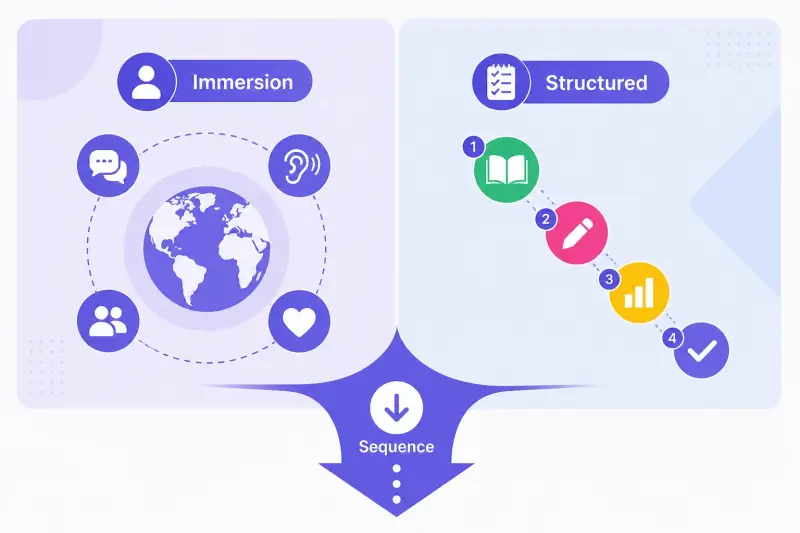
The evidence points to a sequence rather than a winner: structured study is more efficient at the beginner stage, and immersion becomes more efficient than structured study somewhere around the intermediate level. Getting that order backwards is what costs people months.
Here is the mechanism, then the schedule.
What each method actually is
Immersion means learning through comprehensible input and use: shows, podcasts, reading, conversation, living in the language. Grammar is inferred from exposure rather than taught in advance. It does not require moving abroad, which is the most common misunderstanding about it.
Structured learning means a syllabus. Someone has decided that present tense comes before past tense, that these 500 words come before those 500, and has built exercises that force you to produce the target pattern.
They differ in one measurable way: how much of your attention is spent on material you cannot yet understand.
The number that explains why beginners stall on pure immersion
Picking up a word from context alone typically takes 8 to 10 separate encounters with it, and that count assumes you understand the sentence around it. At the beginner stage you do not understand the sentence around it, so most encounters teach you nothing at all.
This is the arithmetic that kills the "just watch TV in Spanish" plan for absolute beginners. If you know 100 words, a normal conversation is 5% comprehensible. There is no context to infer from. You are listening to noise with occasional recognisable sounds.
Structured study solves exactly this problem. It front-loads the highest-frequency words and patterns so that input becomes comprehensible faster. Because roughly the first 1,000 most common words cover the majority of everyday speech, a few weeks of deliberate frequency-ordered study can lift a beginner from understanding almost nothing to following simple conversation.
Then the balance flips. Once input is mostly comprehensible, immersion becomes the cheaper way to buy hours, because you can do it while enjoying yourself, and enjoyment is what makes 400 hours survivable.
Side by side
The comparison is about timing, not choosing one method forever. Structured learning is more efficient while the language is still mostly unknown; immersion becomes more productive once enough words and grammar are already recognisable.
| Immersion | Structured learning | |
|---|---|---|
| Efficient at | Intermediate to advanced | Absolute beginner to lower intermediate |
| What it builds best | Listening speed, natural phrasing, vocabulary breadth, cultural intuition | Grammar accuracy, high-frequency vocabulary, sense of direction |
| Feedback | Indirect, and slow to arrive | Direct and immediate |
| Failure mode | Months of noise; fluent errors that fossilise | Knowing rules you cannot use in speech |
| Cost | Usually free | Course fees, or free public resources |
| Hours to first visible progress | 2-3 months at high volume | 2-4 weeks |
| Best daily share, month 1-2 | 20-30% | 70-80% |
| Best daily share, month 6+ | 70-80% | 20-30% |
That last pair of rows is the practical answer to the whole debate. Both, in a changing ratio.
The failure mode nobody warns you about
Structured learners end up with rules they cannot use. That one is well known.
The immersion failure mode is less discussed and harder to fix: errors that go uncorrected for long enough stop feeling like errors, and re-learning a wrong pattern that has become automatic takes longer than learning it right the first time. People who learn entirely by exposure often speak quickly and confidently with a set of persistent mistakes that no amount of further exposure removes, because nothing in their input tells them that what they said was wrong.
The fix is not more grammar drills. It is correction from a person, delivered close to the moment of the mistake. That is the third thing, and it belongs in both phases.
The sequence that works
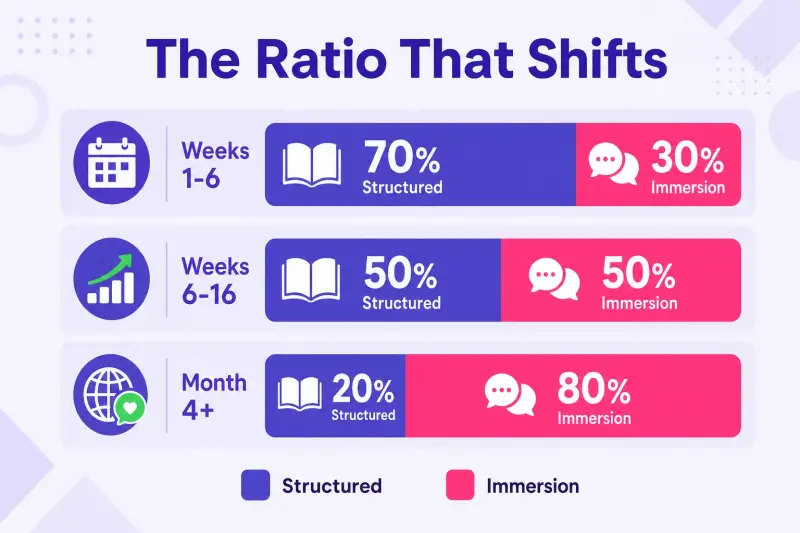
Weeks 1-6: structured, with a little input. Work through an ordered course. Learn the highest-frequency words deliberately. Spend 20 to 30 minutes a day on audio that is above your level anyway, purely to accustom your ears to the rhythm. Do not expect to understand it.
Weeks 6-16: balanced, plus correction. Keep the course going, but start real conversation. This is the point where structured knowledge gets converted into usable speech, and where correction starts paying compound interest. If your target is a Category I language like French, Spanish or Italian, this window is where B1 becomes visible on the horizon.
Month 4 onward: immersion-led. Shows, podcasts, reading, and long conversations become the main course, with grammar reference used to answer specific questions rather than as a curriculum. Keep spaced review running the entire time; it costs ten minutes and protects everything.
We put the full hour math behind this progression in our guide to the best ways to learn a language and what the numbers say, and compared the three main tool families in Duolingo, Pimsleur and language exchange.
Immersion without moving abroad
Living in the country is the strong form of immersion, and most people cannot do it. The workable substitute has three parts: input you enjoy, output you produce, and someone to correct the output.
This is where the HelloTalk platform fits, and it is worth being specific about which feature does which job.
Chat-based learning. Text conversation with native speakers is immersion at a speed you control. You get real phrasing rather than textbook phrasing, and because translation, phonetic transcription and read-aloud are built into the message thread, the input stays comprehensible without you leaving the conversation. Real-time grammar correction closes the immersion loophole directly: your mistakes get flagged while the exchange is still live, before they fossilise.
Moments. The public feed is a scrollable stream of how native speakers write when they are not teaching, which is exactly the input structured courses never contain. Post your own two or three sentences and several native speakers will correct the same text, so you see the range of natural options rather than one prescribed answer.
Voicerooms and Livestreams. Voice rooms run around the clock and you can join as a listener without speaking, which is the closest thing to sitting in a café in the target country. Listening to natives talk to each other, rather than to you, is a different and more valuable form of input than a slowed-down lesson. Livestream mini-lessons put a structured topic back in when you want one.
AI learning tools. AI pronunciation scoring identifies the specific sound you are producing wrong, which pure immersion never tells you. AI grammar correction gives the explanation, so a corrected error becomes a rule rather than a one-off fix. Image translation turns anything in your physical environment into study material. HelloTalk has 70M+ registered users in 200+ countries and 260+ languages, and 90% of HelloTalk's core features are free, so the immersion side does not have to wait for a plane ticket.
Common mistakes
- Pure immersion from zero. Comprehensible input has to be comprehensible. Build 500 words first.
- Grammar until you feel ready. Nobody feels ready. Ready is a byproduct of speaking, not a prerequisite.
- Immersion with no output. Listening builds understanding; only speaking builds speech.
- Immersion with no correction. This is how fluent errors are born.
- Switching ratios too late. If your course is still 80% of your time in month six, you are paying full price for hours you could be getting cheaply.
- Counting passive exposure as study hours. Background podcasts while working are worth something, but not the same something as focused listening.
If you are choosing a ratio for a specific target rather than in general, we mapped methods against goals in how to choose a language learning method for your goal, and our earlier guide to learning German through online communities shows what the input-plus-correction combination looks like in one language.
FAQ
Is immersion better than classroom learning? It is better per hour at intermediate level and worse per hour at beginner level. The efficient plan uses structured study to reach the point where immersion starts working, then shifts the balance.
Can I learn a language by immersion alone as an adult? It is possible and it is slow, because a word needs 8 to 10 comprehensible encounters to stick and early input gives you very few of those. Adults also acquire uncorrected habits that exposure alone does not remove.
How long before immersion starts feeling productive? For a language close to your own, usually 8 to 12 weeks of structured study first, then two to three months of high-volume input before comprehension noticeably jumps.
Do I need to move abroad to immerse? No. Daily conversation with native speakers, native-language media, and public feeds written by native speakers reproduce most of the input. What moving abroad adds is unavoidable output, which you can replicate by scheduling conversations you cannot back out of.
Does structured learning make you sound unnatural? It can, if it is all you do, because textbooks favour complete sentences and formal registers. The fix is input from real speakers plus correction, not abandoning the syllabus.
What about grammar? Should beginners study it explicitly? Yes, but in small, immediately usable pieces. Learn a pattern, then use it in three real sentences with a person that week. Grammar studied without use becomes trivia.
How do I know when to shift toward immersion? When you can follow a slow conversation about a familiar topic without translating in your head, roughly B1. At that point, shows and long conversations start teaching you more per hour than exercises do.
Build the base deliberately, then let real conversation take over. If you want native-speaker input and correction starting this week, you can begin on HelloTalk for free.