
Intensive French Courses vs Self-Study: Which Gets You to B1 in 3 Months?

This decision is usually framed as a question about quality. It is actually a question about hours, and once you count the hours the answer becomes much clearer.
B1 sits at roughly 350 to 400 guided learning hours on the Cambridge scale. Thirteen weeks is 91 days. Reaching B1 in three months requires somewhere between 27 and 30 hours of learning per week, and the only real question is whether you can generate that volume yourself or need to buy it.
That is the whole comparison. Everything below explains how each option delivers those hours and where each one loses momentum.
What an intensive course actually provides
The standard format at established French institutes is 20 hours a week: five half-days, typically 9:00 to 13:00, in a group of roughly 6 to 13 students, sold in four-week sessions with a placement test at the start. Some institutes add reinforcement workshops for grammar or speaking on top, and in several countries a minimum weekly hour count is required for a study visa.
Twenty hours a week over thirteen weeks is 260 hours. Add an hour of homework a day and you are at 351, which lands inside the B1 band. This is the honest case for an intensive course: it is the only option that reliably delivers 260 hours in thirteen weeks, because the hours are scheduled by someone else and you have paid for them.
What you get beyond the hours: a syllabus in the right order, a teacher who corrects you, classmates who force output, and a placement test so you are not repeating what you know.
Access usually requires paid tuition, and some institutes also charge registration fees. Studying abroad can add travel and living expenses, while private lessons use a separate paid model.
What self-study actually provides
Self-study's hours are free and unscheduled, which is both the advantage and the failure mode.
A determined self-studier can assemble: a structured course, a spaced-review habit, daily audio input, and conversation with native speakers. Free and low-cost material for French is abundant. Language Transfer's French course is free with no account required, and various public broadcasters publish graded French listening material at no cost.
The realistic hour output: most self-studiers manage 7 to 14 hours a week, or 91 to 182 hours in thirteen weeks. That is A2 territory from zero, or B1 territory if you started at A2.
The self-study gap is not knowledge, it is scheduled speaking, because reading and listening can be done alone and conversation cannot. Self-studiers who solve the conversation problem tend to reach their targets. Those who do not become good readers who freeze when spoken to.
Side by side
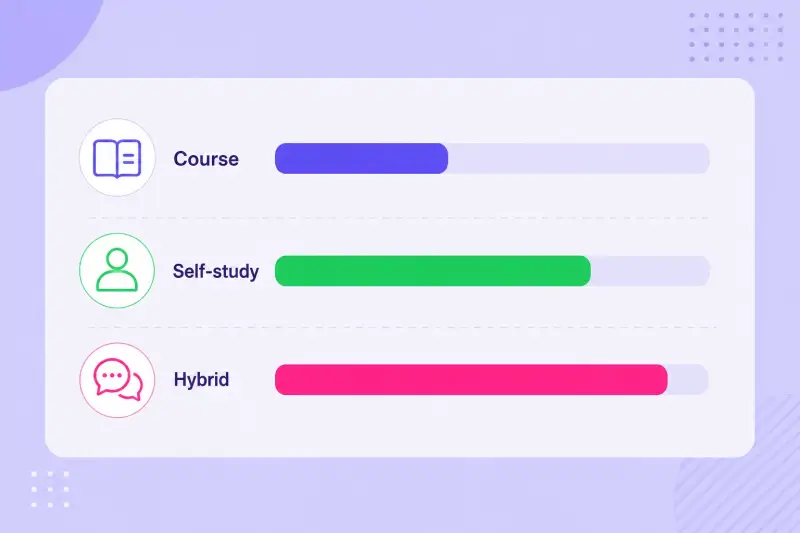
The table compares delivered hours, correction, speaking time, and scheduling rather than treating the two routes as labels. The hybrid column shows what changes when self-study keeps its flexibility but adds structure and scheduled conversation.
| Intensive course | Self-study | Hybrid | |
|---|---|---|---|
| Hours delivered in 13 weeks | 260 in class, plus homework | 91-182 realistically | 180-280 |
| Access model | Paid course; studying abroad adds travel and living requirements | Free and paid resources available | Mostly free resources with optional paid support |
| Structure | Provided | You build it | Course provides it, you add hours |
| Correction | Teacher, several times per session | Only if you arrange it | Native-speaker partners, daily |
| Speaking hours per week | 4-8, shared with classmates | 0 by default | 4-6, one to one |
| Schedule flexibility | None, mornings are gone | Total | High |
| Drop-out risk | Low, sunk cost keeps you there | High, nothing enforces attendance | Medium, depends on booked conversations |
| Realistic outcome from zero | B1 possible | Solid A2 | A2 to lower B1 |
| Realistic outcome from A2 | B1 to lower B2 | Mid A2 to B1 | Comfortable B1 |
The outcome row alone can hide the mechanism behind it. The next section therefore starts with speaking minutes per hour, the variable that most clearly explains why a course, self-study plan, and hybrid can produce different results from similar total time.
The comparison people usually miss: speaking minutes per hour
Class time is not conversation time. In a group of ten with a 20-hour week, your individual speaking time might be 2 to 4 hours of those 20. The rest is listening, reading, exercises and other students talking. That is not wasted, but it is not what most people think they are buying.
One 30-minute one-to-one conversation contains more of your own speaking than a two-hour class of ten students, which is why self-studiers with three weekly exchange partners sometimes out-speak classroom learners who have logged four times the hours.
Accuracy is another matter. A teacher catches errors a friendly exchange partner might let pass, and a syllabus covers grammar you would never choose to study. Classroom learners tend to be more accurate; conversation-heavy learners tend to be more fluent. Both gaps are fixable, and each side fixes the other.
The hybrid that usually works best
For most people the strongest value is not either column but the combination:
- A structured course as the spine, either a paid intensive block if you can afford the time and money, or a free sequenced course if not.
- Ten to fifteen minutes of spaced review daily. A 2022 meta-analysis pooling 98 effect sizes from 48 experiments with 3,411 learners found spaced schedules beat massed study for retention.
- Four to six one-to-one conversations a week with native speakers. This is the piece that closes the classroom's speaking-minutes gap and the self-studier's correction gap at once.
- Daily audio input, because French listening is a distinct skill. Liaison and elision erase word boundaries in speech, so reading fluency does not transfer to hearing.
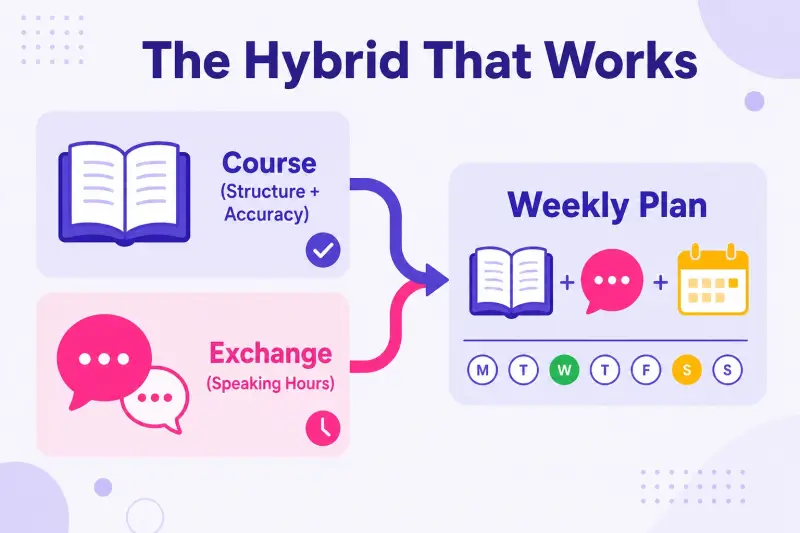
Hours: roughly 20 to 25 a week without a paid course, 28 to 34 with one. The second row reaches B1 from zero. The first reaches strong A2 and touches B1.
The full four-part stack and its proportions are set out in the French three-month method stack, and the week-by-week schedule in the three-month French system with weekly milestones.
Where the conversation hours come from
Four to six conversations a week is 3 to 5 hours. At paid-tutor rates that is a significant monthly cost, which is why exchange partners carry most of these plans.
Chat-based learning. Text chat with French native speakers gives you production with time to think, which suits the first fortnight and any day when your ear is tired. Translation, phonetic transcription and read-aloud sit inside the message thread, and read-aloud earns its place in French specifically because spelling and sound diverge so widely. Real-time grammar correction flags gender and agreement errors during the exchange, which is the classroom's correction advantage delivered outside a classroom.
Moments. Post three French sentences publicly and several native speakers correct the same text. For a self-studier this substitutes directly for a teacher marking your written work, and the plurality of corrections shows you which errors are rules and which are style. The feed itself is informal written French, a register no course covers.
Voicerooms and Livestreams. French voice rooms run around the clock, so a 6am or 11pm session fits around a job that a 9:00 to 13:00 course would not. You can enter as a listener and say nothing, which is the closest self-study equivalent of sitting in a classroom before you are ready to contribute. Livestream mini-lessons add a host and a topic when you want structure.
AI learning tools. AI pronunciation scoring names the specific sound you are producing wrong, closing one gap self-study normally leaves wide open. AI grammar correction explains the rule behind each fix. Image translation handles the French text in front of you, which matters if you are actually in France.
HelloTalk has 70M+ registered users in 200+ countries and 260+ languages, with over 1 billion messages daily, so scheduling five conversations a week is a matter of minutes rather than luck. 90% of HelloTalk's core features are free, which is what makes the hybrid plan affordable.
Common mistakes on both sides
- Buying an intensive course and skipping homework. The 260 class hours were designed to sit alongside self-study, not replace it.
- Assuming class time equals speaking time. Count your own speaking minutes honestly, then add one-to-one conversations.
- Self-studying with no scheduled conversations. This is the standard way to spend three months and stay silent.
- Choosing a course purely on price. Group size and weekly hours affect outcomes more than the fee.
- Expecting B1 from zero on a part-time self-study budget. 91 hours is A1 to A2. Adjust the target, not the accounting.
- Ignoring listening. French listening needs its own daily slot whichever route you take.
- Skipping the placement test. Repeating A1 content you already know is the most expensive kind of wasted hour.
For the platform side of the conversation plan, see the best French language exchange partners and platforms. Our earlier guide to a three-month study plan for learning French efficiently online covers the online-only version of this route.
FAQ
Can I reach B1 French in 3 months with self-study alone? From an existing A2, yes, at around two hours daily. From zero it requires roughly 27 to 30 hours a week, which almost nobody sustains without an external schedule.
How many hours a week is an intensive French course? The standard format is 20 hours across five half-days, usually 9:00 to 13:00, sold in four-week sessions. Some institutes offer super-intensive formats that add reinforcement workshops on top.
Is an intensive French course worth the money? It is worth it if you need the hours enforced, need a certificate or visa-relevant attendance, or want systematic grammar correction. It is poor value if you would use the same hours productively on your own, because the majority of class time is not your own speaking.
What is the cheapest way to reach B1 in French? A free structured course, a free spaced-review habit, free graded listening material, and four to six weekly conversations with exchange partners. The cost is close to zero and the constraint becomes your available hours.
Do intensive courses guarantee a level? No. They deliver hours and instruction; the level depends on your starting point, attendance and outside practice. Institutes place you by test rather than promising an exit level.
How do I get enough speaking practice without a class? Book conversations in advance, several a week, with more than one partner so a cancellation does not cost you the slot. Two 30-minute conversations a week is the minimum that shows a change within a month.
Should I take the course in France or online? In France if you can afford it, because the unavoidable daily use outside class is worth as much as the class. Online plus daily exchange conversations reproduces most of the language benefit at a fraction of the cost.
Count the hours you can honestly deliver, choose the column that matches, then add the conversations either way. You can start that part free on HelloTalk.