Master French in 3 Months: The Method Stack That Actually Delivers Results
Three months is enough time to change your French significantly. It is not enough time to master it, and any plan that starts by pretending otherwise will fall apart in week five when reality arrives.
So let's set the ceiling first, then build the plan against it.
Thirteen weeks of serious daily work puts a motivated beginner at solid A2 with parts of B1 in reach, and puts an existing A2 learner at comfortable B1. That is the honest range. It is also a large, useful change: from silence to holding a real conversation about your life, work and opinions.
The hour math, because it decides everything
On the Cambridge guided-hours scale, A2 sits at roughly 180 to 200 hours and B1 at roughly 350 to 400. The Foreign Service Institute puts French in its most accessible tier for English speakers at roughly 600 to 750 class hours to professional working proficiency, which is a far higher target than conversational fluency.
Now divide by thirteen weeks:
| Daily commitment | Total hours in 13 weeks | Where a true beginner lands | Where an A2 learner lands |
|---|---|---|---|
| 1 hour | 91 | Strong A1, edges of A2 | Mid A2 |
| 2 hours | 182 | Solid A2 | Approaching B1 |
| 3 hours | 273 | A2 with B1 in reach | Comfortable B1 |
| 4 hours | 364 | B1 possible | B1 secured, B2 visible |
| 20 h/week course plus 1 h daily | 351 | B1 realistic | B1 to lower B2 |
Three months of one hour a day will not produce B1 French from zero, and no method choice changes that arithmetic. What method choice changes is how many of your hours are wasted, and the waste in an average self-study plan is substantial.
Pick your row honestly. Then build the stack.
The four-part stack
Three-month plans that work consistently use the same four parts. The proportions move; the four parts do not.
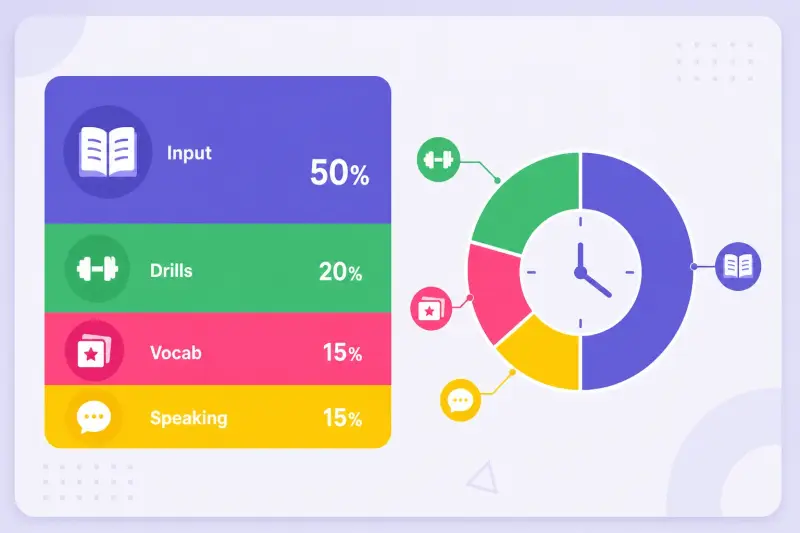
1. One structured source (25% of your time). A course, textbook or app that decides what you learn on Tuesday so you never open a browser and lose twenty minutes choosing. French rewards this because the grammar has dependencies: present tense before passé composé, gender before adjective agreement.
2. Spaced review (10-15%). Ten to twenty minutes daily. A 2022 meta-analysis pooling 98 effect sizes from 48 experiments with 3,411 learners found spaced schedules retained material better than the same time in one block. Cheapest line in the plan.
3. Audio input (20-25%). Slow French news first, then normal-speed content. French has a specific listening problem: liaison and elision mean the written word boundaries disappear in speech, so a learner who reads well can still hear nothing. Ears need separate training.
4. Speaking with people (35-40%). The largest share, and the one almost every three-month plan under-funds. French pronunciation and listening both fail in the same place, at word boundaries, and the only activity that fixes both at once is conversation with native speakers.
That last percentage is the difference between a three-month plan that produces a speaker and one that produces a well-informed silent reader.
Why speaking has to be the biggest share in a short plan
In a two-year plan you can afford to read for six months first. In thirteen weeks you cannot.
Conversation is the only activity that trains retrieval, listening, pronunciation and error correction simultaneously. Everything else trains one of the four. When your total hour budget is 180 rather than 800, activities that train four things per hour are not a nice addition; they are the plan.
There is also a motivational argument that matters more at week seven than any of the above. Courses give you progress markers. Conversations give you evidence. A learner who had a real ten-minute exchange in French in week four does not quit in week seven.
We compared intensive courses against self-study on cost and outcome, including the visa-relevant hour requirements, in intensive French courses versus self-study for reaching B1 in three months.
The 13-week shape
Weeks 1-4: course-heavy, 45% structured source, first text conversations from week two. Weeks 5-9: balanced, conversation rises to a third of your time, slow news daily.
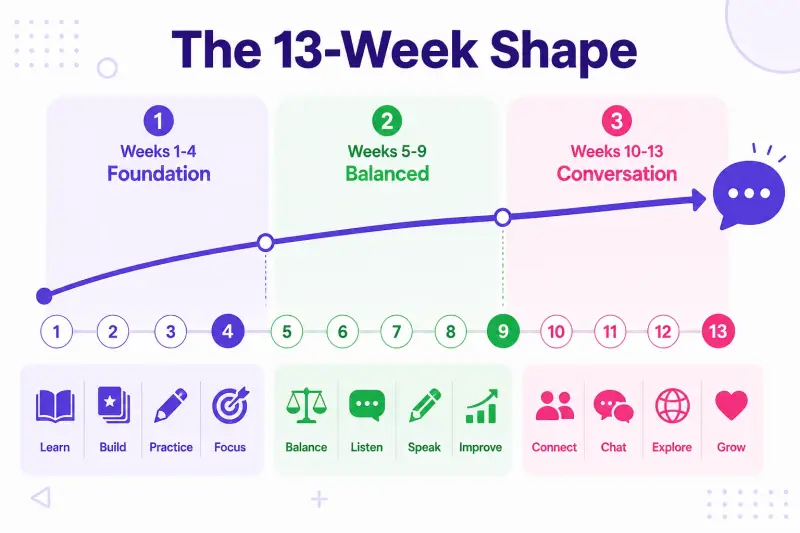
Weeks 10-13: conversation-led, course drops to reference, normal-speed input, longer and less scripted exchanges.
The week-by-week version with checkpoints and time budgets is laid out in the three-month French system with weekly milestones.
Where the speaking hours come from
Sixty to seventy hours of French conversation in thirteen weeks means roughly five hours a week. Paid tutoring at that volume gets expensive quickly, which is why exchange partners carry most short-timeline plans.
Four parts of the HelloTalk platform support this speaking workload:
Chat-based learning. Text chat is where weeks 1-3 happen. You produce French with time to compose, which is the correct difficulty before your ear is ready for live speech. Translation, phonetic transcription and read-aloud sit inside the message thread, so an unfamiliar reply is decodable in place, and read-aloud is unusually valuable in French because the gap between spelling and sound is wide. Real-time grammar correction flags your gender and agreement errors while the conversation is live, before they set.
Moments. Post three sentences about your day in French and several native speakers will correct the same text. In a three-month plan this is the highest-yield ten minutes available: you get corrections on your own errors, from multiple people, at no cost in scheduling. Reading the feed also shows you informal written French, which looks nothing like the French in a coursebook.
Voicerooms and Livestreams. French voice rooms run around the clock, and you can join as a listener and say nothing. For the liaison problem specifically, hearing several native speakers talk over each other is the training your ear needs and no graded audio provides. Livestream mini-lessons give you a topic and a host when free conversation is not what you have energy for.
AI learning tools. AI pronunciation scoring names the specific sound you are missing, which for French learners is usually the u, the r, or the nasal vowels. AI grammar correction explains the rule behind each fix, so corrections compound rather than repeat. Image translation handles menus, signs and forms.
HelloTalk's scale is what makes five hours a week schedulable: 70M+ registered users across 200+ countries studying 260+ languages, with over 1 billion messages daily. 90% of HelloTalk's core features are free, which matters when the plan needs 65 hours of conversation. HelloTalk was named Google Play's Best Social App in 2017 and received a global Google Play homepage feature in 2024.
If you want the exchange side compared across platforms, we covered that in the best French language exchange partners and platforms.
Common mistakes in three-month French plans
- Setting a B1 target on a one-hour-a-day budget. The arithmetic says A2. Adjust the target or the hours, not the expectation.
- Spending weeks 1-6 entirely on input. In a short plan there is no time to build a base before speaking. Speak badly in week two.
- Buying three courses. One spine. The other two will not be finished.
- Treating listening as automatic. French listening is a separate skill because of liaison and elision, and it needs its own daily slot.
- Studying vocabulary without a topic. Learn the 300 words you need for the conversations you actually intend to have.
- No mid-plan check. Run a self-test at week six. If speaking has not moved, the missing input is conversation hours, not study hours.
- Skipping review because it feels like standing still. It is what stops week two from evaporating by week eight.
Our earlier guide to the best methods and resources to master French in three months covers the wider resource list, and building a daily French practice with online courses and apps goes deeper on the daily-habit side.
FAQ
Can I really learn French in 3 months? You can reach solid A2 from zero at two hours a day, and B1 from A2 at the same pace. Full fluency is not a three-month outcome for anyone, and plans that promise it are counting hours differently.
How many hours a day do I need to reach B1 French in 3 months? From zero, roughly three to four hours daily, which is about 273 to 364 hours against the Cambridge estimate of 350 to 400 for B1. From an existing A2, two hours daily is usually enough.
What is the fastest method for French specifically? A structured course for sequencing, plus daily conversation with native speakers from week two. French listening is the main bottleneck for English speakers because of liaison, and conversation is what trains it fastest.
Should I do an intensive course or self-study? Intensive courses at 20 hours a week supply hours you would struggle to self-generate, at real cost. Self-study plus daily exchange conversation reaches similar hour totals more slowly and far more cheaply. We compared both directly in a separate guide.
How much French vocabulary do I need in three months? Around 1,000 to 1,500 words handles most A2 situations, and roughly 2,500 to 3,000 makes B1 conversations comfortable. Choosing which words, based on the conversations you plan to have, matters more than the total.
Is it better to focus on speaking or grammar in a short plan? Speaking, with grammar in small immediately usable pieces. Grammar studied without output in a thirteen-week plan converts into passive knowledge you will not access under pressure.
What if I miss a week? Keep the review habit and drop the course, not the reverse. Review protects everything you already paid for; course progress can wait a week without loss.
Choose your hour row, put the conversations in your calendar before anything else, and let the course fill the gaps. When you need the speaking hours, HelloTalk is free to start.