
The 3-Month French Learning System: Tools, Time, and Weekly Milestones

Three-month French plans usually fail in week six. Not because the material was wrong, but because there was no way to tell whether it was working, and six weeks is about as long as anyone can keep going on faith.
This is a system rather than a resource list. Its central feature is a checkpoint every fortnight that you can pass or fail in ten minutes, because a plan you can test is a plan you will finish.
Thirteen weeks. Two hours a day. Six checkpoints.
Before week one: the three decisions
1. Your daily time budget, written down. Two hours a day for thirteen weeks is 182 hours. Against the Cambridge scale, where A2 sits at roughly 180 to 200 hours and B1 at 350 to 400, that puts a true beginner at solid A2 and an existing A2 learner near B1. Choose your number honestly now; the milestones below assume two hours.
2. Your fixed slots. Not "sometime in the evening". Two named slots, one of which contains a conversation with another human being who is expecting you.
3. Your two tools plus a partner. One structured course. One spaced-review app. Two exchange partners. Adding a third course reduces total hours rather than increasing them.
The daily two hours
The two hours are divided by function so that new material, retention, listening, speaking, and correction all receive protected time. The table also marks the blocks that should survive when the day becomes crowded.
| Block | Minutes | Activity | Non-negotiable? |
|---|---|---|---|
| Morning | 15 | Spaced review, including yesterday's corrections | Yes |
| Morning | 30 | Structured course, next lesson | No, can shift |
| Commute or chores | 20 | French audio, listening only | No |
| Evening | 40 | Conversation with a native speaker, or 15 minutes of writing plus correction on days without a call | Yes |
| Evening | 15 | Write down three corrections from the day, add to review deck | Yes |
The two "yes" rows are the system. Review and correction are the two activities that protect hours you have already paid for, which is why they survive bad days and the course lesson does not.
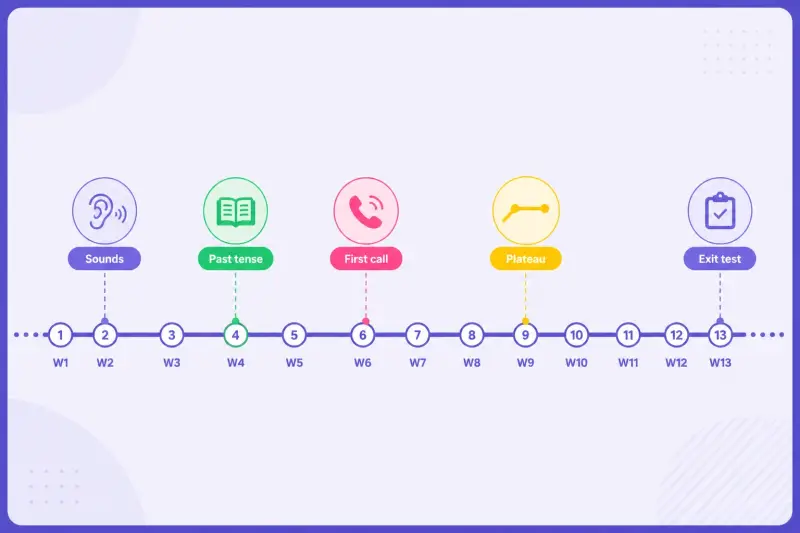
Weeks 1-2: sounds and survival phrases
Focus: pronunciation, present tense, 150 words, first text conversations.
Specific work: French vowels that do not exist in English, especially u and the nasals. The r. And the single most useful early insight, which is that written French and spoken French break in different places, because liaison and elision join words together in speech.
Checkpoint, end of week 2: introduce yourself in French for 45 seconds without stopping, and record it. Keep the recording. It is your baseline and you will want it in week 12.
Weeks 3-4: passé composé and first voice call
Focus: past tense with avoir, 350 words cumulative, first voice conversation.
The first voice call belongs in week three or four, not later. It will be uncomfortable and short. That is the correct outcome. Learners who make their first French voice call in week three reach week thirteen at a noticeably higher speaking level than learners who wait until they feel ready, because feeling ready is a consequence of speaking rather than a precondition for it.
Checkpoint, end of week 4: a five-minute voice conversation about your weekend, with no more than five switches into English.
Weeks 5-6: the plateau, on schedule
Focus: être verbs in the past, negation, questions, 600 words cumulative.
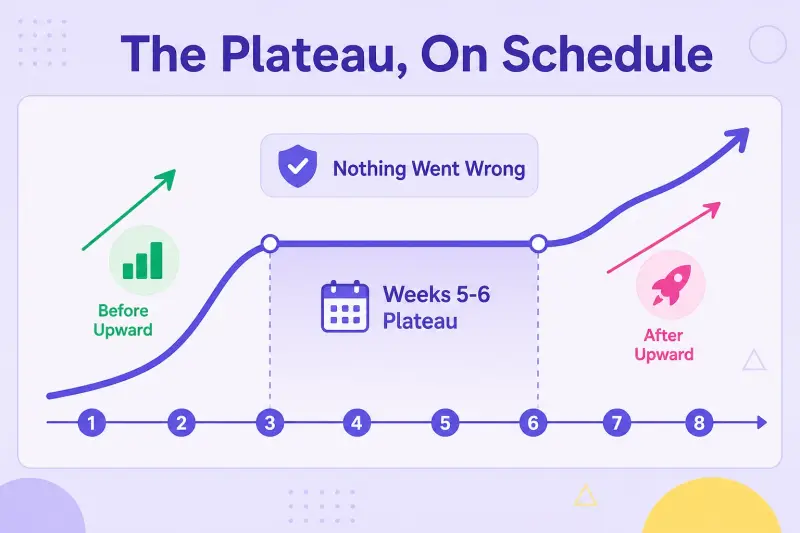
This is the fortnight where progress stops feeling like progress. Nothing has gone wrong. Vocabulary growth becomes invisible because each new word is a smaller share of the total, and grammar has become complicated enough to make you feel worse rather than better.
The response is to change nothing about the plan and run the checkpoint anyway.
Checkpoint, end of week 6: compare a new 45-second recording against your week-2 one. The difference is usually obvious to the ear even when it is invisible from the inside.
Weeks 7-8: raising the conversation share
Focus: future and conditional, 900 words cumulative, three conversations weekly.
Shift the balance. The course drops to 20 minutes, conversation rises to 50. This is the intended direction: by the end of the plan, conversation should be the largest single block.
Checkpoint, end of week 8: ten minutes of conversation about your work or studies, no English.
Weeks 9-10: listening at full speed
Focus: subjunctive in its most common set phrases, 1,200 words cumulative, normal-speed input.
Switch your audio from graded material to real French content chosen for interest rather than level. Expect to understand 40 to 60%. That is the point where input starts building vocabulary efficiently, because a word typically needs 8 to 10 comprehensible encounters to stick and you finally have enough context for those encounters to count.
Checkpoint, end of week 10: follow a three-minute clip of normal-speed French and summarise it out loud in French.
Weeks 11-13: consolidation and the exit test
Focus: no new grammar. Volume, accuracy, and speed. 1,500 words cumulative, four conversations weekly, course used as reference only.
Exit checkpoint, end of week 13: a 20-minute conversation with a native speaker covering three topics you did not prepare, plus a new 45-second recording next to your week-2 baseline. Then write down the three errors you still make most, because those are your first three targets for month four.
The milestone table
The fortnightly sections above describe the work; this table turns them into one tracking view. Each row links a grammar target and vocabulary range to a speaking checkpoint that can be passed or failed.
| Week | Grammar target | Cumulative words | Conversations/week | Checkpoint |
|---|---|---|---|---|
| 2 | Present tense | 150 | Text only | 45-second self-introduction, recorded |
| 4 | Passé composé with avoir | 350 | 1-2 voice | 5-minute weekend conversation |
| 6 | Past with être, negation, questions | 600 | 2 voice | Compare recording with week 2 |
| 8 | Future, conditional | 900 | 3 voice | 10 minutes on work or studies |
| 10 | Common subjunctive phrases | 1,200 | 3-4 voice | Summarise a real French clip |
| 13 | Consolidation only | 1,500 | 4 voice | 20 minutes, three unprepared topics |
Print it. Tick it. The ticking is doing more work than it looks like it is.
The tools that fill each row
The course and review app you can choose freely. The conversation column is the one with a scheduling problem, and it is where the HelloTalk platform supports the system.
Chat-based learning. Weeks 1-3 run on text, which gives you production practice with time to compose. Translation, phonetic transcription and read-aloud sit inside the message thread, and in French read-aloud does specific work: it shows you how a written sentence sounds once liaison has done its job. Real-time grammar correction flags gender and agreement errors while the exchange is live, which feeds directly into the evening "three corrections" block.
Moments. The most reliable ten minutes in the whole system, because it does not depend on anyone being available. Post three French sentences, get corrections from several native speakers, add them to your deck. Reading the feed also supplies informal written French, which is where you meet the abbreviations and slang your course will never mention.
Voicerooms and Livestreams. From week five these carry the listening milestones. French voice rooms run around the clock, so they fit whatever slot your schedule allows, and you can join as a listener and say nothing. Several native speakers talking over each other at full speed is exactly the input the week-10 checkpoint tests. Livestream mini-lessons give you a topic and a host on days when unstructured conversation is too much.
AI learning tools. AI pronunciation scoring names the specific sound you are missing, which is most valuable in weeks 1-2 while habits are forming and again in week 11 when you are polishing. AI grammar correction explains the rule behind the fix, so a correction transfers instead of repeating. Image translation handles French text in your environment.
HelloTalk's scale is what makes four conversations a week a schedule rather than a hope: 70M+ registered users in 200+ countries across 260+ languages, with over 1 billion messages daily. 90% of HelloTalk's core features are free, so a 182-hour plan does not carry a 182-hour bill. HelloTalk was named Google Play's Best Social App in 2017 and received a global Google Play homepage feature in 2024.
Common mistakes with three-month systems
- Starting without a baseline recording. Without week 2 you cannot prove week 6 improved, and week 6 is when you need proof.
- Front-loading conversation into the final weeks. The plan gets its results from conversation starting in week three.
- Skipping review on busy days. It is the cheapest block and it protects everything else.
- Treating the week 5-6 plateau as failure. It is on the schedule. Keep going.
- Adding new grammar in weeks 11-13. Consolidation weeks exist because accuracy needs time without new load.
- No notes from conversations. Three written corrections a day, or the session was social rather than study.
- Setting a B1 target on a one-hour budget. 91 hours is A1 to A2. Adjust the hours or the target.
The reasoning behind the four-part balance is in the French three-month method stack, the cost comparison against a paid intensive course is in intensive French courses versus self-study, and partner-finding is covered in the best French language exchange platforms. Our earlier three-month study plan for learning French efficiently online offers a lighter alternative schedule.
FAQ
What can I realistically achieve in three months of French? At two hours a day from zero, solid A2: everyday conversation about familiar topics with effort and errors. From an existing A2, comfortable B1. Full fluency is not a three-month outcome for anyone.
How many hours a day does this system need? Two. One hour halves the outcome rather than doubling the timeline, because review and conversation both have minimum effective doses. If you only have one hour, keep the review and the conversation and cut the course.
When should I have my first French conversation? Text in week one or two, first voice call in week three or four. Waiting longer is the single most common reason a three-month plan produces a reader instead of a speaker.
How many words do I need in three months? Around 1,500 by week 13 is the target in this system, which covers most A2 conversation. Which 1,500 matters more than the number, so choose them from the topics you actually intend to discuss.
What if I fall behind the milestones? Repeat the fortnight rather than skipping ahead. The milestones are dependencies: week 8 assumes week 6 happened. Falling two weeks behind is normal and does not break the plan.
Is two hours a day sustainable for thirteen weeks? It is if the blocks are short and fixed, which is why the system splits two hours into five pieces rather than one. The 40-minute conversation is the block that carries the motivation for the rest.
What happens after week 13? Drop the course entirely, keep review and conversation, and move to input you enjoy. From A2, the same daily budget reaches B1 in roughly another three to four months.
Print the milestone table, book your first two conversations, and record your 45 seconds this week. When you need the partners, HelloTalk is free to start.