
How Can You Tell Whether an Arabic Course Teaches MSA, a Dialect, or Both?
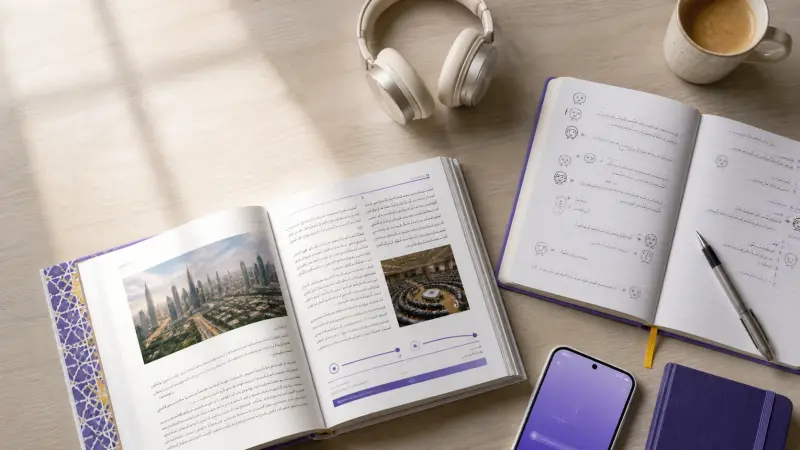
The course page says only "Arabic." You open the free sample lesson and the audio sounds like a news broadcast, slow and formal, while what you actually want is to keep up with conversation at the dinner table. So before you pay, you have to work out whether this course teaches Modern Standard Arabic (MSA), a dialect, or both. You can usually settle that in under ten minutes, without paying anything: the course page leaks the answer through five signals, one free lesson confirms it, and real speakers settle whatever doubt is left.
The check matters because MSA and the dialects are not one language with two accents. MSA runs news, books, and formal speech. Daily life runs on Egyptian, Levantine, Gulf, Iraqi, or Maghrebi speech, and even a basic greeting changes from region to region, something Duolingo's own dialect guide openly admits. Pick blind and you can spend six months learning a register nobody uses at the dinner table.
The Arabic resource stack for MSA, dialects, and speaking practice covers what to do after this check; this piece is the check itself.
Read the Course Description Like a Contract: Five Signals That Reveal the Variety
Course pages are marketing, but marketing leaks. One signal is a hint. Three matching signals are an answer.
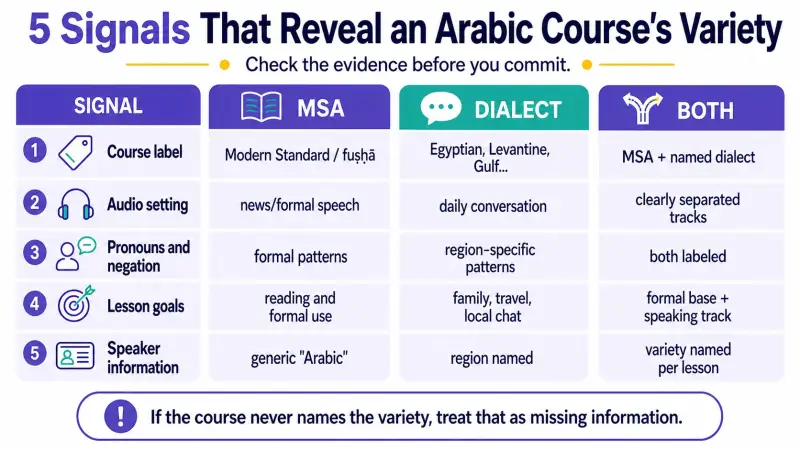
Signal 1: is any variety named at all? A course page that never names a specific Arabic variety is almost always teaching Modern Standard Arabic. MSA is the default in formal education, so silence about dialects means the course follows the standard written language.
Signal 2: what jobs does the course promise? "Read the news," "understand media," "formal settings": that is MSA territory. "Everyday conversation in Egypt," "what people actually say at home": that is a dialect. Pimsleur's own Egyptian Arabic page draws this line plainly, calling Egyptian Arabic a mostly spoken language while MSA handles writing and official life.
Signal 3: what greeting appears first? A course that opens with kayfa haluka is teaching MSA. One that opens with izzayyak leans Egyptian; kifak or shlonak point to Levantine and Gulf or Iraqi speech. Sample dialogues are the least polished part of any course page, which makes them unusually honest.
Signal 4: how does the demo audio handle qaf and jiim? The pronunciation of the letters qaf and jiim is one of the fastest audible clues to which Arabic variety a course teaches. Jiim is a hard g in Egypt. Qaf comes out as a glottal stop in Cairo and Beirut but as a hard g across much of the Gulf, while MSA keeps it deep in the throat. Thirty seconds of audio settles what three paragraphs of copy will not.
Signal 5: script or romanization? Full Arabic script with vowel marks from day one usually means the MSA classroom tradition. Spellings like biddi or 3ayez are a strong dialect tell, because dialects are rarely written formally. If those small marks are new to you, the guide to resources for learning Arabic short vowel marks explains what they encode.
How Popular Arabic Courses Actually Label and Sequence MSA and Dialect Content
The signals get easier once you see them across real products. Here is how six named resources declare and organize variety on their own course pages. Read the last column as planning information, not a ranking.
| Resource | Varieties offered | How the variety is labeled | What the structure means for you |
|---|---|---|---|
| Duolingo | MSA only | Stated in its course materials and dialect blog | One track; daily spoken practice needs a separate dialect resource |
| Pimsleur | Eastern (Levantine), Egyptian, and MSA | Three separate audio courses, variety in the course name | You choose the variety before lesson one; no mixing inside a course |
| Mango Languages | Egyptian, Iraqi, Levantine, and MSA | Four separate courses on its language list | Parallel study works by running two courses side by side |
| Language Transfer | Egyptian (Cairene) | Stated inside its free Introduction to Arabic audio course | A free audio intro that uses Egyptian to explain patterns shared across dialects |
| ArabicPod101 | Separate pathways, including Egyptian and MSA | Pathway names and lesson tags, such as a Level 1 Egyptian path aligned with CEFR A1 | The lesson library lets you stay inside one variety on purpose |
| Playaling | MSA plus Levantine, Egyptian, and Gulf | Per-video variety labels across its video library | Not a sequenced course; a labeled library for hearing each variety in real speech |
Notice the structural pattern. Duolingo's Arabic course teaches Modern Standard Arabic only, with no spoken dialect track. Pimsleur and Mango never blend varieties inside one course; they split them into separate products with the variety in the title. So when a course claims to teach "both," ask what that means mechanically. In serious resources, "both" almost always means two clearly separated tracks. A course that mixes MSA and dialect material without labeling which is which deserves extra caution, not extra credit.
Quick Tests You Can Run on a Free Lesson to Identify What You Are Really Learning
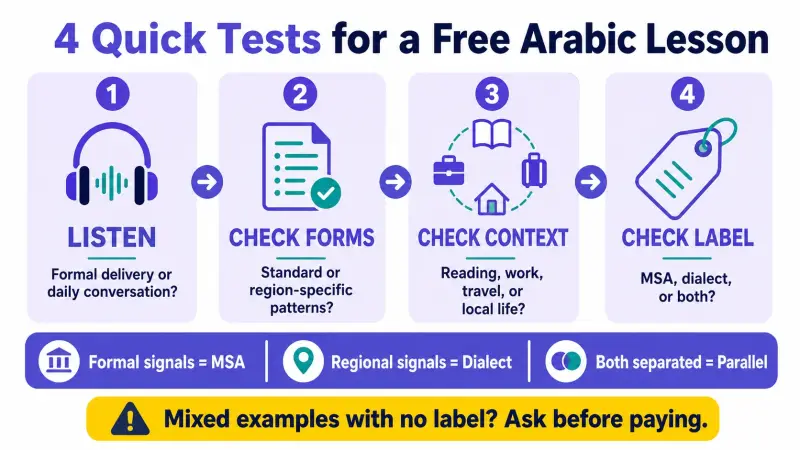
The page told you what the course claims. A free lesson lets you check. Each test takes under two minutes.
The greeting test. Note the first greeting taught. Kayfa haluka points to MSA, izzayyak to Egyptian, kifak to Levantine speech.
The "I want" test. Uriidu is MSA. 3ayez or 3awez is Egyptian. Biddi is Levantine. Few words split the varieties this cleanly.
The negation test. MSA negates with laa, lam, and laysa. Egyptian and much Levantine speech wrap the verb with mish or a ma...sh pattern. If the lesson negates with mish, you are not in a pure MSA course.
The qaf and jiim replay test. Replay any line containing qaf or jiim and apply signal four. Audio cannot hide its variety the way copy can.
The diacritics test. Fully marked Arabic script suggests an MSA or classical orientation. Romanization-first presentation usually signals a spoken dialect focus.
If a lesson labeled simply "Arabic" mixes markers from different columns, it is a blended course. Blended is not automatically bad. But choose it knowingly instead of discovering it in month three.
Verifying a Course's Labels Against Real Usage in HelloTalk Moments and Chats
One question is still open after the free lesson: does this phrase live outside the classroom? Only real speakers can answer that. HelloTalk Moments and real chat samples provide a usage-verification layer after a course labels a phrase as MSA or dialect.
The check is small. Post the phrase in HelloTalk Moments with one concrete question: where would you actually say this, and to whom? HelloTalk Moments is a public feed read by native speakers, and comments and corrections are a common way people interact there, so a single post can collect views from several regions. Treat each answer as a data point, not a verdict, and never assume a reply is guaranteed.
Scale is what makes the check realistic. The HelloTalk platform reports 70M+ registered users learning across 260+ languages, so speakers of several Arabic varieties are reachable in one app instead of scattered across forums. HelloTalk was also named Google Play Best Social App in 2017, recognition tied to exactly this community layer.
Two more features sharpen the check. HelloTalk's chat includes built-in translation, transliteration, and read-aloud playback, so when someone replies in unmarked Arabic script you can decode it without leaving the conversation. And HelloTalk's Voicerooms are live group audio spaces you can join as a listener first, a low-pressure way to hear whether your course's phrases appear in unscripted talk, or never do.
Asking an Arabic-Speaking Partner Which Variety Fits a Specific Situation
Moments gives you breadth. A language partner, a separate human resource from any app or course, gives you situational depth. A partner is a context-check resource: someone who can tell you which variety they themselves would understand or use in one concrete situation, with a shopkeeper, a grandparent, a government office.
A useful message looks like this: "My course says this phrase means 'how are you'. Would you say it to a taxi driver in your city, or would it sound formal?" You are asking for lived usage, not a grammar ruling, and when a partner chooses to respond, that is an easy and interesting question to answer.
Keep one boundary firm: one partner's answer is contextual evidence, not a universal language rule. A speaker in Amman and a speaker in Cairo can give opposite answers about the same phrase, and both are right for their own streets. Ask partners from two or three countries and the scattered opinions become a usable map. When you want feedback on your own sentences rather than variety checks, the guide to Arabic speaking resources that give sentence-level feedback covers that next step.
Choosing MSA-First, Dialect-First, or Parallel Study Based on Your Goal
Once you can identify and verify what a course teaches, the last question is sequencing, and that is goal math, not ideology. The US Foreign Service Institute places Arabic among its most demanding languages for English speakers, estimating about 88 weeks or 2,200 class hours to reach professional working proficiency. At that scale, choosing your first year deliberately beats choosing it fast.
MSA-first fits goals built on reading, media, religious study, or formal exams, because MSA is the shared written register across the Arab world. Dialect-first fits goals tied to one region, family conversation, or speaking early, since daily talk runs on dialects. Parallel study fits long-horizon learners who accept slower early progress in exchange for balance, and separate-course resources like Mango Languages make running an MSA track beside a dialect track mechanically easy.
Whichever branch you pick, the sound system needs its own tools, because MSA and dialect audio differ in exactly the sounds English speakers find hardest. The comparison of Arabic pronunciation tools built for English speakers covers that layer.
Is MSA useless if my goal is everyday conversation?
No. MSA remains the shared register for news, books, and formal speech, and speakers generally understand it. It just sounds formal in casual settings, so conversation-focused learners usually add a dialect sooner rather than later.
Can a beginner learn MSA and a dialect at the same time?
Yes, and separate-course resources make it practical. The tradeoff is honest: parallel study splits your hours, so early progress in each track feels slower than committing to one.
Which dialect makes sense if I have no target country?
Egyptian is widely understood because of Egypt's media output, and Levantine is widely taught and used across several countries. Either is a defensible default. A specific person or place you care about beats both.
How do I catch a course that quietly mixes varieties?
Run the free-lesson tests on two different lessons. If the greeting test says MSA but the negation test says Egyptian, the course is blending. Confirm with real usage in HelloTalk Moments before committing.
Do native speakers understand learner MSA?
Generally yes, since educated speakers grow up with MSA in school and media. Expect replies to come back in dialect, which is itself useful listening practice.
The fastest way to close the loop on any course is to test its phrases on real people. Post one sentence from your current lesson and see where it actually lands, starting on HelloTalk.