
Where Russian Learning Resources Break Down: Cyrillic Is the Easy Part

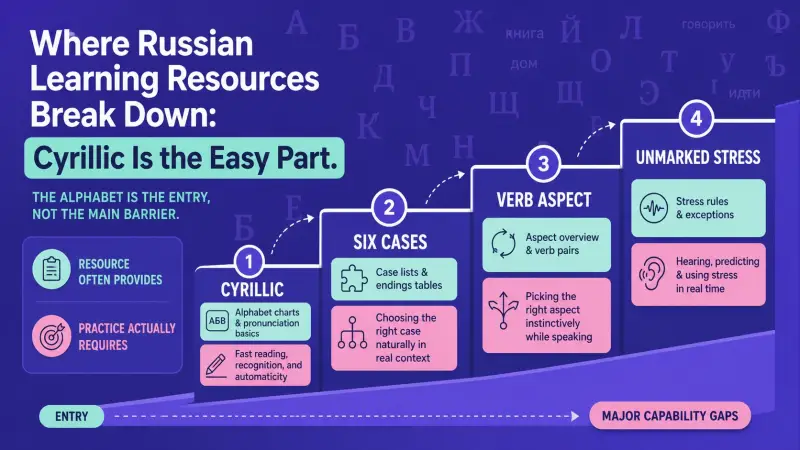
Russian learning resources are built around the wrong fear: the Cyrillic alphabet is the easiest part of Russian, and it is the part resources handle best. The alphabet has 33 letters, many resembling Latin or Greek ones, and most beginners read slowly but correctly within a couple of weeks. Resources know this, which is why alphabet modules are polished, gamified, and satisfying. The actual difficulty of Russian starts after the alphabet, in three systems where the same resources thin out or fail outright: the case system, verb aspect, and unmarked word stress.
The mismatch is worth naming because it shapes how beginners judge their own progress. A learner who breezes through Cyrillic concludes the resource works and Russian is manageable, then hits the case system with the same tool and concludes they have stopped being good at Russian. Neither conclusion is right; the resource simply left its zone of competence. This article maps the three breakdown points, how typical resources handle each, and what supplement each calls for.
Breakdown one: six cases, taught as tables
Russian nouns, adjectives, and pronouns change their endings across six cases, depending on their role in the sentence. Anyone searching for help with Russian cases finds the same artifact everywhere: the declension table. Tables are how textbooks, apps, and grammar sites almost universally present the system, and tables are genuinely necessary as reference.
The breakdown is that tables train recognition of a system, not selection under pressure. Producing Russian requires choosing an ending mid-sentence, in real time, based on the verb or preposition just used, and that skill is built only by producing sentences and having the endings checked. Most resources offer fill-in-the-blank drills as the production step, which helps but stops short: the blanks isolate one decision at a time, while real sentences stack several. The case system is the first point where a Russian learner needs a resource that responds to their own output, and it arrives within the first two months.
This is the category where real-person feedback resources enter a Russian stack, earlier than in most languages. HelloTalk is a representative example of that category. In HelloTalk chats a native speaker reads the learner's own sentence and corrects the specific ending that failed, which is the one exercise format a declension table cannot generate, and HelloTalk's AI grammar correction returns an explained version instantly when no partner is awake, so a sentence written at midnight is not lost to the next day. The exchange dynamic itself, and how partners handle case corrections in practice, is covered in detail in the guide to Russian language exchange and how to actually practice.
Breakdown two: verb aspect has no lookup table
Nearly every Russian verb comes in a pair: an imperfective form for ongoing or repeated action and a perfective form for completed action. Russian verb aspects are a different kind of difficulty from cases. Cases are a large but finite system that can at least be tabulated. Aspect is a semantic judgment: which member of the pair fits depends on what the speaker means, and the pairs themselves are often formed irregularly.
The comparison of beginner Russian resources that explain verb aspect through real situations focuses on this meaning problem and shows which tools move beyond pair lists.
Resources typically handle aspect in one of three insufficient ways:
- Delaying it, introducing aspect late as an advanced topic even though beginners meet paired verbs in their first weeks of real input.
- Rule-listing, offering guidelines that cover the clear cases and go silent on the ambiguous ones that dominate real usage.
- Vocabulary-flattening, teaching one member of each pair as "the word for" an action and leaving the learner to discover the twin later.
What aspect actually requires is massive exposure to pairs in context plus correction when the learner's choice conveys the wrong meaning. The exposure half can come from listening and reading resources. The correction half again needs a responder, human or otherwise, that evaluates meaning rather than form, because an aspect error usually produces a grammatical sentence that says something the learner did not intend. HelloTalk Moments is a low-cost way to get that reading: a two-line post using one member of a pair draws replies from Russian speakers answering what the sentence appeared to say, which is how a wrong aspect choice becomes visible.
Breakdown three: stress is unmarked and changes everything
Russian word stress is not written in normal texts, is not predictable from spelling, moves within word families, and controls pronunciation beyond the stressed syllable itself, because unstressed vowels reduce. The word for milk, молоко, is spelled with three o letters and pronounced with only the final one as a clear o. Learner materials mark stress; the real world does not. The moment a learner leaves textbook texts, every new written word is a pronunciation guess.
Resources break down here in a quiet way: they solve the problem inside their own walls by marking stress, which works until the learner reads anything else. The demand this creates is audio-first exposure to new vocabulary and a habit of confirming stress before a word gets rehearsed. HelloTalk's read-aloud does the first job on any Russian message a partner sends, and HelloTalk's AI pronunciation scoring does the second by flagging which syllable a recorded attempt landed on, which is the check молоко requires, and a HelloTalk Voiceroom exposes the same habit at conversational pace. The table below lines up all three breakdown points, since the pattern across them is easier to see side by side than in sequence.
| Breakdown point | How typical resources handle it | Why that is not enough | Supplement type required |
|---|---|---|---|
| Six-case system | Declension tables, isolated blanks | Trains recognition, not real-time selection | Output practice with correction on your sentences |
| Verb aspect pairs | Delay, rule lists, or one verb per pair | Ambiguous cases dominate real usage | Context-heavy input plus meaning-level feedback |
| Unmarked mobile stress | Stress marks inside the resource only | Real texts carry no marks; guesses harden | Audio at first exposure, stress confirmation habit |
Read across the rows and one column repeats: the third column keeps pointing at feedback on the learner's own production or perception. That is not a coincidence, and it is the structural reason a beginner Russian stack cannot stay input-only for long, a dynamic examined more generally in input versus output in language learning.

Reading a resource against this map before committing
Anyone who wants to learn Russian for beginners can screen a candidate resource against the three breakdowns in a single sitting:
- Find the case content and check whether any exercise requires building a full original sentence, not filling a blank.
- Search for a common verb pair, such as читать and прочитать, and see whether both members appear and are contrasted.
- Open five vocabulary items beyond the first unit and count how many present audio or stress marks at first exposure.
- Look for any mechanism, human or automated, that responds to sentences you compose yourself.
A resource can fail parts of this screen and still belong in a stack, provided something else covers the failing rows. What a beginner should not do is stack three resources that all pass the alphabet and all fail the same later systems, which is the most common configuration precisely because alphabet quality is what the first week of use shows off. How that mismatch plays out over a learner's second month, and what resource structure prevents the drop, is the subject of the companion piece on why Russian resources lose beginners in month two.
FAQ
How long should the Cyrillic alphabet actually take before moving on?
Reading Cyrillic slowly but accurately typically takes days to two weeks of short daily sessions, and that level is enough to move on. Fluent reading speed comes from reading real material for months, not from extending the alphabet unit. A useful signal that it is time to move on: you can sound out unfamiliar words correctly even when you do not know what they mean. Staying in alphabet drills past that point trades real progress for the comfort of high scores.
Which of the three breakdown points should a beginner worry about first?
Stress, in a narrow sense, because it affects every word learned from day one and bad stress habits are expensive to unlearn. Adopt the audio-first habit immediately. Cases become the active front within the first two months, as soon as full sentences start. Aspect can be met with exposure from the start, learning verb pairs together when they appear, while postponing fine-grained aspect judgments until sentences flow. The ordering is about attention, not avoidance; all three systems are present in real Russian from the first text you read.
Do I need a teacher for cases and aspect, or can an exchange partner cover it?
They cover different halves. A teacher or structured course explains the systems efficiently and sequences them so rules arrive in a sane order. An exchange partner supplies the volume of corrected production that makes the systems automatic, at a frequency no weekly lesson can match. Learners succeed with either half missing, but slowly. The combination that shows up repeatedly in successful stacks is a compact grammar resource for explanations plus frequent short exchanges where real sentences get checked.
Should the six cases be learned one at a time or as a whole system?
One at a time for production, with the whole map visible from the start. Seeing the full system early, six roles, each answering a question a sentence needs answered, prevents the false impression that each new case is a surprise expansion. But drilling all six in parallel overloads a beginner, because every case carries its own ending sets across genders and numbers. The sequence that recurs in well-built resources is functional: nominative and accusative first, since they cover subject and object, then prepositional and genitive for everyday phrases, with dative and instrumental layered in as real sentences demand them. Mastery order should follow usefulness order, not textbook chapter order.
Is there a reliable rule for verb aspect, or is it pure memorization?
There is a reliable core meaning and an unreliable surface. The core is learnable as a rule: the imperfective describes process, repetition, or the fact that an activity happened, while the perfective reports a completed result, and most sentences choose correctly once that contrast is internalized. What resists rules is formation, because pairs like читать and прочитать are built with prefixes and suffixes that vary by verb, so pairs are best memorized together as single vocabulary items. The practical split follows from that: learn the meaning contrast once, through examples and corrected use, and treat each pair as one dictionary entry rather than deriving it fresh each time.