
Russian Language Exchange in 2026: How to Find a Partner and Actually Practice

You have made peace with the Cyrillic alphabet. You can read a menu, slowly. You have memorized the six cases in a table and you can recite them like a poem. Then you try to say a simple sentence to a native speaker, "I am going to the store with my friend," and everything falls apart, because now you have to decide which case "store" takes, which case "friend" takes, whether the verb of motion changes, and by the time you have worked it out the moment has passed and the other person has switched to English.
This is the specific pain of Russian. The grammar is front-loaded and unforgiving, and no amount of table-memorizing prepares you for choosing the right case in real time. The only thing that does is talking, a lot, with someone who catches your case errors in the moment and does not let them harden into habits. That is what a Russian language exchange gives you. This guide covers how to find a native partner, how case correction actually works in conversation, and how to build a weekly routine that turns those grammar tables into reflexes.
Why Russian Is Uniquely Hard to Self-Study
It is worth being clear about what makes Russian different, because the difficulties point directly at why an exchange partner matters so much.
The biggest one is the case system. Russian nouns, adjectives, and pronouns change their endings depending on their grammatical role, across six cases and multiple genders and numbers. You can learn the tables in a month. Deploying them correctly in live speech takes far longer, because in a real sentence you have to apply several case decisions at once, instantly. This is a skill that only develops through volume of real production. A partner who corrects your endings in context is worth more than any grammar drill, because you are fixing the exact mistake you just made in a real sentence you cared about.
The second is verbs of motion and aspect. Russian distinguishes between going by foot and going by vehicle, between one-directional and multi-directional movement, and between perfective and imperfective aspect on nearly every verb. These distinctions barely exist in English, so they feel arbitrary until you hear them used naturally, over and over, by real speakers. Exposure fixes this. Rules do not.
The third is stress and reduction. Russian word stress is unpredictable and can change the meaning, and unstressed vowels reduce in ways the spelling does not show, so the word you see on paper is not the word you hear. You cannot learn this from text. You have to hear enormous amounts of spoken Russian, which is exactly what voice messages, live calls, and audio rooms give you.
Every one of these problems is a real-conversation problem, and every one gets solved by the same medicine: talking with native speakers who correct you. Our overview of how language exchange works covers why two-way practice beats passive study for exactly this kind of pattern learning.
How to Find a Native Russian Partner
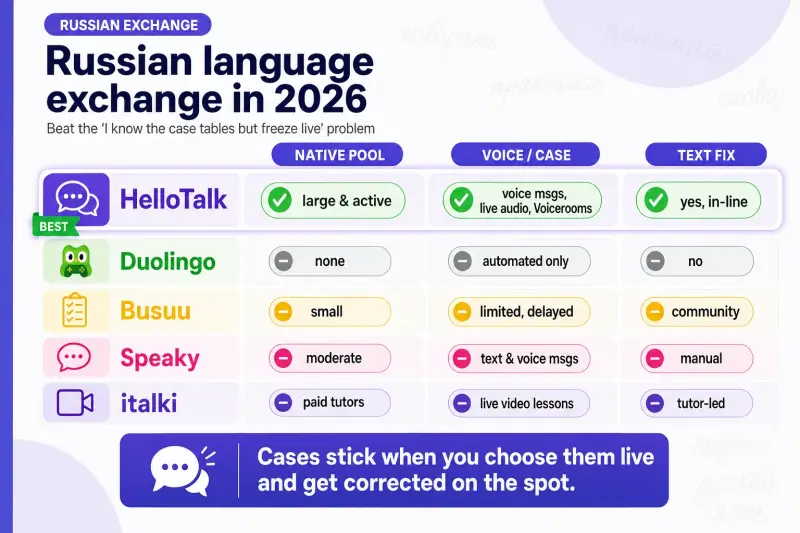
The good news is that finding a Russian speaker to practice with is more achievable than many learners assume, if you use the right platform. Here is how the main options compare for Russian specifically.
| App | Native Russian pool | Voice / case correction | Text correction | Best for |
|---|---|---|---|---|
| HelloTalk | Large, active community | Voice messages, live audio, Voicerooms | Yes, in-line | Daily exchange and case feedback |
| Duolingo | None (no exchange) | Automated only | No | Alphabet and first vocabulary |
| Busuu | Small feedback pool | Limited, delayed | Community corrections | Structured course plus occasional review |
| Speaky | Moderate | Text and voice messages | Manual | Casual text-first chatting |
| italki | Paid tutors | Live video lessons | Tutor-led | Structured paid lessons |
Duolingo and Busuu are useful for getting comfortable with Cyrillic and building your first vocabulary, and italki is a solid choice if you want to pay for structured tutoring. But for the free, daily, two-way correction that fixes cases, you want a platform built around exchange itself.
HelloTalk works well here because of scale. With 70M+ registered users across 200+ countries and support for 260+ languages, the Russian-learning and Russian-speaking community is large enough that you can reliably find a partner who natively speaks Russian and is learning your language. That mutual setup matters, because it gives your partner a reason to keep correcting your cases week after week, rather than drifting off after the first chat. If you are evaluating exchange platforms more generally, the logic in our guide on how to choose an English speaking app transfers directly to picking a Russian partner platform.
How Case Correction Actually Works in a Conversation
Here is where a Russian exchange earns its keep, and where it differs completely from, say, a Spanish or Chinese exchange. Your partner is your live case checker.
A workflow that works looks like this. In a text chat, you write a sentence: "Я иду в магазин с мой друг." Your partner fixes it in-line and hands it back: "Я иду в магазин с моим другом," and then, ideally, adds a one-line note that "с" takes the instrumental case, which is why "мой друг" becomes "моим другом." Now you have the correction and the reason behind it, tied to a sentence you actually wanted to say. That sticks in a way a textbook table never does.
For pronunciation and stress, voice is essential. Record a short voice message describing your day. Your partner listens, corrects any case endings they hear, and re-records the sentence so you can hear the correct stress and vowel reduction. You replay their version several times, then re-record your own. Doing this daily, even for ten minutes, moves your cases from "I have to think about it" toward "it just comes out right."
Dropping into a Voiceroom is the low-pressure companion to this. Join a room where people are chatting in Russian, keep your microphone off, and let the endless stream of correctly-cased, naturally-stressed Russian wash over you while you do the dishes. You are not studying. You are soaking your ear in the patterns until they start to feel normal. When you are ready, you unmute and try one sentence. If you get an ending wrong, someone friendly will fix it, and you will remember it. Our piece on why social feedback increases language practice explains why this kind of low-stakes, real-time correction sticks better than solo drilling.
A Weekly Russian Exchange Routine
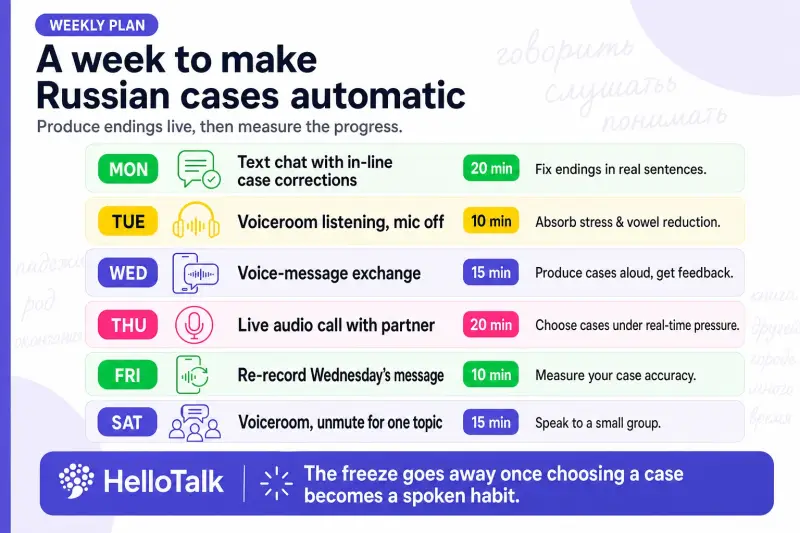
Cases become reflexes through consistent, structured practice. Here is a week that balances correction, listening, and speaking. Adjust the times to fit your life.
| Day | Activity | Time | Goal |
|---|---|---|---|
| Monday | Text chat with in-line case corrections | 20 min | Fix endings in real sentences |
| Tuesday | Voiceroom listening, mic off | 10 min | Absorb stress and vowel reduction |
| Wednesday | Voice message exchange | 15 min | Produce cases aloud, get feedback |
| Thursday | Live audio call with partner | 20 min | Choose cases under real-time pressure |
| Friday | Re-record Wednesday's message | 10 min | Measure your case accuracy |
| Saturday | Voiceroom, unmute for one topic | 15 min | Speak to a small group |
| Sunday | Review the week's corrections | 10 min | Lock in the patterns |
Thursday is the hard day and the most valuable one. A live call forces you to make case decisions in real time, with no chance to consult a table. It feels rough at first. But this is the exact skill you are training, and there is no shortcut around doing it. Friday's re-recording gives you a concrete measure of progress, which is what keeps you going.
Finding a Partner Who Will Actually Stick Around
Getting matched is easy. Keeping a partner who consistently corrects your cases is the real skill. Most exchanges fade in the first two weeks, usually because they were one-sided or aimless.
Look for green flags. A good partner is learning your language with similar seriousness, so the trade is fair. They correct your case endings without being asked. They reply within a day or two. And they will do voice, because that is where your stress and aspect actually improve.
Watch for red flags. Someone who only wants you to teach them English and never speaks Russian back is not an exchange partner. Someone who refuses voice will not help your pronunciation or stress. And someone who chats pleasantly but never corrects anything is nice company but not useful for progress.
Set the terms early. A simple "Let us split each session between Russian and English, and please correct my case endings" turns a vague chat into a real exchange. It also filters out the people who were never serious, which saves you time.
The community itself is a backup. If one partner drifts away, a large Russian-learning community means you can find another the same day. Livestreams and Voicerooms are full of learners and native speakers you can connect with, so you are never stuck with a single point of failure. If English is also on your list, the same freeze-and-recover pattern shows up there, and our guide to an English speaking practice app tackles it from the other side.
Common Problems and How to Fix Them
"I know the case tables but freeze when I have to choose one live." This is the core Russian problem, and the only fix is volume of real production. Do more voice messages and live calls, accept that you will get endings wrong, and let each correction sink in. Speed comes from reps, not from re-reading the table.
"My partner corrects everything and I feel overwhelmed." Ask them to correct only your two or three biggest errors per message. Fixing everything at once is discouraging. Fixing the worst offenders first is manageable and steady.
"The word I hear does not match the word I learned." That is vowel reduction and unpredictable stress. The fix is listening volume: more Voicerooms, more voice messages, more Livestreams. Your ear adjusts within a few weeks of daily exposure.
"We just make small talk and I am not improving." Bring a topic each session, describing your weekend, planning an imaginary trip, discussing a film, and deliberately use structures you are shaky on. Structure beats drift.
Frequently Asked Questions
Is Russian language exchange free? Yes, on several platforms. HelloTalk, Speaky, and Busuu's community features have free tiers for finding partners and chatting. Paid tiers usually add translation and extra tools. italki charges per lesson because it provides tutors rather than reciprocal exchange.
How long does it take to get conversational in Russian through exchange? With twenty to thirty minutes of daily practice, most learners reach comfortable basic conversation in nine to twelve months, a bit longer than easier languages because of the case system. Case accuracy improves steadily once you are getting daily correction, usually noticeably within the first couple of months.
Do I need to know all six cases before starting an exchange? No. Start as soon as you can read Cyrillic and form simple sentences. You will learn the cases far faster through corrected conversation than by waiting to master the tables first. The exchange is where the tables turn into instinct.
What if I am nervous about speaking Russian aloud? Start with re-recordable voice messages, where you can try as many times as you like. Then use Voicerooms with your microphone off to build listening confidence. Move to live calls only when you feel ready. Every fluent speaker started out fumbling their endings.
Can I focus on a specific kind of Russian, like formal or conversational? Yes. Tell your partner what you are after, whether it is everyday conversational Russian or more formal register, and they can steer the practice. A large community also lets you find partners with different backgrounds and speaking styles.
How do I keep a Russian partner engaged long-term? Make it genuinely mutual, show up consistently, and take an interest in their learning too. The exchanges that last become friendships built around a shared goal. When both of you are improving, both of you keep showing up.
Turn Those Case Tables Into Reflexes
The gap between knowing Russian grammar and speaking it is closed by one thing: talking to native speakers who correct you every day. You can find a Russian partner, get your cases fixed in real time, and soak your ear in Voicerooms at HelloTalk.
Exchange closes the output gap, but it assumes input is coming from somewhere. Our list of the rest of the beginner Russian toolkit that exchange sits on top of covers the courses, audio and reading material that feed it.