
Thai Tones for Beginners: Why Most Learners Get Stuck and How to Actually Fix It
Let us say something that might be a relief. If we have been studying Thai and feel stuck, it is probably not that we are bad at languages, and probably not that we need more vocabulary. Thai has five tones, and using the wrong tone is the single most common reason beginners are misunderstood.
Thai is tonal, which means pitch is part of the word, the same way a letter is. We can know the word, know the grammar, and still not be understood because we said it on the wrong pitch. So instead of piling more words on a shaky base, let us fix the base.

The five Thai tones, with examples
Thai has five tones: mid, low, falling, high, and rising. The script marks them through a mix of consonant class and just four tone marks (the mid tone needs no mark), which is part of why tones feel hard to pin down at first.
The famous demonstration is the syllable that sounds like "maa." On three different tones it becomes three different words, which is why a tiny pitch slip changes the meaning entirely.
| Tone | Pitch shape | Example | Meaning |
|---|---|---|---|
| Mid | flat and steady | 喔∴覆 (maa) | come |
| Low | low and level | 喔傕箞喔?(kh脿a) | galangal |
| Falling | starts high, then drops | 喙勦浮喙?(m芒i) | no |
| High | high and level | 喔∴箟喔?(m谩a) | horse |
| Rising | dips, then rises | 喔浮喔?(m菐a) | dog |
Look at the last three rows. The same syllable "maa" means "come," "horse," or "dog" depending only on the tone. For learners whose native language uses pitch for emotion rather than meaning, this is a genuinely new skill, and that mental switch is the real beginner hurdle.
Why we get stuck, and it is not laziness
A few specific things trap beginners on tones:
- We cannot hear them yet. Early on, the five tones sound almost identical to an untrained ear. If we cannot hear the difference, we cannot copy it. This passes with focused listening.
- Romanized spelling hides the tone. Learning Thai through English-style spellings strips out the tone information, so we guess, and usually guess wrong.
- We practice without feedback. We say words alone, they sound fine to us, and nobody corrects us. We are rehearsing mistakes confidently.
- We skip ahead to vocabulary. It feels like progress, but every word learned on the wrong tone is a word we will repair later.
The pattern underneath is the same. Tones are a listening-and-feedback skill, and most study methods give us neither real listening practice nor real correction. That is the gap to close, and it is why apps alone tend to fall short, as we cover in our Thai learning apps comparison.
The fix: train the ear, then get a real ear to check ours
Fixing tones is less about studying harder and more about changing what we practice. Two principles carry almost all the weight.
First, train our ear before our mouth. We cannot produce a tone we cannot hear, so the early work is listening: short clips, the same words again and again, until the pitch differences stop being a blur. This is immersion in the most practical sense.
Second, get a real Thai speaker to check us, often. This is the part solo study cannot replace. Ten minutes a day of saying words and having a native speaker tell us exactly what our pitch did moves us faster than hours of guessing alone.
A simple daily tone method, about 10 minutes
- Pick three words on different tones. Keep the set small.
- Listen and shadow (3 min). Play a native clip of each and say it at the same time, copying the pitch like a tune, not like spelling.
- Record and self-check (2 min). Record all three and listen back. We will start hearing our own flat tones, which is progress in itself.
- Send to a native speaker (3 min). Send the three as a voice message and ask, "Which tones were wrong?" This is the step that fixes us.
- Redo the flagged ones (2 min). Say the corrected versions a few times so the fix sticks.
New words each day, and the five tones stop being a wall within a few weeks. The power is in step four, the real feedback.
Where the daily feedback comes from
Getting a native speaker to check us every day used to be impossible without a paid tutor. That is the part that changed. HelloTalk connects us with native Thai speakers across a community of 70M+ registered users in 260+ languages, and it was featured on Google Play's global homepage in 2024.
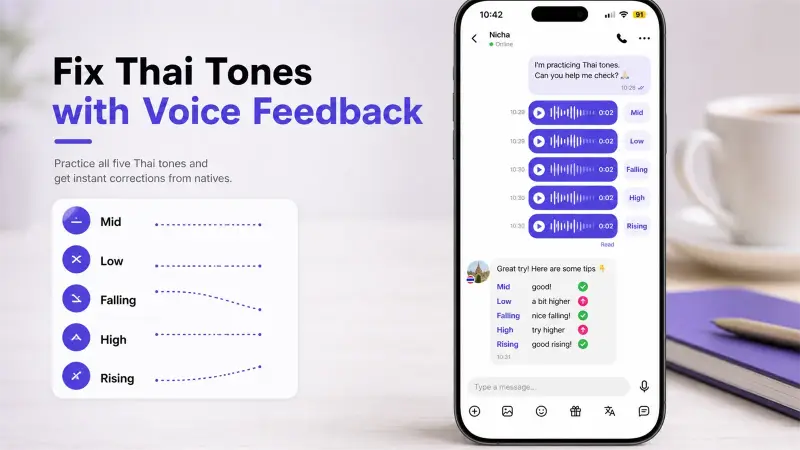
For the tone problem specifically, four features do the work:
- Chat-based learning. We send a Thai voice message inside the chat, and built-in transliteration, read-aloud audio, and real-time correction let a native partner show us the right pitch without anyone leaving the conversation. This is the engine of the daily method above.
- Moments. Post one clip of our three words and several native speakers correct our tones, each noticing something different, like a small panel of coaches. The feed also shows how Thai is really used.
- Voicerooms and Livestreams. We drop into a Thai voice room as a listener to soak up natural tones before we ever speak, which suits tone-shy beginners. Livestream mini-lessons let us ask a host about a tone and hear the answer live.
- AI learning tools. AI pronunciation scoring is especially useful here, pointing at the specific tone that slipped instead of a vague pass or fail. The AI grammar tool explains its corrections, and image translation handles Thai text we meet in the wild.
The listening features build the ear, the AI handles solo reps, and real Thai speakers give the human judgment that tones actually require. That blend of interactive practice and real feedback is the whole point.
Tones are the unlock, so start there
For Thai beginners, tones are not one topic among many. They decide whether everything else we learn is usable. Fix tones early and the rest of the language opens up. Ignore them and we keep getting head-tilts no matter how many words we know.
The fastest way to start is to put our voice in front of a real Thai speaker today. Open HelloTalk, pick three words, and send them as a voice message. The first correction we get back is the moment our tones start to fix themselves.
Tones are the first step rather than the whole route. They sit inside the full beginner plan these tone drills belong to, which attaches a named resource to each of the three stages of a first month.