
Starting Thai Today: A Same-Day Action Plan That Works
Starting Thai Today: A Same-Day Action Plan That Actually Works
We have all done it. We decide to learn Thai, then spend the whole evening reading "best resources" lists, bookmarking courses, comparing apps, and feeling productive. By midnight we have a tidy plan and we still cannot say a single word of Thai.
So let us do the opposite today. The first real step in learning Thai is getting one tone corrected by a native speaker, and that is achievable in the next few hours. This is not a resource list. It is a short sequence of actions we can finish today, ending with a real Thai person hearing our voice.
To be clear about scope: this article is about the next few hours, not the next few months. For the full multi-week roadmap, see how to start learning Thai, and for why tones come first, see Thai tones for beginners. Here, we just start.
Why "start today" usually fails
Most "start learning Thai today" plans go nowhere because they hand us a library instead of a first step. A list of twenty resources is not a beginning, it is a decision we keep postponing.
A real same-day plan has three qualities. It is specific (not "study tones," but "say these three words and get them checked"). It is small enough that there is no excuse to skip it. And it ends in real feedback, so we find out today whether what we said works on a Thai ear. That last point is the one almost every plan misses.
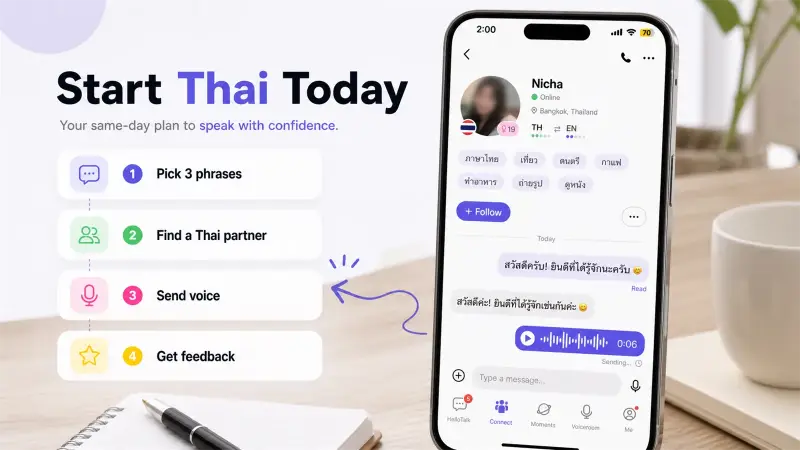
The same-day action plan
ActionTimeWhat we getLearn three survival phrases as sounds10 minWe can attempt hello, thank you, deliciousDownload HelloTalk and set Thai as our language5 minAccess to native Thai speakersFind and message one Thai language partner10 minA real person to practice withSend a voice message and ask for a tone check10 minOur first real tone correction, today
That is well under an hour, spread across the day. Here is each step in a little more detail.

Action 1: Learn three survival phrases as sounds (10 min)
Not the alphabet, not grammar. Three phrases we would use today: "hello" ("sawatdee krub" or "sawatdee ka"), "thank you" ("khop khun krub" or "khop khun ka"), and "delicious" ("aroi"). Learn them by listening and repeating, not by reading romanized spelling, because Thai is tonal and romanized spelling hides the pitch.
Action 2: Download a tool that connects us to real Thai speakers (5 min)
This is the step that turns today into a real beginning. We need a fast way to put our voice in front of a native speaker, and the simplest free option is to download HelloTalk and set our profile to learning Thai. It is a language exchange app with 70M+ registered users, where Thai speakers are learning our language in return, 90% of its core features are completely free, and it was featured on Google Play's global homepage in 2024, so this is not a trial that locks up after a day.
Action 3: Find our first Thai language partner (10 min)
Search for Thai speakers learning our language, read a few profiles, and send a short, friendly first message. A specific opener gets a reply far more often than a plain "hello." A few templates we can copy:
- "Hi Alex, I started learning Thai today and I can help you with English. Could I send you a couple of voice messages to check my pronunciation?"
- "Hello Emma, I am a total beginner in Thai. I would love to trade, your Thai for my English. Mind if I practice a few words with you?"
- "Hi David, learning Thai from scratch here. Would you be up for correcting my tones now and then?"
Action 4: Send our first voice message and get corrected (10 min)
Record ourselves saying the three phrases, send them, and ask, "Did my tones sound right?" Within hours, often minutes, a real Thai person tells us exactly what landed. That first correction is the moment we genuinely started learning Thai, not when we downloaded an app, but when a human ear responded to our voice.
How HelloTalk makes the same-day plan real
The plan works because the tools to run it sit in one place and are mostly free. Each main feature removes a reason we might stall today:
- Chat-based learning. Built-in translation, transliteration, read-aloud audio, and real-time grammar correction live inside every chat, so we never break the conversation to look something up. On day one, read-aloud and transliteration let us attempt Thai and immediately hear the correct version.
- Moments. If messaging one person feels like a lot, we post our three phrases as a voice clip to the public feed and let several native speakers correct us. It is a low-pressure way to get real feedback the same day, and the feed shows how Thai people actually communicate.
- Voicerooms and Livestreams. We can join a 24-hour Thai voice room as a listener within minutes of signing up, with no pressure to speak, just to soak in real tones. Livestreams are interactive mini-lessons where we can ask a host a question and get a live answer.
- AI learning tools. Before we message anyone, AI pronunciation scoring will listen to our three phrases and flag the exact tone that slipped. The AI grammar tool explains its corrections, and image translation reads any Thai text we point our camera at. The AI is a private warm-up, the real speakers are the human check.
Together this is what makes day one immersive and interactive instead of solitary. We are not studying about Thai people, we are talking with them, today.
The first message beats the perfect plan
We can keep researching how to learn Thai, or we can start learning Thai. The learners who make progress are almost never the ones with the most polished plan. They are the ones who sent a clumsy first voice message and got a real reply.
So let us not close this and open another article. Open HelloTalk, find one Thai language partner, and send our first voice message before the day is over. The reply we get back is the moment "someday" becomes "today."