What Is English Fluency? How to Diagnose Your Gaps and Improve
English fluency does not mean sounding like a native speaker or speaking without mistakes. It is the ability to understand, respond, and keep communication moving.
The useful question, then, is not "how fluent am I overall?" but "where does my communication break first?" The five-minute check below helps you find that point and match it to a focused practice task.

Start Here: A Five-Minute English Fluency Self-Check
Before changing anything in your routine, collect one honest data point about your own speech. To be clear about what this is: a quick personal diagnostic, not a CEFR test, an ACTFL rating, or a validated score of any kind. The timings are a practical guide, not a researched optimum.
Here is the sequence:
- Pick a familiar prompt, something like "describe your typical workday," and record a one-minute spoken answer without a script.
- Listen back once. Mark the first point where the message breaks: you misunderstood the prompt itself, you stalled hunting for a word, the sentence order collapsed, a word came out in a way a listener would struggle to catch, or you simply could not extend the turn past two sentences.
- Note one phrase or repair expression you were missing, such as "let me put that another way."
- Record a shorter second attempt using that phrase.
- Compare the two recordings for observable behaviour only: fewer long stalls, a clearer sequence, a successful repair, a completed thought.
A recording shows you the exact point where your speech breaks, which you cannot observe while you are busy speaking. That is the whole reason to record instead of judging yourself from memory.
Resist the urge to turn the result into a score out of ten. You are looking for one first-break category to carry into your next practice session, nothing more.
Read Your Results: Where Does Communication Break Down First?
So you have a recording and a rough sense of where it went wrong. Now name the breakdown precisely, because different first breaks call for completely different fixes, and this is where it is easy to go vague.
The first point where communication breaks is more useful information than any overall fluency score, because it tells you exactly what to practise next. ACTFL's Can-Do statements make a related point: a person can perform at different levels across skills and modes, so one universal number was never going to describe you accurately anyway.
The self-check surfaces six common first breaks. The table below maps each one to the evidence you would notice in your own recording and the practice task it calls for; the next section explains each route in enough detail to run it this week.
| First breakdown | Evidence in your recording | Next practice task |
|---|---|---|
| Comprehension | You answered a different question than the prompt asked | Short listening with one replay, then a spoken summary |
| Word retrieval | Long silences while hunting for a specific word | Phrase sets tied to one real topic, recalled aloud |
| Coherence | Words arrived but the order of ideas collapsed | Point, reason, example, return to point |
| Interaction | You could not extend or repair the turn | Follow-ups and repair phrases with a real partner |
| Pronunciation intelligibility | A listener would mishear a key word | Record, fix one sound or stress issue, re-record |
| Accuracy | The same grammar error repeated several times | Collect recurring errors and repair those patterns |
Read the table as a diagnosis chart, not a ranking. You may find breaks in more than one place; for now, mark only the one that came first and treat it as your starting target.
Match Each Gap to the Right Kind of Practice
Once you know your first break, pick the route built for it. Each one is small enough to fit inside a normal week.
Comprehension gap. Use short listening material at a level you can mostly follow. Play it once, replay it once, then summarise the main point out loud. If a transcript or a correction is available, check your summary against it. The goal is catching the message in real time, not decoding every word.
Retrieval gap. Prepare a small set of phrases tied to one real topic you actually talk about. Recall them without reading, then use them inside a new spoken answer. Retrieval improves when you pull phrases out under mild pressure, not when you reread the list.
Coherence gap. Practise one simple sequence: state your point, give a reason, add an example, return to the point. This is an editorial scaffold, not an official proficiency formula, but it gives your ideas a track to run on while your working memory is busy with words.
Interaction gap. Solo rehearsal cannot fully reproduce this one, because spontaneous reciprocal interaction depends on a reply you did not write yourself. Practise follow-up questions, clarification requests, and repair phrases in an exchange where another person's response changes your next turn. More on where to find that in a moment.
Pronunciation-intelligibility gap. Record a short message, identify one sound, stress, rhythm, or phrasing issue, and repeat a focused version. Intelligibility is the target here, not a native accent; those are two different goals, and only one of them affects whether you are understood.
Accuracy gap. Collect a small number of recurring errors from your actual output and repair those specific patterns. Do not wait for error-free speech before communicating; waiting for zero mistakes is waiting for something fluency never required.
If you want a deeper breakdown of how each individual skill feeds into speaking, the guide to English fluency by skill covers that skill-by-skill reasoning so this article does not have to repeat it.
Build a Balanced Practice System Instead of Chasing One Skill
Fixing your first break is the priority, but do not let it become your only activity for months. The CEFR describes language ability through communicative activities grouped as reception, production, interaction, and mediation, and its picture of spoken language includes range, accuracy, fluency, interaction, coherence, and phonology. In plain terms: fluency is one strand in a wider communication profile, not the whole profile.
Because you can perform at different levels across skills and modes, a routine built entirely around one skill can leave the rest of your communication profile untested. A workable weekly shape: put most of your practice time on your current first break, keep a smaller slot for listening input, and make room for some genuinely interactive exchange so the interaction strand does not stay unexamined.
If your routine used to feel productive and then flatlined, one possibility worth checking is that your real bottleneck is different from the skill you keep training. The piece on why your English stopped improving walks through that stall pattern specifically.
Where HelloTalk Fits in Your Fluency Practice
Four of the six routes above can run solo with a phone recorder. The interaction route is different: solo rehearsal cannot fully reproduce spontaneous reciprocal interaction, because the task only exists when someone else's reply is genuinely outside your control.
A real person's unpredictable response creates an interaction task that no scripted prompt can fully predefine. You ask a follow-up, the answer surprises you, and now you have to clarify, repair, or redirect in real time. That is the specific situation the interaction gap needs.
HelloTalk supports text, voice, and video communication with language partners, which lets you choose the pressure level: text when you need thinking time, voice messages when you want speaking practice without the live clock, calls when you are ready for the full task. HelloTalk's chat tools include corrections, translation, pronunciation support, and transliteration, so a breakdown inside a conversation can turn into a repair attempt on the spot instead of a reason to end the exchange.
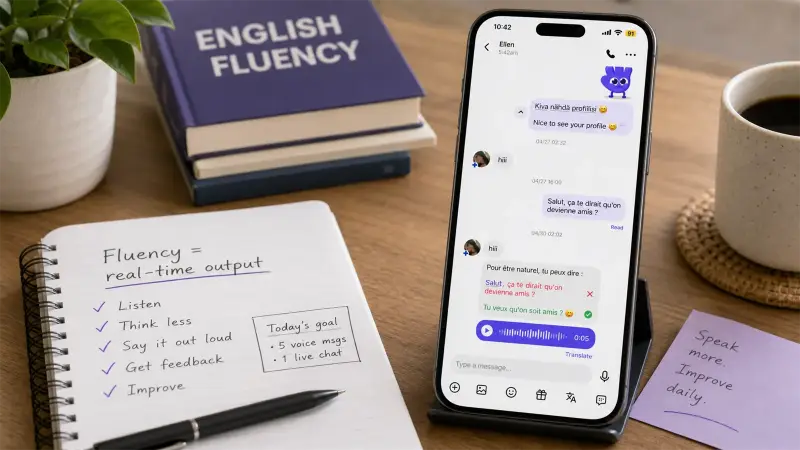
For gaps beyond interaction, HelloTalk's public formats give each one a venue: Moments is a place to post written output, where feedback or corrections on your recurring errors may come from other users; Voicerooms let you practise following live group audio for comprehension work; and Live sessions add listening in a real-time setting. One honest caveat: not every exchange gets corrected and not every conversation is equally useful, so treat partners as practice opportunities and expect the feedback to vary.
If you are comparing tools more broadly, the roundup of English fluency apps in 2026 puts conversation platforms next to drill-based apps so you can see which job each one owns.
Signs Your Fluency Is Actually Improving
At some point you will want evidence that the matched practice is working. Skip the temptation to measure accent or raw speed. Fluency progress is visible in behaviour you can count: completed thoughts, repaired misunderstandings, relevant follow-up questions, and shorter unplanned silences.
Two more trackable signals: you summarise the main point of a short listening input correctly, or a listener understands you after one targeted pronunciation repair. These are personal comparison signals, not proof of a CEFR or ACTFL level, and they only mean something when you compare the same type of task over time. One unusually easy chat with a patient partner about your favourite topic tells you little; the same monthly-report call going more smoothly than last time is a more cautious and more trustworthy personal comparison signal.
Frequently Asked Questions About English Fluency
Does English fluency mean speaking without mistakes?
No. Fluency is the ability to understand, respond, and keep communication moving, and people do that while still making errors. Collect your recurring errors and repair those patterns, but keep communicating while you do.
Do I need a native accent to be fluent?
No. The practical target is intelligibility: a listener catches your words. Record a short message, fix one sound or stress issue, and re-record. That loop improves how clearly you are understood without chasing an accent.
Is the five-minute self-check an official assessment?
No. It is a personal diagnostic for choosing your next practice task. CEFR and ACTFL describe proficiency through what you can do with language, and only a proper assessment can place you on those scales.
Can I become fluent from input alone, without conversation?
Input genuinely contributes, especially to comprehension and word retrieval. Interaction adds one task input cannot: responding to a turn you did not predict. A balanced system keeps both.
How often should I repeat the self-check?
Pick a repeat interval you can keep consistent, and use the same type of prompt each time so the comparison is fair. What matters is comparing like with like over time, not hitting a universal schedule.
Which gap should I work on first?
Start with the break your recording showed first. It is the earliest observable point where your message stopped landing, which makes it a practical first target. When you re-run the check later, watch whether that first break has moved.
The next English call will still move fast. But if you run the five-minute check today, name your first break, and put one matched task on this week's calendar, you will walk into that call with a plan instead of a hope. And when the plan calls for a real person, HelloTalk is where you can find one.