English Fluency Apps in 2026: What Works, What Wastes Time
English Fluency Apps in 2026: What Works vs What Wastes Your Time
There are more English apps than ever, and most of them are genuinely good at something. The problem is that we often pick one, finish hundreds of lessons, and still cannot hold a natural conversation. The app did its job. We just asked it to do a job it was never built for.
Here is the honest frame for choosing in 2026. Apps can take us most of the way to fluency, but the last mile, natural speech under real pressure, is only walked through real conversation. So the question is not "which app is best," it is "which tool covers which part, and what covers the part none of them can."
The comparison at a glance
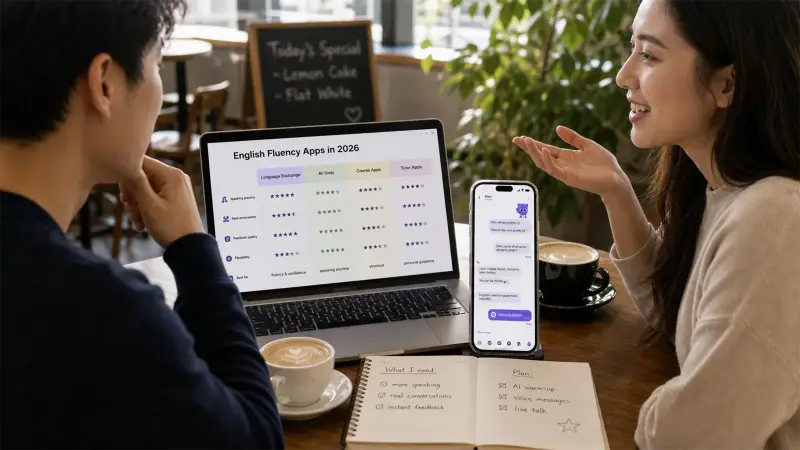
AppBest atBuilds real conversation skill?CostDuolingoDaily habit, vocabulary baseNoFree, Premium optionBusuuStructured lessons, async correctionsPartial, written and delayedFree, Premium optionELSAPronunciation and accentNo, single words and phrasesFree, Premium optionSpeakAI speaking drillsPartial, scripted with an AIPaid, free trialHelloTalkReal conversation with native speakersYes, live and unscripted90% of core features free
What each type of app does well
Let us give credit where it is due, because these tools earn their place.
Habit and vocabulary apps like Duolingo are great for showing up daily and building a word base. Structured course apps like Busuu give us a clear path and even let native speakers correct our exercises after the fact. Pronunciation apps like ELSA are genuinely strong at one job, telling us which sounds are off. AI speaking apps like Speak let us rehearse talking with no human watching, which is a real confidence builder.
If our goal is vocabulary, grammar, or cleaner pronunciation, the right app moves us forward fast. None of that is wasted time.
The part no app finishes
Now the honest part. None of these apps can fully build the skill of speaking naturally with a real person, because that skill only forms through real, unpredictable conversation.
An AI partner is predictable, a lesson is scripted, and a pronunciation tool grades single sounds. Real fluency lives in the messy space they avoid: someone changes the subject, uses slang, talks fast, and we have to react in the moment. That reaction is the last mile, and it is exactly the mile that apps, by their nature, cannot walk for us. We explain why that mile matters in what English fluency actually means.
This is not a reason to drop the apps. It is a reason to add the one thing they are missing.
What finishes the last mile
The missing piece is real conversation with native speakers, and the barrier has always been access and cost. That is the part that changed.
HelloTalk exists to fill that exact gap. Its English-speaking community is among the largest of any language app, with 70M+ registered users worldwide, which means fast matching and a real person available whenever we are. 90% of its core features are completely free, and it was named Google Play's Best Social App in 2017, so the lowest-barrier path into real English output is also one of the cheapest.
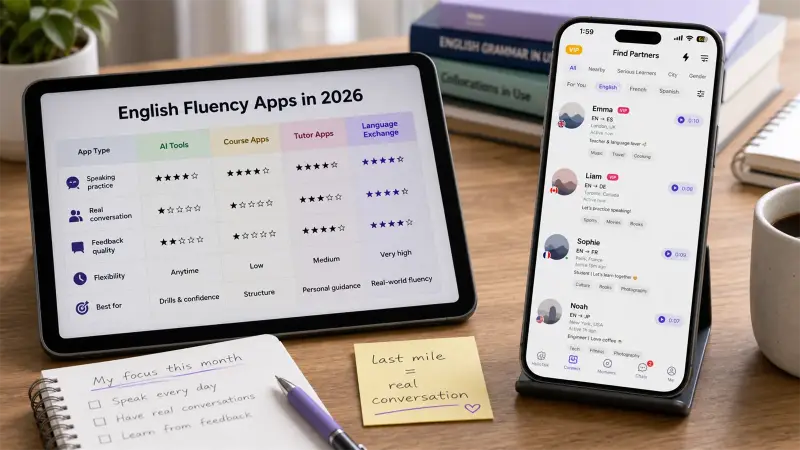
Here is how its parts cover the last mile that the other apps leave open:
- Chat-based learning. Built-in translation, transliteration, read-aloud audio, and real-time grammar correction live inside the chat, so we can hold a real conversation and fix our English without ever leaving it.
- Moments. We post a thought in English and get corrections and replies from several native speakers, while seeing how real people phrase things day to day. That is where natural expression comes from.
- Voicerooms and Livestreams. These 24-hour group voice rooms let us practice live speaking, listening first if we are nervous, then joining in. Livestreams are interactive mini-lessons with a host we can question in real time.
- AI learning tools. AI pronunciation scoring flags our specific weak sounds, AI grammar correction explains its fixes in the moment, and image translation reads English text through our camera. The AI handles the solo reps, the real speakers handle the last mile.
The difference is not that HelloTalk has more lessons. It puts real, interactive conversation into the loop, which is the one thing the other apps cannot.
So what should we actually use?
The setup that works is a combination, not a single app. Keep a study app for vocabulary and grammar, add a pronunciation tool if our accent needs it, and add HelloTalk for the real conversation that finishes the job. Which tool covers which skill is laid out in English fluency by skill.
The apps that waste our time are not bad apps. They are good apps used as if they were the whole answer. So let us use them for what they do, then open HelloTalk, find an English partner, and walk the last mile where it actually happens, in a real conversation.