English Fluency by Skill: The Right Tool for Each One
English Fluency by Skill: The Right Tool for Speaking, Listening, and Natural Expression
We tend to talk about "improving our English" as if it were one task with one solution. It is not, and that is why a single app so often disappoints us. No single tool builds all of English fluency, because speaking, listening, pronunciation, and natural expression are different skills that grow in different ways. The learners who break through are not the ones who found the perfect app. They are the ones who matched the right tool to each skill.
So let us map it out, skill by skill.
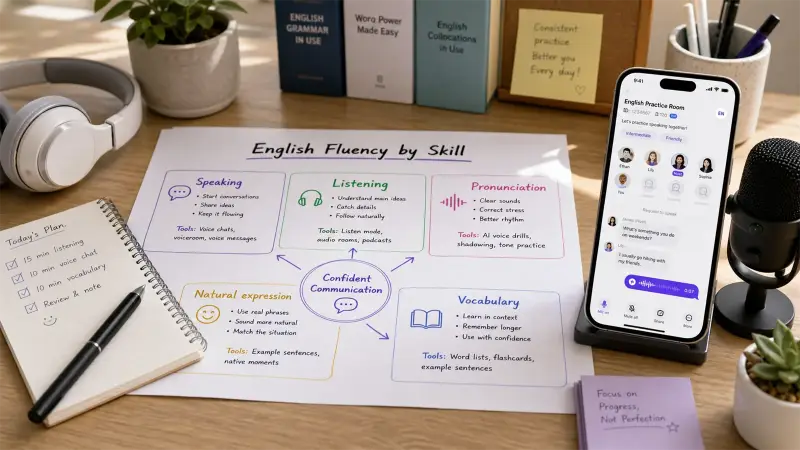
The right tool for each skill
SkillHow it actually growsBest-fit toolsPronunciationTargeted feedback on specific soundsAI scoring (ELSA, HelloTalk AI), native voice messagesListeningLots of real, varied native audioNative media, HelloTalk Voicerooms and LivestreamsSpeakingProducing speech in real conversationReal partners on HelloTalk, tutorsNatural expressionExposure to how natives really phrase thingsHelloTalk Moments, real chats, native contentVocabulary and grammarStructured review and repetitionDuolingo, Busuu, structured courses
The takeaway from the table is simple. Self-study apps handle vocabulary, grammar, and pronunciation well, but the two hardest skills to self-study, speaking and natural expression, both require real people. That is where most learners are missing a piece.
Why speaking and natural expression are the hard ones
Vocabulary and grammar respond well to apps because they are rule-based and reviewable. Pronunciation responds to AI because a sound can be measured. But speaking and natural expression resist software for the same reason: they only form in real, unpredictable interaction.
Speaking is the skill of producing the right words fast, under pressure, while listening and reacting at the same time. Natural expression, what many of us call "sounding native," is knowing that we say "grab a coffee" and not "take a coffee," which no grammar rule teaches. Both are learned by being around real native speakers, not by drilling alone. This is also why intermediate learners plateau, as we explain in why your English stopped improving.
The combination strategy
The smart approach is not to find one tool, it is to build a small stack where each piece covers a different skill.
- Vocabulary and grammar: a structured app for daily review.
- Pronunciation: an AI scoring tool to clean up specific sounds.
- Listening: plenty of real native audio and conversation.
- Speaking and natural expression: regular real conversation with native speakers.
Get the first two from apps, and the last two, the hardest and most important, from real people. For specific app picks on the study side, see English fluency apps in 2026.
The piece most stacks are missing
Almost everyone has the study apps. What they lack is the real-people layer that covers speaking and natural expression. That is the layer HelloTalk is built for, and it happens to also support the other skills.
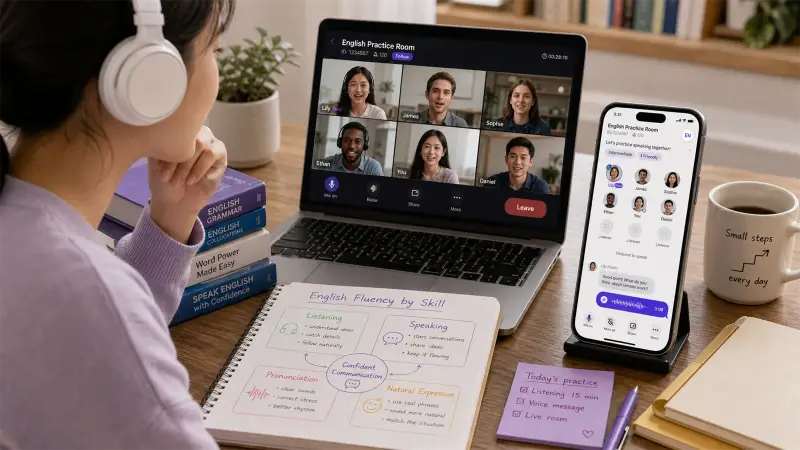
It connects us with native English speakers across 70M+ registered users in 260+ languages, and 90% of its core features are completely free, so the hardest-to-self-study skills become the cheapest to practice. Here is how its four parts map onto the skill table:
- Chat-based learning. Real conversations with built-in translation, transliteration, read-aloud, and real-time grammar correction. This is where speaking and natural expression get built, with the safety net of instant help.
- Moments. The public feed is a constant stream of how real native speakers phrase things, plus a place to post our own English and get it corrected. This is the natural-expression engine.
- Voicerooms and Livestreams. These 24-hour group voice rooms are listening and speaking practice in one, joinable as a listener first. Livestreams add interactive mini-lessons.
- AI learning tools. AI pronunciation scoring covers the pronunciation row of our table, AI grammar correction reinforces grammar with explanations, and image translation helps with reading. The AI handles the measurable skills so our time with real people goes to the human ones.
In one app, that covers the two skills no app can self-teach plus support for the rest, which is why it is the piece a combination strategy should not skip.
Match the tool to the skill, then start
The mistake is hunting for one perfect app. The fix is a small stack, where apps handle the measurable skills and real people handle speaking and natural expression. Once we see fluency as separate skills, choosing tools gets easy, and progress stops stalling.
The two hardest skills are also the ones we can start on today. Open HelloTalk, find a native English partner, and have one real conversation. For what fluency we are aiming at in the first place, see what English fluency actually means.