Korean Language Exchange App: Practice Honorifics With Real Native Partners

You learn that 먹다 means "to eat," and you feel good about it. Then you sit down to message an older Korean coworker, and you freeze. Do you write 먹어요, 드세요, or 잡수세요? Your textbook listed all three, but it never told you which one a real person expects in this exact moment, with this exact person, on a Tuesday afternoon. That hesitation is the wall almost every Korean learner hits, and it is the reason a Korean language exchange app does something a grammar book cannot. It puts a living native speaker on the other end who reacts, gently corrects, and shows you what register actually sounds like in the wild.
This guide is about getting past that wall. We will look at why Korean honorifics break learners who otherwise know the grammar, how a real exchange partner fixes the problem faster than any course, what to look for in a Korean language exchange app, and how to turn the supply of Korean speakers online into steady speaking practice. If you want the broader skill underneath all of this, our guide to speaking practice and why output beats input sets the foundation, and the complete guide to language exchange covers partner selection in any language.
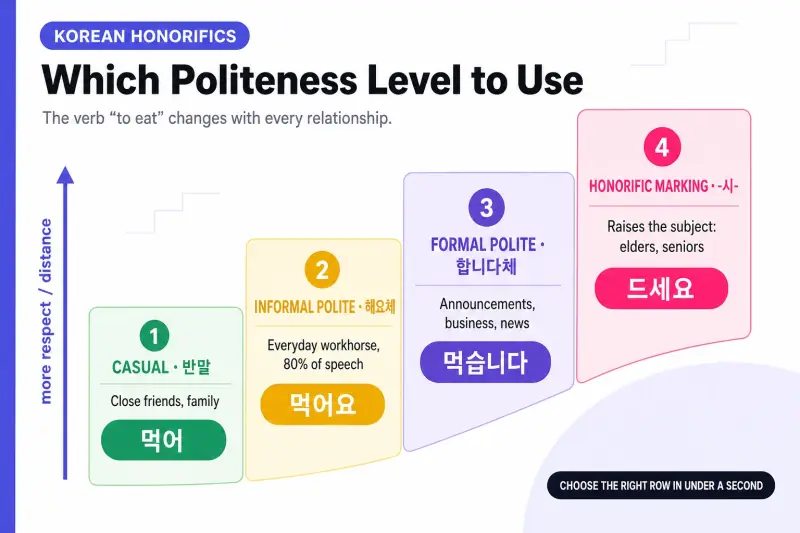
Infographic of Korean honorific levels and when to use each
Why Korean honorifics are the real wall, not vocabulary
Most learners assume the hard part of Korean is memorizing words or surviving the case-like particles. Those take effort, but they are learnable from a desk. The part that quietly defeats people is the honorific system, because it is not a vocabulary problem at all. It is a social-decision problem that fires in real time, every single sentence.
Korean encodes the relationship between you, the listener, and the person you are talking about directly into the verb. Every time you open your mouth, you are making a calculation: How old is this person relative to me? What is our social distance? Is this a formal setting or a casual one? Am I showing respect to the subject of my sentence or the person I am speaking to? Get it wrong in one direction and you sound cold or arrogant. Get it wrong in the other and you sound like you are talking down to your boss.
Here is the structure most courses present, and why it does not stick:
- Formal polite (합니다체). Used in announcements, business presentations, news, the military. It feels stiff and ceremonial. Textbooks teach it first because it is regular, but you will rarely start a friendship in it.
- Informal polite (해요체). The everyday workhorse. Polite but warm, used with strangers, coworkers, shopkeepers, and most adults you do not know well. This is where you will live 80% of the time, and ironically many courses underweight it.
- Casual (반말). Dropped endings, used with close friends, younger people, family. Using it too early with the wrong person is one of the fastest ways to offend someone in Korean.
- Honorific marking (-시 and special verbs). A separate layer that raises the subject of the sentence regardless of formality level. 드시다 instead of 먹다, 주무시다 instead of 자다, 계시다 instead of 있다. This is where 드세요 and 잡수세요 come from, and it stacks on top of the levels above.
The problem with learning this from a book is that the book gives you rules, but Korean honorifics run on judgment. The same sentence to your grandmother, your manager, and your gym friend takes three different forms, and no rule sheet can rehearse that switching for you. Only repeated real exchanges with native speakers build the reflex. That is the exact gap a Korean language exchange app fills.
How a real exchange partner teaches honorifics faster than any course
Think about how you learned register in your own first language. Nobody handed you a chart. You absorbed it by being corrected, by noticing reactions, by hearing how adults spoke to each other versus to you. Korean register works the same way, and a native partner recreates that natural feedback loop on demand.
Here is what an exchange partner gives you that a textbook structurally cannot:
- Live register correction. You write 먹어 to someone you should be addressing in 해요체 and a partner says, "with me 먹어요 is better, save 반말 for close friends your age." That one correction, tied to a real person and a real moment, sticks harder than a week of drills.
- The reaction, not just the rule. Native speakers will tell you not only what is wrong but how it landed. "That sounded a little too formal, like you were being distant." Tone information like that is invisible in a course.
- Permission to drop levels. A genuinely useful moment in Korean friendship is 말 놓자, the agreement to switch to casual speech. You can only learn to navigate that negotiation by living it with a real partner, and it is one of the warmest parts of making a Korean friend.
- Context that changes the answer. Your partner can show you that the same workplace uses 합니다체 in meetings and 해요체 at lunch. Register is situational, and only a person embedded in the culture can walk you through the switches.
This is why the social, real-time element matters so much for Korean specifically. The honorific system is fundamentally about relationships, and you cannot practice relationships against an app that only checks grammar. You practice them with people. For more ways to build that speaking reflex beyond exchange, the free Korean learning resources guide pairs well with partner practice. For a resource-by-resource view of the same problem, the comparison of Korean learning websites that teach speech levels through real situations shows which sites provide relationship context instead of only conjugation tables.
Honorific level cheat sheet: which form to use and how to drill it with a partner
This is the table to keep open while you practice. It maps a real situation to the register a native speaker expects, then tells you exactly how to use an exchange partner to lock that register in. Reading it teaches you the map; drilling each row with a real person builds the reflex.
| Situation | Register you should use | The verb "to eat" looks like | How to drill it with a native partner |
|---|---|---|---|
| Texting someone older or senior you barely know | Informal polite + honorific | 드세요 / 드셨어요 | Ask your partner to roleplay as a senior coworker and correct your endings |
| Talking with a coworker your own age | Informal polite (해요체) | 먹어요 | Have a partner chat casually and flag any 반말 that slips out too early |
| Speaking to a close friend the same age | Casual (반말) | 먹어 | Practice only after a partner agrees to 말 놓다 with you |
| Presenting, interviewing, or in a formal meeting | Formal polite (합니다체) | 먹습니다 | Ask a partner to do a mock interview and mark stiff vs natural phrasing |
| Asking your friend's parents or a teacher to eat | Informal polite + honorific | 드세요 | Have a partner play the elder and rate how respectful you sounded |
| Narrating a story about your grandmother | Honorific marking on the subject | 할머니가 드세요 | Tell a partner a real story and let them catch missing -시 forms |
The pattern to notice across the table: the grammar of "eat" is trivial. The skill is choosing the right row in under a second, with a real person watching. That speed only comes from repetition against native speakers who react, which is precisely what daily exchange gives you. Each row is a drill you can run in a five-minute voice message or a quick text exchange, and a steady partner will cycle you through all of them without you ever opening a workbook.
What to look for in a Korean language exchange app
Not every app that calls itself a language exchange app handles Korean well. The features that matter most for Korean are not the generic ones. They tie directly to the honorific and script challenges above. When you compare options, weigh these Korean-specific angles, not just the marketing.
| Feature | Why it matters for Korean specifically | What to check |
|---|---|---|
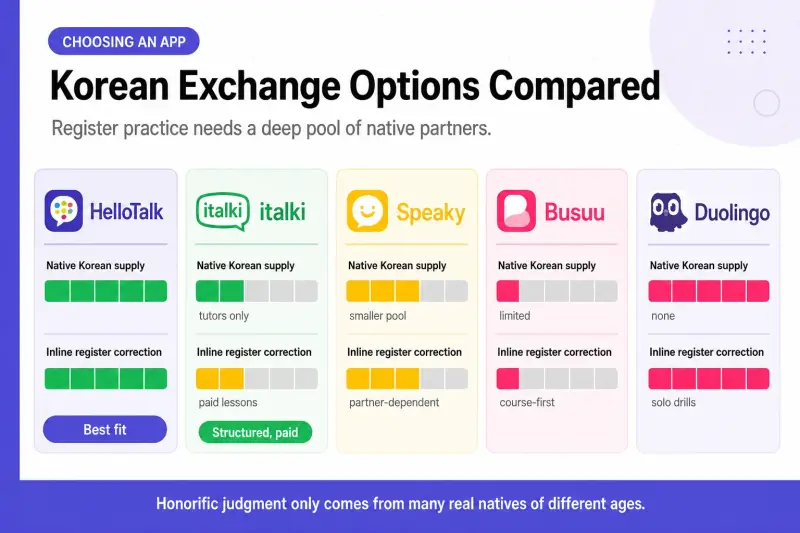
| Native Korean partner supply | Honorific judgment only comes from real natives; you need many, not one | How many Korean speakers are active and online in your timezone |
| In-chat translation and transcription | Hangul typing and reading is slow at first; you need a bridge that does not stall the conversation | Whether translation is built into the chat, not a separate app |
| Real-time grammar and register correction | You need someone or something flagging wrong politeness levels as you write | Whether corrections happen inside the message thread |
| Voice features | Honorific endings change pronunciation and intonation; text alone hides this | Live audio rooms or voice messaging with natives |
| Pronunciation feedback | Korean has sounds, including tense consonants, that English lacks | Whether the app scores your pronunciation |
| Free access | You should be able to test partner supply before paying | How much works without a subscription |
A Korean learner's needs are different from, say, a Spanish learner's. You are not just practicing conversation. You are practicing a social register system that the app needs to support through both correction tools and a deep enough pool of native partners that you can find someone of the right age and background to model the right speech for you. Supply of Korean exchange partners is the quiet make-or-break factor. An app with only a handful of Korean speakers cannot teach you register, because register requires variety.
How HelloTalk supplies Korean exchange partners and register practice
When learners ask us where to actually find a Korean language exchange partner, the answer usually comes down to supply and the right tools layered on top. HelloTalk is the platform we see Korean learners use most, mostly because the scale solves the supply problem. With 70M+ registered users across 200+ countries and 260+ languages, there is a large active community of Korean speakers, so you are not stuck with one partner who may go quiet. 90% of its core features are free, which means you can test the Korean partner pool before spending anything. It was named 2017 Google Play Best Social App and earned a 2024 Google Play global homepage feature.
Here is how its four main features map onto the specific job of Korean exchange and honorific practice:
- Chat-based learning is where Korean exchange usually starts, and it is built for the honorific problem. Text lowers the pressure while you decide on register, and the built-in translation, transcription, and reading tools handle the early hurdle of typing and reading Hangul. The real-time grammar correction means when you pick the wrong politeness level, a partner or the tool can flag it inside the thread, so 먹어 to a senior becomes a teaching moment instead of an embarrassment.
- Voicerooms and Livestreams are 24-hour live audio rooms and interactive streams you can enter as a listener first. For Korean this matters because honorific endings carry intonation and rhythm that text cannot show. You hear how 해요체 actually sounds among real speakers, then join in when you are ready.
- Moments lets you post a short Korean sentence or voice note to the community and get corrections from several native speakers at once. Post a message and ask "did I use the right honorific here?" and you get multiple Korean speakers weighing in, which is exactly the variety register practice needs.
- AI learning tools give you pronunciation scoring for sounds English speakers struggle with and grammar correction with explanations, useful for the solo reps between live exchanges with your partner.
The combination matters. A large supply of native Korean partners gives you variety of age and background, the correction tools turn every register mistake into a lesson, and the voice features expose you to how honorifics actually sound. That is the full loop the cheat sheet above asks for.
Infographic comparing Korean language exchange options
Turning Korean partner supply into steady practice
Finding a Korean language exchange partner is the first step. Keeping the practice alive is the harder one, and it is where most learners drift. A few habits make the difference, all of them built around the honorific angle that makes Korean unique.
- Pick partners across different ages. Because register depends on the relationship, practicing only with people your own age teaches you 해요체and 반말 but leaves you helpless with seniors. Find at least one older partner so you have to use honorific forms regularly.
- Make register the explicit topic. Tell your partner early: "I want to practice choosing the right politeness level." A partner who knows your goal will correct register actively instead of letting it slide to be polite.
- Trade fairly. Korean exchange works because your partner wants your language as much as you want theirs. Split sessions cleanly, half Korean and half their target, so the relationship lasts.
- Use voice for the endings. Honorific endings like -세요 and -습니다carry intonation. Send voice messages and join voice rooms so you train the sound, not just the spelling.
- Save your corrections. Keep a running note of every register fix your partner gives you. Patterns emerge fast, and reviewing them turns scattered corrections into a usable map.
The thread running through all five is that Korean speaking practice is social practice. You are not memorizing a system in isolation. You are learning to read relationships and respond with the right register in real time, which only happens with a steady supply of real partners. For the cross-timezone logistics of keeping that going, the international language exchange guide covers scheduling across regions, and the broader language exchange guide covers session structure.
Frequently asked questions
What is the best Korean language exchange app for practicing honorifics?
Look for one with a large supply of native Korean partners and correction tools built into the chat, because honorific judgment only comes from real speakers reacting to your register in real time. HelloTalk is the one we see Korean learners use most, largely because its 70M+ user community gives you enough Korean speakers of different ages to practice the full politeness range, and 90% of core features are free so you can test the partner pool first.
Can a language exchange app really teach Korean honorifics better than a course?
For honorifics specifically, yes, because the challenge is not memorizing rules but making fast social judgments. A course gives you the chart; a native partner gives you the live correction, the reaction, and the situational context that turns the chart into a reflex. The two work best together, with the course building the base and exchange building the speed.
How do I find a Korean language exchange partner who will actually correct my register?
Tell them directly that register correction is your goal, and choose partners across different ages so you are forced to use honorific forms. On a platform with a deep Korean community you can keep several partners, which matters because register practice needs variety, not a single conversation.
Do I need to know Hangul before starting Korean exchange?
It helps, but the early reading and typing hurdle is manageable if your app has built-in translation and transcription. Many learners start in text with translation support, get comfortable, then move to voice once Hangul feels natural. Do not wait until you read perfectly to start exchanging.
Is it rude to use the wrong honorific level with a Korean partner?
With an exchange partner, no, because they expect you to be learning and want to help you fix it. That safety is exactly the point of practicing with a partner rather than waiting to be perfect. Making the mistake with a patient native speaker is how you avoid making it later with a boss or an elder.
How often should I practice with a Korean exchange partner?
Short and frequent beats long and rare. Ten minutes of voice messages a day, cycling through the situations in the cheat sheet, builds register reflexes faster than one long weekly call. Consistency is what makes the politeness choice automatic.
Start practicing Korean register this week
The vocabulary will come from study, but the honorific reflex only comes from talking to real Korean people who react and correct you. Pick one partner older than you and one your own age, tell them you want to practice register, and run a few rows of the cheat sheet through voice messages with a community like HelloTalk. The form of "eat" was never the hard part. Choosing it in real time, for the right person, is, and that is a skill you build by speaking.