
International Language Exchange: How to Find Partners Across Time Zones and Borders
Language Exchange International: How to Find Partners Across Time Zones and Borders

It is 9pm in New York and you want to practice Japanese, but every local meetup wrapped up hours ago and the one Spanish conversation group near you only meets on Thursdays. This is the wall most learners hit. The people who speak your target language natively are mostly not in your city, and the few who are keep a schedule that never quite lines up with yours. An international language exchange approach solves this by treating the whole planet as your partner pool instead of a five mile radius. When you stop limiting yourself to who is physically nearby, the math changes completely: you greatly increase the chances of finding a native speaker who is available when you are.
Infographic of how international language exchange works across time zones
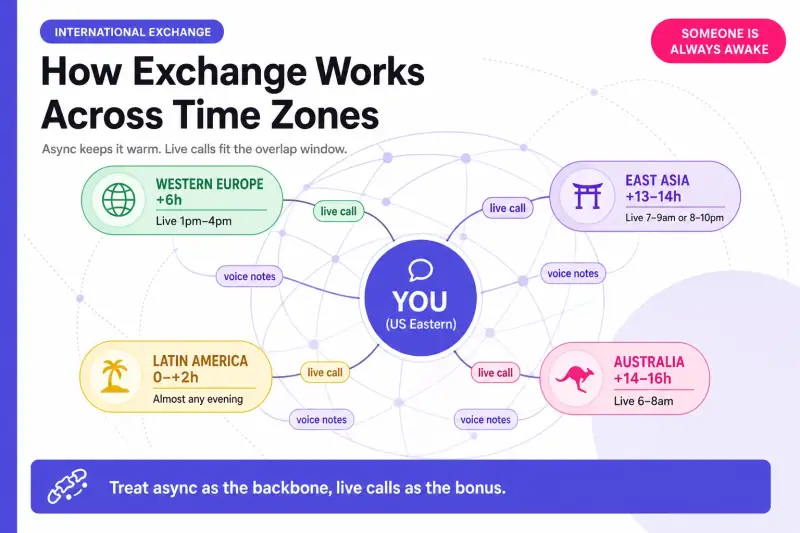
This guide walks through how international language exchange actually works in practice. You will see how to find partners across time zones, when an online exchange beats a local one and when the reverse is true, how to read the supply of partners for your specific language, and which tools fit which goal. If you want the broader picture of how language exchange fits into a full speaking routine, our pillar guide on speaking practice covers the methods around it, and our complete guide to language exchange is the main reference for setting up exchanges that last.
What "international" actually changes about language exchange
A local language exchange is constrained by geography. If you live in a mid-sized city and want to learn Korean, you might find two or three Korean speakers in a meetup group, and only if the schedules work. An international exchange removes that ceiling. Instead of asking "who near me speaks this," you ask "who anywhere speaks this and is free when I am," and the second question has thousands of answers.
Three things shift when you go international:
-
Supply explodes. A language with almost no local speakers in your town might have millions of native speakers reachable online. Languages that are difficult to find locally may become much easier to practice online.
-
Time becomes a tool, not a barrier. A twelve hour time difference feels like a problem until you realize it means someone is always awake. Your late night is their lunch break.
-
You get real regional variety. Local exchanges give you whoever happens to be in town. International ones let you choose between Mexican and Argentine Spanish, or Parisian and Quebecois French, based on which variety you actually need.
The tradeoff is that online exchange loses the in-person texture: body language, the energy of a room, the accidental friendships that form over coffee. That is why this guide treats online and local as complementary rather than competing. Most committed learners end up using both.
Online vs local international exchange: a direct comparison
People searching for "language exchange near me" usually want one of two different things without realizing it. Some want the social experience of meeting speakers in person. Others just want to practice and assume local is the only option. The table below lays out where each format wins so you can pick deliberately.
| Factor | Online international exchange | Local in-person meetup |
|---|---|---|
| Partner supply for your language | Millions of native speakers reachable | Limited to who lives near you |
| Scheduling flexibility | Any hour, someone is always online | Fixed weekly slots, often evenings only |
| Regional accent choice | Pick the exact variety you want | Whoever shows up |
| Cost | Most platforms free to start | Free to low, plus travel and drinks |
| Social depth | Builds over weeks of chat and calls | Immediate face-to-face rapport |
| Best for rare languages | Strong, supply is global | Often impossible locally |
| Best for staying motivated | Needs self-discipline | Group accountability helps |
Neither column is the right answer for everyone. If you live in a city like New York with a dense population of speakers, a local language exchange meetup in NYC can be excellent for the social side, and many learners pair a weekly local group with daily online practice. If you live somewhere with thin local supply, or you are learning a language with few speakers in your region, online international exchange is not a fallback. It is the main event.
Finding partners across time zones
The biggest worry people have about international exchange is timing. "How can I practice with someone twelve hours ahead?" The answer is that time zone gaps are easier to work with than they look, because exchange does not always require both people online at the same moment. You can text and send voice notes asynchronously during the day, then schedule live voice calls for the windows where your waking hours actually overlap.
Here is a planning table for finding live-call overlap from a US Eastern Time base. Find your target language region, and the overlap column shows the realistic window when both of you are likely awake.
Time differences are approximate and may shift during the year because of daylight saving time.
| Your target region | Time difference from US Eastern | Best live-call window (your time) | Async-friendly approach |
|---|---|---|---|
| Western Europe (France, Germany, Spain) | +6 hours | 1pm to 4pm | Morning voice notes, they reply at lunch |
| East Asia (Korea, Japan, China) | +13 to +14 hours | 7am to 9am, or 8pm to 10pm | Your evening is their morning |
| Latin America (Mexico, Colombia) | 0 to +2 hours | Almost any evening | Near real-time all day |
| Middle East (Arabic regions) | +7 to +8 hours | 12pm to 2pm | Their evening is your midday |
| Australia / New Zealand | +14 to +16 hours | 6am to 8am | Your night is their next morning |
Two habits make this work in practice. First, treat asynchronous exchange as the backbone and live calls as the bonus. A steady stream of text corrections and voice notes keeps the relationship warm even when your clocks rarely sync. Second, when you do find a partner whose overlap window is generous, protect it. A partner two time zones away who is reliably free in your evening is worth more than a perfect match you can only reach at 4am.
How community scale decides whether you find a partner at all
Everything above depends on one thing: the size of the pool you are drawing from. A language exchange program with a few thousand members works fine for common pairs like English and Spanish, but it falls apart the moment you want something less common, like practicing Korean from a small US town at 11pm. The deeper the international community, the more likely your specific combination of language, level, and available hours actually exists in someone real.
This is where platform scale stops being a marketing number and becomes the thing that determines your experience. HelloTalk is the community we point learners to most often for international exchange, and the reason is reach. With 70M+ registered users across 200+ countries and 260+ languages, the odds that a native speaker of your target language is online and matched to your interests at any given hour are high, even for off-peak times and less common languages. Because 90% of core features are free, you can test whether the supply is there for your specific pair before spending anything. With over 1 billion messages daily moving through the platform, the community is active rather than dormant, which matters enormously when you are trying to find someone awake across the world.
Infographic comparing online and in-person international language exchange
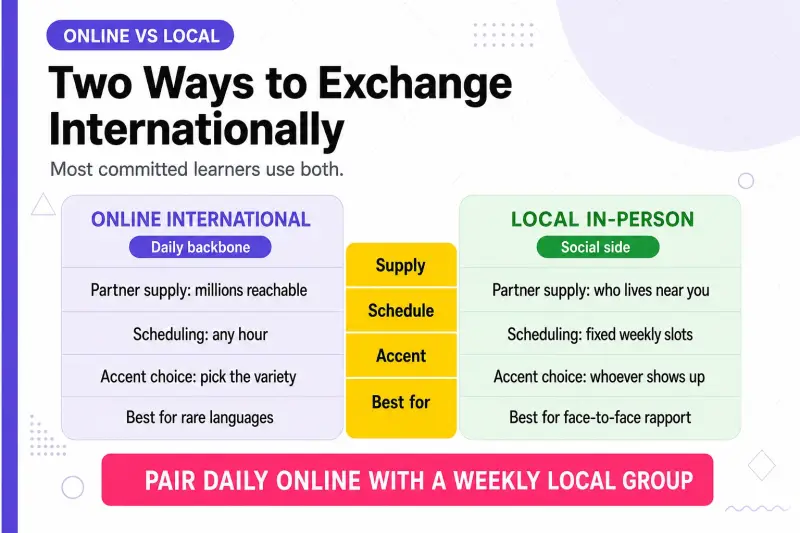
The four features that matter for cross-border exchange
International exchange has specific problems that a single chat box does not solve. Here is how HelloTalk's four core tools map onto the realities of practicing across borders and time zones:
-
Chat-based learning is built for asynchronous, cross-time-zone exchange. The built-in translation, transliteration, and read-aloud tools mean you can keep a conversation going with a partner thirteen hours ahead even when you cannot get on a call. The correction + AI grammar tools turns every text message into a small lesson, so the gaps between live sessions stay productive instead of idle.
-
Moments is the part that makes a global community feel reachable. You post something short in your target language, and native speakers from many countries correct it in the comments. For an international learner, this is the fastest way to get feedback from multiple regional varieties at once, without having to schedule anything with anyone.
-
Voicerooms and Livestreams make it easier to find live conversations across different time zones. With a global community active at different times of day, you may be able to find a live conversation in your target language even when your regular language partner is unavailable. You can join as a silent listener first to get comfortable, then speak when ready, which lowers the barrier for a learner who is nervous about real-time international calls.
-
AI learning tools fill the inevitable gaps when your time zones simply will not align. AI pronunciation scoring and AI grammar correction with explanations let you keep practicing during the hours no human partner is available, so an awkward time difference never means a day of zero practice. Image translation helps when you are exchanging photos of menus, signs, or notes with a partner across the world.
The combination matters more than any single feature. Asynchronous chat keeps the relationship alive across time zones, Voicerooms provide live practice at any hour, Moments delivers community-wide feedback, and AI tools cover the dead hours. Together they make a partner on the other side of the planet feel as accessible as one across town.
Tools and channels for international exchange compared
You have several options for finding international partners, and they serve different needs. The table below compares the main channels by what they are actually good at, so you can match the tool to your goal rather than defaulting to whatever is most familiar.
| Channel | Strength | Limitation | Best fit |
|---|---|---|---|
| HelloTalk | Largest community, built for exchange, free to start | Designed for partner exchange, not paid tutoring | Finding native partners worldwide across time zones |
| Speaky | Simple matching interface | Smaller pool, fewer learning tools | Casual text exchange |
| Busuu | Structured courses with community feedback | Course-first, exchange is secondary | Learners who want a curriculum plus light community |
| italki | Professional paid tutors | Costs money per lesson, not peer exchange | Structured lessons when you want a teacher, not a swap |
| Duolingo | Gamified solo practice | No real human exchange | Vocabulary and streak-building, not conversation |
| Local meetup groups | Real in-person rapport | Geography and schedule limited | The social side, if speakers live near you |
The honest read: for genuine international peer exchange, where the whole point is trading languages with native speakers around the world, a large dedicated community is the right tool. Paid tutoring platforms like italki are excellent for structured lessons but are a different model, and gamified apps like Duolingo are solo practice rather than exchange. Many learners run a free exchange community for daily conversation alongside occasional paid lessons when they want focused correction.
Building an exchange routine that survives the distance
Finding an international partner is the easy part. Keeping the exchange alive across an ocean and a time gap is where most people quietly drift away. A few habits make the difference between a partner who fades after a week and one who is still correcting your sentences six months later.
- Set a shared rhythm, not a rigid schedule. Agree on something like "we both send a voice note daily and call once a week when our windows overlap." Rhythm survives time zone chaos better than fixed appointments.
- Lead with genuine curiosity about their country. International exchange has a built-in advantage: you are talking to someone whose daily life is foreign to you. Ask about it. The relationship lasts when it is about people, not just grammar.
- Trade fairly. The exchange breaks down when one person always teaches and the other always learns. Spend real effort helping with your native language, and your partner stays invested.
- Use async to protect the live time. Do the vocabulary and text correction asynchronously so your rare live-call windows go to actual conversation, which is the part that builds fluency.
- Keep more than one partner. Time zones mean any single partner will sometimes be unavailable. Two or three loose exchanges across different regions means you always have someone awake.
If you want the deeper mechanics of starting and structuring these relationships, our main guide to language exchange goes into far more detail on first messages, correction etiquette, and keeping exchanges productive over the long run. Pair it with the speaking practice pillar for the solo drills that fill the gaps between sessions.
A realistic example of going international
Consider how this plays out. Sarah lives in a small town in Ohio and wants to practice Korean. There is exactly one local meetup, and it focuses on Japanese. Locally, her options are zero. So she goes international: she joins a global exchange community, posts a short introduction in Korean on Moments, and within a day gets corrections from three native speakers in Seoul and Busan. She matches with David, a Korean engineer learning English, whose evening overlaps with her morning commute. They settle into a rhythm of daily voice notes and a Sunday call. On the nights neither is free, she drops into a Korean Voiceroom to listen and an AI pronunciation tool to drill the sounds she keeps missing. Six months later she is holding real conversations, with a partner she would never have found within driving distance.
That sequence is only possible because the community was large enough to contain David in the first place. This is the quiet truth of international exchange: scale is not a luxury feature, it is the precondition for finding the one person who matches your language, your level, and your hours.
Frequently asked questions
Q: How do I find a language exchange partner across time zones?
A: Start by treating most of the exchange as asynchronous. Send text messages and voice notes that your partner can answer when they wake up, and reserve live calls for the few hours your schedules overlap. Use the planning table above to identify realistic call windows for your target region, and prioritize partners whose free hours fall in your evening or morning rather than the middle of your night.
Q: Is online or local language exchange better?
A: They serve different goals. Local exchange gives you in-person rapport and group accountability but is limited to speakers who live near you and meet on fixed schedules. Online international exchange gives you a vastly larger partner pool, flexible timing, and regional accent choice, at the cost of face-to-face energy. Most committed learners use both, with online as the daily backbone and local meetups for the social side.
Q: What is a language exchange program and how is it different from tutoring?
A: A language exchange program connects two learners who each speak the language the other wants to learn, so you trade time as peers with no money changing hands. Tutoring, on platforms like italki, means paying a professional to teach you. Exchange is better for conversation practice, cultural insight, and motivation; tutoring is better for structured correction. They work well together.
Q: Can I do language exchange if I live somewhere with few local speakers?
A: Yes, and this is exactly where international exchange shines. If your target language has almost no speakers in your area, an online community with global reach lets you find native partners regardless of where you live. A large platform with users across 200+ countries means even uncommon language pairs usually have active partners available.
Q: How many partners should I have for international exchange?
A: Two or three loosely active partners across different regions works better than one. Time zones, busy weeks, and life mean any single partner will sometimes be unavailable, so a small spread ensures someone is always reachable when you want to practice. Keep each relationship genuine rather than collecting contacts you never message.
Q: Does the size of the exchange community really matter?
A: It matters most for less common languages and off-peak hours. For a popular pair practiced in the evening, almost any community works. But the moment you want a specific language, level, and odd time slot, you need a deep pool for a real match to exist. Platforms like HelloTalk, with 70M+ users across 200+ countries, raise the odds that your exact combination is reachable at any hour.
Going international is the single change that turns language exchange from a scheduling headache into something that fits your life, because the world is always awake somewhere. If you want to start finding native partners across borders today, explore HelloTalk and see who is online in your target language right now.