
Why Russian Resources Lose Beginners in Month Two, and What Structure Prevents It

When beginners quit Russian in month two, the cause is usually the structure of their resources, not a shortage of willpower. The timing is too consistent to be a personality trait. Month one delivers the Cyrillic alphabet, a compact system with visible daily wins that almost every resource teaches well. Month two delivers the start of Russian grammar proper, where the same resources shift to a mode that produces no visible wins for weeks. The learner experiences this as suddenly getting worse. What actually changed is that the resource ran out of the material it was designed around.
Framing dropout as a motivation problem leads to motivation solutions: streaks, reminders, encouragement. Framing it as a structural problem leads to structural solutions, which is what this article is about. The question throughout is not what a learner should do differently but what a resource, or a stack of resources, has to be shaped like so that month two produces evidence of progress instead of an unexplained wall.
The month-two scene, described precisely
The typical month-two beginner can read the Cyrillic alphabet, slowly but correctly. They know greetings and some vocabulary. Then three things happen at once. Real sentences appear, and reading them letter by letter does not yield meaning at conversational speed. The case system arrives, so words the learner "knows" start appearing with unfamiliar endings. And nothing the learner can do yet resembles speaking: asked a simple question, they can retrieve words but not assemble them.
None of this is a regression. It is the gap between recognizing symbols and operating a grammar, and every Russian learner crosses it. The resource-design question is what the learner's tools are doing during the crossing.
The structural flaw: input keeps flowing, output has no outlet
Most beginner Russian resources are input pipelines. Lessons present material; exercises check recognition of that material; progress is measured in units consumed. In month one this structure fits the content perfectly, because an alphabet is a recognition task. In month two the same structure keeps delivering input, more vocabulary, more grammar exposition, while the skill the learner now needs is production: assembling case endings and verb forms into sentences of their own.
The flaw compounds in a specific way. Production is where errors happen, and errors are where the case system actually gets learned, and the input pipeline generates no errors because it never asks for free production. So the learner's error rate stays at zero while their ability stays flat, and the resource's progress meters keep climbing. A beginner can complete every exercise a typical Russian course offers in month two and still be unable to produce one original sentence with correct endings, because no exercise asked for one. The general version of this imbalance is laid out in the overview of input versus output in language learning; Russian is a severe case of it because Russian front-loads so much grammar into basic sentences.
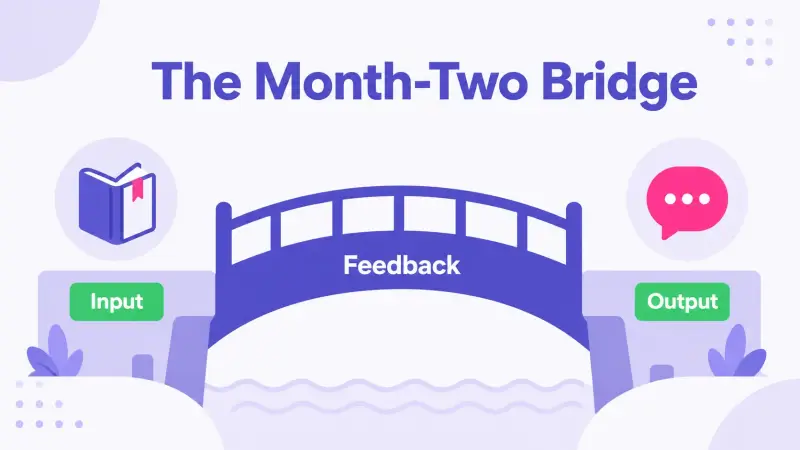
What a month-two-proof structure contains
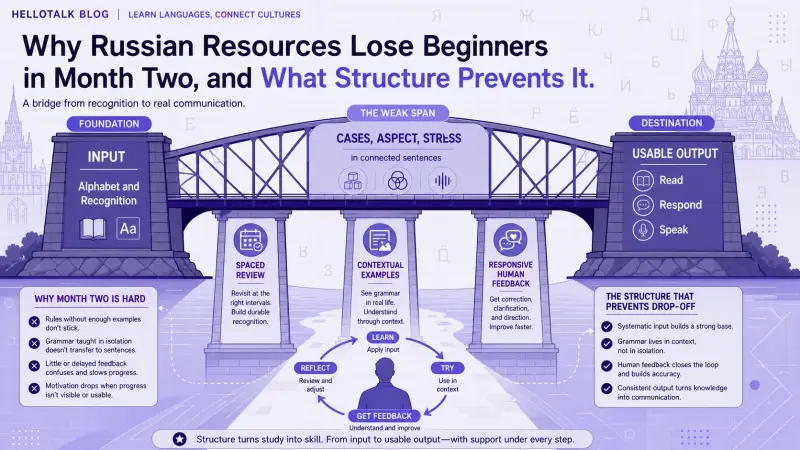
A resource structure that carries beginners through month two has four identifiable components. Stated as design features rather than advice:
- Interleaved production from the first grammar unit: every input lesson is paired with a task that requires composing something original with the new material, however small.
- A feedback channel that reads free production: something, human or automated, that responds to sentences the learner invented, not only to sentences the resource generated.
- Progress markers attached to ability, not consumption: the structure surfaces "you could not say this two weeks ago and now you can" rather than units completed.
- Grammar dosing matched to output: cases introduced one function at a time and immediately used, instead of the full six-case table followed by a long recognition phase.
The second component is the one most beginner stacks are missing entirely, and it is the one hardest to package as content, because free production needs a reader. This is the structural slot that real-person exchange resources occupy, and HelloTalk is a standard example of the category. HelloTalk chats give a month-two beginner a place where two-line Russian messages get read and corrected by native speakers, with translation and read-aloud beside the message so a correction can be heard as well as understood. HelloTalk's AI grammar correction covers the hours when nobody replies, returning an explained version of the same two lines, which is what keeps the channel a daily routine rather than a weekly event. What that correction loop looks like in Russian specifically, endings checked, stress re-recorded, is documented in the practical guide to Russian language exchange.
Comparing structures at the point of failure
The table below contrasts how the common input-pipeline structure and a production-interleaved structure behave at the exact moments where month two goes wrong. It is a comparison of structures, not of products; any given app, course, or tutor arrangement can be located in either column by checking what it asks the learner to do.
| Month-two moment | Input-pipeline structure | Production-interleaved structure |
|---|---|---|
| First case endings appear | Presents tables, drills recognition | Assigns two original sentences using one case function |
| Learner produces an error | No channel to produce it, so it never surfaces | Error surfaces and is corrected within a day |
| Learner asks "am I progressing?" | Points to units and streaks | Points to sentences producible now versus two weeks ago |
| Reading speed feels stuck | Adds more vocabulary | Pairs short real texts with retell tasks |
| Motivation dips | Sends reminders | Schedules a low-stakes exchange, since a waiting reader creates a reason to write |
The right-hand column is not exotic. It describes what a decent tutor does by default and what a well-assembled self-study stack can replicate. The last row is the easiest to underestimate: HelloTalk Voicerooms run around the clock and can be entered as a listener, so the low-stakes exchange that row describes needs no scheduling, which matters in the month when scheduling is the first thing to slip. The point of the comparison is that every left-column behavior is reasonable in isolation; the failure is only visible when the columns are read against the month-two moments.
Assembling the structure from separate resources
No single free resource reliably provides all four components, so in practice the structure is assembled. The assembly rules are short:
- Keep one structured grammar source for sequencing, so cases and verb aspects arrive in a sane order rather than as encountered chaos.
- Attach a production task to every grammar unit yourself if the source does not: the unit is not done until something original has been written or said with it.
- Route the production somewhere it gets read: an exchange partner, a community feed, a tutor. A HelloTalk Moments post is the lowest-friction version, since one Russian sentence can draw corrections from several native speakers without arranging anything with anyone.
- Track ability milestones in a plain list, one line each, dated, because the feeling of no progress in month two is usually false and the list is the cheapest correction for it.
Which specific grammar systems deserve the earliest production attention, and where mainstream resources thin out on each, is mapped in the companion diagnosis, where Russian learning resources break down. The two articles are halves of one argument: that one locates the failure points in the language, this one locates the failure point in the calendar.
Naming the structure is only useful if you know what to put in each slot. Our guide to named Russian resources for each of the three channels lists specific options for courses, audio, reading and speaking practice.
FAQ
Is month two harder in Russian than in other languages, or does every language have this drop?
Every language has a post-honeymoon drop, but Russian sharpens it unusually. Languages like Spanish or Italian let beginners build simple correct sentences with almost no morphology, so early production is cheap. Russian demands case endings for even basic sentences, which delays the first fluent-feeling production and concentrates the difficulty right after the alphabet ends. The drop is therefore steeper and more predictable in Russian, which is also why it is more preventable: its timing and cause are known in advance.
I am in month two right now and it feels like I forgot everything. What does the structural view say I should change first?
Add the feedback channel before adding any new content, because it is the component whose absence produces the "forgot everything" feeling. Concretely: write two short original sentences a day using whatever grammar you met that week, and send them somewhere a Russian speaker will respond, an exchange chat or community post. Within about two weeks the corrections start repeating, which is visible evidence of specific, fixable gaps rather than general decline. New content can resume once that loop exists.
Do gamified streaks and reminders do any good at all in month two?
They solve a real but different problem: showing up. A streak keeps the session happening; it says nothing about what happens inside the session. In month one, when the content is recognition-shaped, showing up is most of the battle, which is why streaks feel so effective early. In month two the binding constraint moves from attendance to feedback on production, and streaks cannot carry that load. Keep them if they cost nothing, but treat them as an attendance tool, not a progress measure.
How much daily time does the three-channel structure actually need?
Less than the month-one routine most learners are already running; the change is in composition, not volume. A workable floor is a session split into thirds: one part new or reviewed content, one part producing a few original sentences, one part reading corrections and reattempting yesterday's errors. On a thirty-minute day that is ten minutes per channel, and the structure survives shrinking better than it survives amputation: a short day with all three channels beats a long day of content alone. The expensive-feeling part, waiting for a response to your sentences, runs on someone else's clock and costs you nothing while you wait.
I already quit Russian once in month two. What should a restart do differently?
Two things, in order. First, skip the victory lap: re-entering through the alphabet unit you already passed rebuilds the month-one high and schedules the same crash, so start with a quick placement instead, reading a real short text and writing a few sentences to find the actual edge. Second, install the feedback channel in week one of the restart rather than waiting for the drop, since your previous attempt has already demonstrated where the structure fails. A restart carries an advantage a first attempt lacks: dormant knowledge returns quickly under production, and visible recovery of old ground supplies the progress signal that month two otherwise takes away.