
When Should Arabic Learning Resources Stop Showing Every Short Vowel?
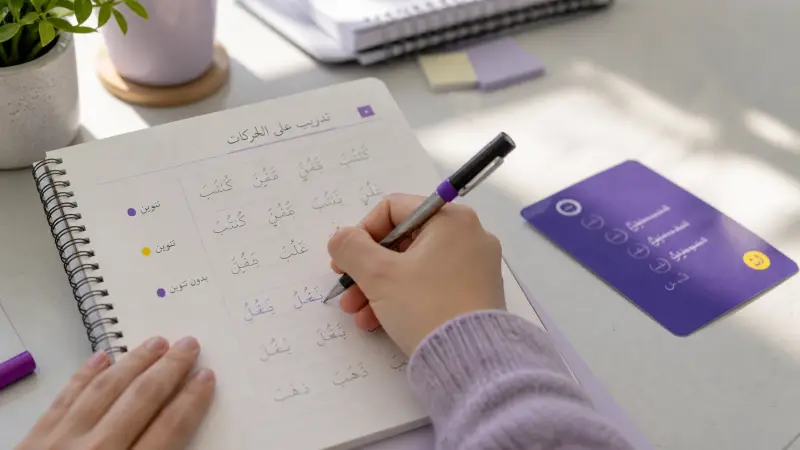
Your materials should start dropping short vowel marks as soon as you can read familiar words without them, and not one chapter sooner. That moment comes earlier than most learners expect and later than most learners want.
You feel why the first time you step outside your textbook. Every word in your lessons carries its full set of marks, then a friend sends a two-line message, or you open a news headline, and words you read comfortably yesterday now stand bare. You stall on the second word, because nothing has trained you to read it without the vowels.
That stall is structural. Everyday written Arabic in newspapers, books, websites, and social media omits most short vowel marks, so every learner eventually has to read words from context instead of from diacritics. Full marking survives mainly in the Quran, dictionaries, children's books, and learner materials. The fatha, kasra, damma, sukun, and shadda you learned in week one are scaffolding, and the real question is when your resources should start taking the scaffolding down, and how to tell if yours are doing it too fast or not at all.
Signs You Are Ready to Read With Fewer Vowel Marks
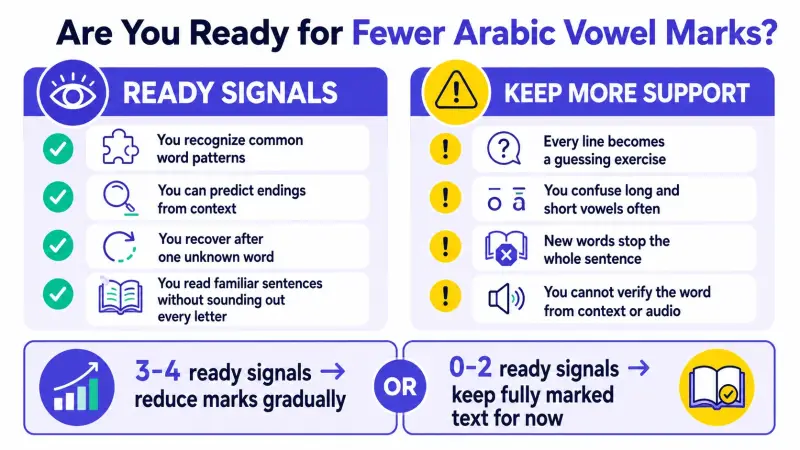
Check yourself before you check your books, because the taper should follow your reading skill, not a page number.
The marks are doing real work. Teams building automatic vowelization software have reported that missing diacritics can leave more than 90 percent of the words in a text ambiguous when read out of context. Native readers cut through that instantly with vocabulary and grammar. You need enough of both that the marks become confirmation instead of information.
You are probably there, or close, when a few of these sound familiar:
- You read كتاب or مدرسة as a shape. No sounding out, no letter-by-letter. You see it, you know it.
- You guess new words from their pattern. A place noun or an active participle built on a familiar template, and you can predict the vowels before checking.
- You catch your eyes skipping the marks on words you know. Learners often feel guilty about this. Do not. The skipping is the readiness signal.
- The endings stop surprising you. If the sentence already told you the case or the verb form, the final mark is just agreeing with you.
A learner is ready to reduce short vowel marks when they can recognize a word's root and pattern without sounding out each letter, because pattern knowledge is what native readers use in place of diacritics. If none of this describes you yet, staying with fully marked text is not falling behind. It is building the exact memory the next stage runs on.
How Different Resource Types Taper Diacritics: Textbooks, Graded Readers, and Apps
Once you see those signs in yourself, the next check is whether your materials are moving with you. Resource types handle the taper very differently, and a mismatch in either direction costs you: too many marks and you never build pattern reading, too few and every page is a decoding grind. The table below compares the main types on one thing: how each manages the move from fully marked to unmarked text.
| Resource type | Named example | How it handles short vowel marks | Best-fit stage |
|---|---|---|---|
| Alphabet and sounds course | Alif Baa (Georgetown University Press) | Full marks throughout; the marks are the lesson | First contact with the script |
| University textbook series | The Al-Kitaab program | Heavy marking early; new vocabulary marked, familiar text progressively bare | Structured beginner to intermediate study |
| Graded readers | The Sahlawayhi graded stories | Controlled vocabulary recycled across 24 stories in 6 levels, so words become recognizable with less support | Extensive reading practice |
| Dialect and MSA reader publishers | Lingualism readers | Tashkeel plus transcription in learner materials, graded roughly A1 to B2 | Bridging into spoken varieties |
| Mobile apps | Duolingo's Arabic course | Teaches MSA and keeps diacritics on exercise text from the first alphabet lessons | Casual daily exposure |
| Native media | News sites, novels, social posts | Almost entirely unmarked, with rare marks on ambiguous words | The destination, in small doses |
A few specifics behind those rows. Alif Baa is built for roughly the first 20 to 25 classroom hours of an Arabic program, with 40 to 50 homework hours alongside, and full marking makes sense there because the marks are the curriculum. The Al-Kitaab series that follows it has been the most widely used Arabic textbook program in the United States since its first edition in 1995, and its whole structure assumes you lean on marks less each semester. The Sahlawayhi series takes the other route: 24 stories of 200 to 400 words each across six levels, with vocabulary deliberately recycled, which is what makes lighter marking survivable. You meet the same words often enough to own them.
None of these is the answer for everyone. The useful move is smaller: open your current resource, look at what it is doing with marks, and ask whether that still matches the signs from the last section.
What Good Partial Vocalization Looks Like: Marking Only What Is Ambiguous
The best materials do not just taper book by book. They taper inside the page, and that middle state has a name: partial vocalization.
Researchers who work on Arabic text processing describe the same convention native publishers follow: drop most marks, add them back only where a word would genuinely mislead, and keep full marking for scripture and beginner materials. Good partial vocalization marks only the diacritics that resolve a genuine ambiguity, which makes it the natural middle stage between fully marked learner texts and unmarked adult prose.
In practice, a well-edited partially vocalized text keeps marks in a few predictable spots:
- Passive verbs, where كُتِبَ (it was written) would otherwise look identical to كَتَبَ (he wrote).
- A shadda that changes meaning, since doubling a consonant can turn one verb form into another.
- Rare words and proper names, where you have no stored pattern to lean on.
- Poetry and quoted classical lines, where the exact vowels carry the meter.
This gives you a fast quality test for any intermediate book. If it marks everything, it is a beginner resource in intermediate clothes. If it marks nothing, it skipped the bridge. If it marks passives, shaddas, and new words while leaving familiar text bare, it is tapering properly, and reading it trains exactly the judgment you will need later on bare text.
Using HelloTalk Moments as a Bridge to Naturally Unvowelled Arabic
Even a well-tapered reader was still edited for you. At some point you need writing that was never prepared for a learner, and the gentlest version of that is short and social, not a full news article.
HelloTalk Moments show short, naturally written public posts from native speakers, which makes the HelloTalk platform a usable source of real unvowelled Arabic in beginner-sized doses. A Moment might be two sentences about someone's morning in Cairo or Amman, typed the way Arabic actually gets typed: no marks, casual wording, sometimes dialect. That is the exact reading environment the materials in the guide to Arabic resources by learning stage are preparing you for, shrunk to the size of a scroll.
Arabic Moments from different regions are easy to find, since the HelloTalk platform supports learners across 260+ languages, and the same reading strategy works in chat, where HelloTalk carries over 1 billion messages daily. Three built-in supports matter for this specific job:
- HelloTalk's in-chat translation and transliteration let you check a guess about a bare word without leaving the conversation, so an unknown vowel pattern becomes a ten-second lookup instead of a dead end.
- HelloTalk's AI pronunciation scoring lets you say the word the way you read it and see which sounds drifted, which turns silent vowel-guessing into checked practice. Pair it with the tools in Arabic pronunciation tools for English speakers and you cover the sound side of the same transition.
- HelloTalk Voicerooms and Livestreams let you hear words you have only read, and you can sit in as a listener first. Hearing a word's real vowels once often fixes a spelling you kept misreading.
Treat Moments as extensive reading, not a test. Skim, pick one or two words per post to guess vowels on, verify, move on. Volume does the rest.
Asking a Partner How They Read One Unvowelled Word in Its Sentence
Reading native posts will keep producing one specific kind of question: two possible readings of one word, both plausible. This is where a person does a job no book can.
Use a language partner on HelloTalk as an ambiguity checker. Pick one word in one sentence from a Moment or a message and ask something like: "In this sentence, is this word kutiba or kataba? How did you know?" The answer itself is nice. The reasoning is the prize, because it is usually a nearby word or the shape of the sentence, and that is the part you can reuse. No response or correction is guaranteed, so keep the questions small enough to answer in passing.
Two cautions keep this honest. One partner's answer tells you how one reader resolved one sentence. That is contextual evidence, not a rule of Arabic. When different people give the same explanation across different sentences, then you have a pattern. Also, a partner reading a word for you is a different job from a partner reacting to sentences you build yourself; that second job is covered in Arabic speaking resources that give feedback on full sentences. And which variety your partner reads naturally matters too, which loops back to the earlier decision in choosing between MSA and a dialect course.
A Staged Plan for Moving From Fully Marked to Unmarked Text
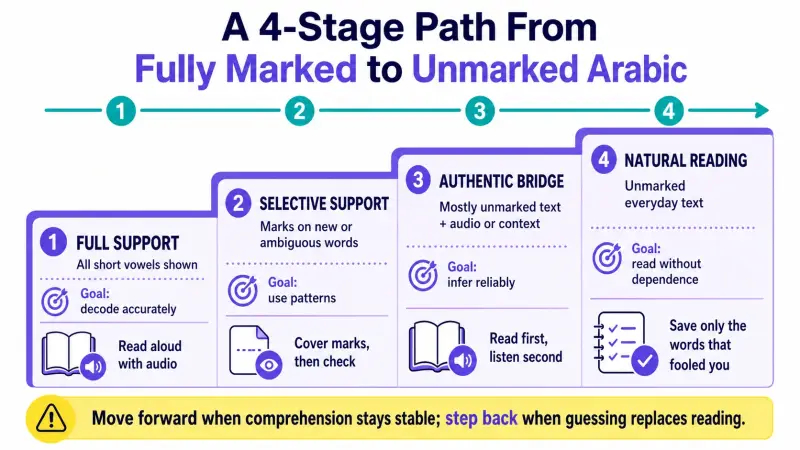
Everything above stacks into a sequence. The plan has four stages, and they are ordered steps, not a ranking: each stage assumes the skills of the one before it, so the question is which stage you are in now, not which one sounds best. The table lays out what to read and practice at each stage, and the questions after it cover what learners usually ask mid-transition.
| Stage | What you read | How much is marked | What you practice |
|---|---|---|---|
| Stage 1: Full marks | Alphabet course and early textbook chapters | Everything | Learning what each mark does; reading aloud accurately |
| Stage 2: Marked new, bare familiar | Later textbook units, level 1-3 graded readers | New vocabulary marked, known words bare | Recognizing frequent words as shapes |
| Stage 3: Partial vocalization | Intermediate readers, level 4-6 graded stories | Only ambiguous items marked | Predicting vowels from root and pattern, then checking |
| Stage 4: Unmarked with support | HelloTalk Moments, chat, then short articles | Almost nothing | Guess, verify with translation or a partner, move on |
Move up one stage when the current one stops producing surprises. Sliding back for hard material is normal. Even advanced readers take poetry fully marked.
Do native speakers ever use the marks themselves?
Yes, in specific places. Full marking is standard in the Quran, dictionaries, children's books, and poetry, and writers drop in a single mark to stop a misreading. Everyday adult prose stays bare.
Should I skip diacritics from day one instead?
Skipping them entirely removes the feedback that tells you whether your reading of a new word is right. Keep the scaffolding until the structure stands; just do not keep it forever.
How long does the transition take?
It tracks vocabulary size and reading volume, not months studied, so timelines vary widely. That is why the staged plan is defined by ability signs, not dates.
Do Arabic dialects use short vowel marks differently?
Dialect writing is informal and usually bare, and spelling habits vary from writer to writer. Learner-focused publishers like Lingualism spell out their own tashkeel choices precisely because written dialect has no single standard.
Can HelloTalk show me how an unmarked word sounds?
HelloTalk's chat tools include transliteration and read-aloud support, so you can see a romanized version or hear a message spoken. Use that to check a guess, not to replace building your own pattern knowledge.
The marks were never the destination. They were the map you used until the streets got familiar, and when your resources start taking them away, that is the course working. If you want real unmarked Arabic arriving in friendly two-sentence doses, with native speakers around to ask about the odd word, start on HelloTalk.