
An Eight-Week Thai Speaking and Listening Plan You Can Adjust

If you want eight weeks of Thai that end in real speech, run one beginner course, turn each week's lesson into one short recording, and keep every week finishable alone. You need another person at one point: to hear whether your words were understood, and to get an answer you did not script. HelloTalk serves that step: you send the week's short voice message in a chat and ask one question a partner can genuinely answer.
The gap is this: your own recording sounds fine to you, and you still cannot tell which word a listener caught. Sending that message is part of each week's work; when someone replies is not yours to control, so every week below also names what to do while that task stays open.
Choose One Main Course and See How the Eight Weeks Fit Together
Stacking resources is what makes a weekly plan hard to finish. If you run an app, a podcast and a textbook at the same time, each one introduces phrases the others never repeat, and your review load grows faster than your repetition. One main course plus one place to use it keeps the material small enough that week 6 can still be built on week 3.
This plan is written against ThaiPod101's Level 1.1 Can Do Thai for Absolute Beginners, whose published lesson catalogue covers greetings, introductions, where you are from, occupation, well-being, clarification, asking for a word, and hobbies. This plan spreads those tasks across eight weeks rather than one per week: week 2 combines two of them, week 7 revisits week 2 material, and week 8 adds no new topic so that time goes to review. If you have not chosen a course yet, a side-by-side look at Thai learning apps narrows the field, and the beginner plan for your first day of Thai covers the steps that come before a weekly schedule makes sense.
Two other beginner courses are worth a quick look before you commit, because the difference that matters is how you prefer to take in new material. Read the table by your own starting point, pick one row, then treat that row as your only material source for the eight weeks.
| Main course option | What its published materials cover | What this plan still asks of you | Where a HelloTalk exchange fits |
|---|---|---|---|
| ThaiPod101 Level 1.1 Can Do Thai for Absolute Beginners (used below) | Task lessons with audio and video on eight everyday topics | Choose one lesson per week and record your own version | Send the week's short recording in a HelloTalk chat and ask one question the person can answer from their own day, because a lesson replies the same way every time |
| Pimsleur Thai | Portable audio lessons in standard central Thai | Write your own notes for the sentences you plan to reuse | Try one audio phrase in a HelloTalk chat, since a partner may phrase the answer differently from the recording |
| Learn Thai From A White Guy | Script and tones, core sentence patterns, dialogues | Decide how much daily speaking you add on top | Ask one HelloTalk partner about a word from a dialogue, because course dialogues are fixed and people vary their wording |
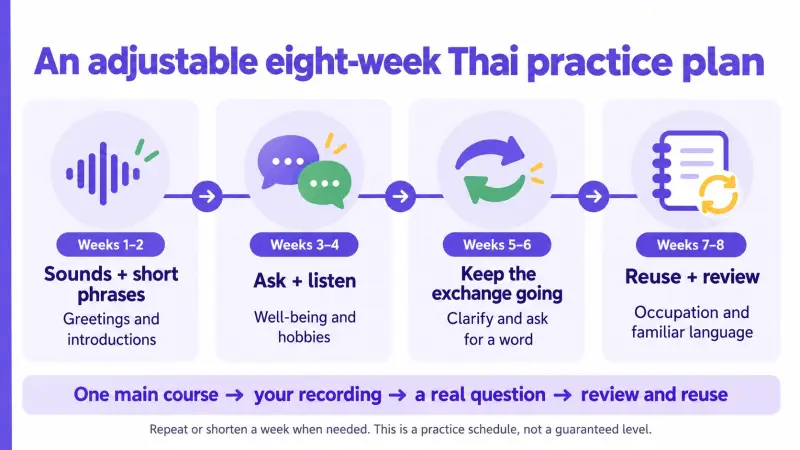
Here is the whole arc, so you can see where each week sits. The eight weeks run as four two-week blocks in order: sounds with short phrases, asking and listening, keeping an exchange going, and reusing language in new situations. Mark the week you are on, then read that week's full section before starting it, since this table deliberately leaves out the exchange and the check.
| Week | Course lesson | What you produce alone |
|---|---|---|
| 1 | Basic greetings | One kept recording of the greeting |
| 2 | Introduce yourself, say where you are from | A 20-second self-introduction |
| 3 | Ask about well-being | A recorded question plus one line in your notes |
| 4 | Talk about hobbies | A 30-second hobby description reusing that line |
| 5 | Ask for clarification | A two-turn mini dialogue with yourself |
| 6 | Ask for a word in Thai | One new word built into a sentence |
| 7 | Talk about your occupation, plus week 2 material | Two versions of your introduction |
| 8 | Review of weeks 1 to 7 | A combined recording and a repeat list |
Every week below has the same four parts: input from the course, something you produce alone, one HelloTalk exchange that puts that week's material in front of a person, and a self-check you can rewrite. The mapping of lessons to weeks is a practice schedule built on top of a catalogue that exists, not that provider's official eight-week program and not a sequence proven best for everyone. An eight-week schedule can produce eight weeks of recordings, notes and review, not a fixed level of Thai. Lengths, counts and checks here are planning suggestions, and the daily time assumed is roughly 25 to 40 minutes.
Weeks 1 and 2: Connect Thai Sounds With Short, Useful Phrases
These two weeks pair sound work with phrases you intend to say, so the greeting and introduction lessons carry the tone practice rather than a separate drill list.
Week 1: The greeting, and what tone practice is for
The goal is one greeting you can say without reading it, matched as closely as you can to the lesson audio. Take the "How to Use Basic Greetings" lesson from Level 1.1, record the greeting a few times across the week, compare each take with the lesson recording, and keep the one that matches best. Your week 1 recording tests that greeting, not every tone in the language.
Alongside it, one labelled contrast explains why the comparison matters. Thai has five tones, and one romanized syllable can carry different meanings: มา (maa) is "come" with a mid tone, ม้า (máa) is "horse" with a high tone, and หมา (mǎa) is "dog" with a rising tone. Those three words come from a tone reference rather than from the greetings lesson, so use them as an illustration. If the contrast still sounds flat to you, a beginner walkthrough of the five Thai tones is a reasonable extra read this week.
The exchange task is small on purpose. Send one HelloTalk voice message of about 10 to 15 seconds containing just the greeting, and add a line of text in a language you share asking which greeting they would use at that hour where they live, because that gives you an answer about their day rather than a verdict on you. HelloTalk's help pages describe recording by tapping the microphone icon to the right of the input box in a chat.
If you want feedback, ask permission first and keep it to one thing: was any word unclear? Offer to answer their questions in the language they are learning so the exchange runs both ways. The week 1 check, which you can make easier: can you say the greeting without replaying the audio first? If not, carry the drill into week 2 rather than pausing the schedule.
Week 2: Say who you are and where you are from
Week 2 turns sound work into two sentences you will reuse for the rest of the plan. Use the "How to Introduce Yourself" and "How to Say Where You're From" lessons, write both sentences in your notes in the Thai script your course shows, with whatever romanization that course uses consistently, and record a self-introduction of about 20 seconds. Romanization such as maa, máa and mǎa is a note-taking aid; the Thai script and your course audio are what you check pronunciation against.
Send that self-introduction to a HelloTalk partner and ask where they are from, which is a question anyone can answer and which hands you the same pattern spoken naturally. If they are willing to add feedback, keep the request to which word was unclear, since a listener can tell you whether your name and your city came through and your own replay cannot. HelloTalk's correction tool works on text in chats and Moments, so typing the same sentence under the voice message gives a partner something they can mark up.
If no one answers this week, the lesson's model introduction is your second voice: record the model version, then your own, and compare where they differ. The check: can you say both sentences without reading them? If not, re-record and keep week 2 material running under week 3.
Weeks 3 and 4: Ask Everyday Questions and Listen to the Replies
Weeks 1 and 2 gave you language you fully control. The next two weeks add language you do not control, because an answer you did not script is the first unpredictable listening material in this plan.
Week 3: Ask how someone is, then work through the answer
Use the "How to Ask About Well-Being" lesson. Alone, drill the question until it comes out without reading, then record 15 to 20 seconds: your week 1 greeting, your week 2 introduction with your own name and city in place of the model's, and this week's question addressed to one person rather than to nobody in particular.
Send it in a HelloTalk chat with one short line of text under it: could you answer in a short voice message, and if it is okay, one thing only, was any word unclear? The reason to ask a person here is that a recording answers the same way every time, while a partner answers from their own day. A reply is new listening material as well as feedback: it gives you the same topic at natural speed in someone else's wording.
When an answer arrives, listen twice, once without reading and once while reading your notes, then write down one line you understood and one you did not. That written line is what you carry into week 4, which is how a phrase moves from a chat into your own speech.
If nobody answers, take the model answer from the same lesson, record both turns yourself, and reuse that line in week 4 instead. The check, which you can soften: can you produce the question from memory twice, and did one new line reach your notes? If you were still reading your script aloud, run the same task again next week.
Week 4: Hobbies, and listening to a longer answer
The "How to Talk About Your Hobbies" lesson gives you a topic long enough to need real listening. Alone, prepare about 30 seconds on one thing you do most weeks, and build in the line you wrote down in week 3, whether it came from a reply or from the lesson model.
Then ask a HelloTalk partner what they do on a day off, and ask whether they would reply with a short voice message rather than text, because that person answers from their own weekend in their own wording, which a fixed recording cannot do. Offer to answer the same question in their target language so the trade is even.
If no voice reply comes, the lesson's own dialogue audio keeps the solo listening task running, though it does not stand in for an actual exchange: play it, write down every word you recognize, and compare that list with your script. The check: can you pick out two or more studied words in whatever audio you listened to? If you caught almost nothing, replay the same audio and list the unfamiliar words before adding any new material.
Weeks 5 and 6: Keep an Exchange Going When the Reply Is Unexpected
At some point an answer contains something you did not plan for, and the exchange either continues in Thai or switches to English. These two weeks build the two moves that keep it going.
Week 5: Clarify instead of switching to English
Take the "How to Ask for Clarification" lesson and drill the phrase until you can produce it without composing it word by word. Alone, record a two-turn mini dialogue: your question, then your clarification phrase placed where a confusing reply would be.
The exchange task is to use that phrase for real the next time a HelloTalk reply contains something you missed, instead of looking the word up quietly and moving on. A chat gives you time to produce the phrase before you answer, and the partner's second attempt may be slower or reworded, which is the listening half of the task.
With no exchange this week, the lesson audio stands in: play one line, pause, say the clarification phrase, then play the line again and see how much more you catch. The check: could you produce the phrase without writing it out first? If you drafted it in English first, repeat the drill with a shorter version.
Week 6: Ask for a word, then send it back in a sentence
Open the "How to Ask for a Word in Thai" lesson and start by listing five things you wanted to say in weeks 4 and 5 and had no word for. Alone, write the asking-for-a-word question and your five candidates, then revisit the hobbies lesson to see which of them the course already gives you.
Ask one HelloTalk partner what a single one of those things is called in Thai, and include a photo or a short description so they can give you the word that fits your situation rather than a dictionary entry. Build the word into a short sentence and send it back as a voice message, because the same person can then see whether you used it the way they meant, which is the reason to close the loop instead of just saving the word.
If no answer comes, pull a word from the hobbies lesson and build the same sentence, or post the written version to Moments, where HelloTalk supports text corrections and a reader may mark it up, though nobody is obliged to. The check: can you rebuild last week's hobby sentence with one new word inside it? If the new word never reached your speech, repeat week 6 on the same topic rather than adding another.
Weeks 7 and 8: Reuse Familiar Language in New Situations
The last block adds one new topic and spends most of its time on material you already have, because the question now is whether language that works with a familiar partner still works when the situation changes.
Week 7: Occupation, and the same introduction with someone new
Week 7 adds the "How to Talk About Your Occupation" lesson and replays your week 2 material. Alone, record one occupation sentence, then record your introduction twice for two different situations, for example to a shopkeeper and to a new chat partner, and note which words changed between them.
Then open a HelloTalk chat with someone you have not spoken to before, lead with that introduction plus one question about their work day, since a partner with no history with you shows whether your phrases carry without a familiar listener filling in gaps. Keep it to one person rather than copying the same message around.
If no new chat starts, use the occupation lesson's model answer as the second turn and record the exchange yourself. The check: if a reply came, did it address the question you asked, which tells you more than praise does; if none came, can you switch between your two introduction versions without reading?
Week 8: Review, compare recordings, and choose week 9
No new lesson topic this week. Re-record your week 1 greeting and your week 2 introduction, play them next to the first takes, and count how many saved lines you actually reused across weeks 3 to 7.
For the exchange, send one HelloTalk voice message with your greeting, your introduction and one real question. Save the clarification phrase for the moment it is actually needed: if a reply comes back with something you do not follow, use it there in the same chat. If the person agrees to add feedback, keep it to one limited question, was any part unclear, and whichever part they name becomes your first repetition in week 9.
With no reply, compare your week 8 recording against your week 1 and week 2 takes and against the lesson audio, and pick the sentence you still read off the page. The check that decides week 9 is a list rather than a level: which tasks can you now finish without a script, and which ones still need the page in front of you?
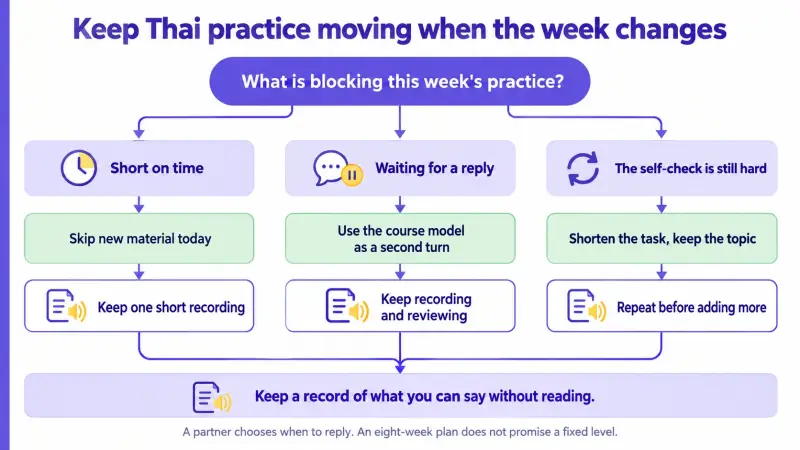
Adjust the Plan When You Need More Review, Have Less Time, or Are Waiting for a Reply
Weeks rarely run clean. The table below covers four situations this schedule has to survive. Find your row, cut what it says to cut, and keep the listed minimum so the week still ends with something you produced.
| Situation | Cut | Keep at minimum | Effect on the plan |
|---|---|---|---|
| Under 20 minutes today | The new lesson | One short recording of this week's phrase | The week runs a day longer, order unchanged |
| No reply after several days | Waiting as an activity | The course model answer as your second turn, plus one written sentence posted to Moments, where HelloTalk supports text corrections so a reader can mark it up | Solo output and input stay on schedule |
| The week's check failed | Nothing from the topic | The same topic with a shorter task | One extra week, no new material added |
| You want to start reading script | Notes that stay romanization only | Reading in Thai script the words you already say | Reading begins inside this plan, with no second course |
Two of those rows deserve a sentence more. When a check fails twice, change the size of the task rather than the topic, since a 10-second recording of one sentence beats a 40-second one you keep postponing. When nobody answers, treat a reply as a person's choice rather than a service: keep the course input and your recordings running, and let the exchange happen whenever someone is free.
On reading, no single month is correct for everyone. Learn Thai From A White Guy builds its course around script and tones together with core sentence patterns and dialogues, which shows a script-early route is a real option, while an audio-first course leaves the timing to you. The version that fits inside this plan is to read in Thai script only the words you can already say, adding more as your spoken vocabulary grows.
Frequently Asked Questions About an Eight-Week Thai Plan
Can I reach a specific level or become fluent in eight weeks?
No schedule can promise that, and this one does not. Eight weeks of this plan can produce a set of recordings, a set of lines you reused, and a clear answer about which tasks you can finish without reading. Those are a more useful measure than a level label.
Do I need to learn Thai script before I start speaking?
Not before, and not on a fixed date. Courses exist that teach script and tones from the first lessons, and audio-first courses leave reading until later, so both routes are real. A workable middle is to read in Thai script the handful of words you already say out loud, adding more as that list grows.
What do I do in a week when nobody replies?
Keep the lesson, the recording and the review on schedule, and use that week's substitute, which is the course's own model language as your second turn. You can also post one written sentence from the same lesson to Moments, where HelloTalk's correction tool lets someone mark up text if they choose to. Your solo work for that week can be finished on schedule, while the exchange task stays open until a partner is free to answer.
How do I ask for feedback without turning a partner into an unpaid teacher?
Ask permission first and limit the request to one thing, for example whether any word was unclear. That is answerable inside a normal chat without taking over someone's evening, and it stays mutual if you also answer their questions in the language they are learning.
How do I decide whether to repeat a week or move on?
Each week ends with a check based on what you did rather than how you felt: can you produce the phrase without reading, did the answer address the question you asked, did you recognize studied words in the audio. If a check fails, repeat the same topic with a smaller task. Repeating a week costs less than reaching week 8 with nothing you can say from memory.
Can I follow this plan with a different course?
Yes. Keep the weekly shape of goal, solo output, one exchange task and one check, and swap in your course's equivalent lesson. If your course is audio-first, write your own notes for the sentences you plan to reuse, since the later weeks depend on that reuse.
Does the romanization in this article replace pronunciation practice?
No. Forms such as maa, máa and mǎa help you keep notes and talk about tones, while the sounds themselves come from your course audio and from comparing your recordings against it. The Thai script มา, ม้า and หมา stays accurate as your reading develops.
When you are ready to send one of these weekly recordings to someone who can answer it, open a chat on HelloTalk with your greeting plus one question, and keep any feedback request to a single word.