
How to Start Learning Thai: A Beginner Plan for Today

Most people who want to learn Thai spend two weeks choosing an app and the third week quitting. Thai punishes a habit carried over from Spanish or French: learning words silently and saying them out loud much later. In Thai, a word at the wrong pitch is a different word, so silent study builds in errors.
This plan is short on purpose: three steps for your first month, a named resource for each, and the five mistakes that stall almost every beginner. Step one takes twenty minutes tonight. A first tone check with a native speaker can happen the same week, and step three turns those quick checks into regular conversation from week four, which is where a language exchange like HelloTalk fits in.
Why Thai feels harder than it needs to be
The US State Department sorts languages into difficulty bands for its own diplomatic training, and Thai sits in one of the harder bands, with a full-time course scheduled to run far longer than for Spanish or French. Those schedules describe students in class with a teacher every working day, aiming at professional working proficiency, so they are not a conversion table for two evening sessions and no published figure covers self-directed learners. Stop measuring your evenings against them.
The real difficulty is narrower than that count suggests. Thai grammar is friendly: no conjugations, no genders, no plurals, no articles. You can build a correct sentence on day two. The entire difficulty of beginner Thai concentrates in two places: the five tones and the 44-consonant writing system.
Thai has five tones (mid, low, falling, high, rising). The standard illustration is the syllable maa, which means come, horse, or dog depending on pitch. Your ear and your mouth therefore need training together from week one, not after you have built a vocabulary.
Do you need to learn the Thai script
Short answer: not in month one, and yes eventually. Romanized Thai does not encode tone reliably. No transliteration standard is universal, so the same word appears as krap, khrap, and kráp across three sources, and none of those spellings tells you the pitch.
The practical order: four weeks on spoken Thai and tone recognition, then start the script in month two while you keep speaking. The 44 consonants sort into three classes, and those classes determine tone in writing, so the script is not a separate chore. Learning the Thai writing system is the fastest way to stop guessing at tones, because the tone is encoded in the spelling itself. One exception: if your goal is a two-week holiday and a few polite phrases, skip it.
A three-step roadmap for your first month
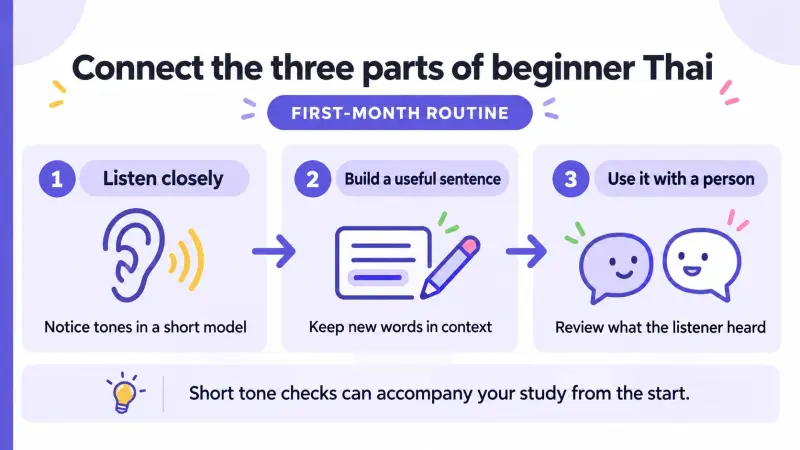
The three steps below add load gradually: ear training first, then vocabulary inside sentences, then regular conversation. They are not a rule that you stay silent for three weeks. From day one you can record a few words and send the clip to a native speaker for a quick tone check, which is a small enough request to answer in a couple of minutes and does not require you to hold a conversation. Whether a particular partner answers quickly, or at all, is up to them, so send it to two or three people rather than one. What changes in week four is the size of the task: from short tone checks to full exchanges three times a week.
Step 1, week 1: train your ear before your mouth (20 minutes a day)
Listen to one short dialogue repeatedly and do nothing but identify tones. Ignore meaning. Pick five common words and learn to hear their tones apart with your eyes closed. Tone discrimination improves faster when you practice it directly rather than as a side effect of vocabulary work. Record those five words yourself at the end of the week and send the clip for a tone check, as described in the feedback section below.
Step 2, weeks 2 and 3: build 100 words inside sentences (25 minutes a day)
Never learn a Thai word in isolation. Learn it inside a full sentence you could say, with the tone marked. One hundred words handled this way covers greetings, numbers, ordering food, directions, and basic questions. With no conjugation, one pattern generates dozens of sentences the moment you swap a word. Keep sending a short recorded sentence or two for a tone check each week; the point is that a person hears you before the sentences pile up.
Step 3, week 4 onward: speak to a person and get corrected (three sessions a week)
By week four you have a hundred words you have already practised inside sentence patterns, which is enough material to keep a short exchange moving, so the brief tone checks of the first three weeks become 15-minute exchanges three times a week. Postponing this step is the biggest cause of stalled Thai. You can be confident about a tone and wrong about it, and solo practice will never tell you which. A native speaker hears the error in one syllable. The week-by-week speaking schedule for new Thai learners lays out what to say in each session.
If you want the version organised by week rather than by step, and a check for which week you are actually in, see our week by week Thai speaking plan.
Named resources for each of the three steps
Most beginner Thai advice describes the steps but names no tools. Here is what to open for each, with a note on where each one stops.
| Step | Named resources | Where they stop |
|---|---|---|
| Step 1: ear training and tones | ThaiPod101 beginner audio, Pimsleur Thai, Learn Thai From A White Guy tone drills | Strong input. None hears you back or checks whether your tone landed |
| Step 2: 100 words in sentences | Ling, Write It Thai (script, month two), StudyThai and Language Life vocabulary sets | Good drilling and spaced repetition. Output is typed, not spoken |
| Step 3: speaking and correction | HelloTalk for native-speaker chat and voice (short tone checks from day one, full exchanges from week 4), italki for paid structured lessons, Lingbe for short voice calls | Use the same tone or sentence pattern across the lesson, HelloTalk practice, feedback review, and the next attempt |
The language-specific sites deserve credit. ThaiPod101, Ling, and Write It Thai are genuinely good: accurate tone explanations, native-recorded audio, and in Write It Thai's case, better coverage of the 44 consonants than general apps attempt. The comparison of Thai learning apps by feature has more.
They share one blank spot. A recorded Thai lesson, however accurate, cannot hear the tone you produced, and the only way to find out whether it landed is a listener reacting to your own recording. Pimsleur is the clearest case: its audio-first method trains your ear, and its recordings cannot check whether the sound you produced matched the one you heard.
The HelloTalk platform covers that gap by connecting learners with native speakers rather than teaching a curriculum, which makes it the wrong choice for the ear-training drills of step 1 and the right choice for the quick tone checks along the way and the conversations of step 3.
Five mistakes that stall Thai beginners
Mistake 1: treating tones as an accent detail. Beginners decide to fix tones later and chase vocabulary first. Tone is part of the word, the way b is part of bat. Five hundred words with unreliable tones means learning them twice.
Mistake 2: relying on romanization past month two. Useful crutch in week one, liability by month three. Because no transliteration standard is universal, you end up memorizing spellings that contradict each other while learning nothing about pitch.
Mistake 3: studying silently. Reading and tapping feel like progress and build almost no speaking ability in a tonal language. Say every sentence out loud.
Mistake 4: skipping the polite particles. Khrap and kha at the end of a sentence are not decoration; dropping them sounds abrupt.
Mistake 5: waiting to feel ready before talking to a native speaker. If you spend three months on apps before anyone hears you, you have no way of knowing whether the rising tone you have been practicing has been a falling tone all along. The earliest possible correction is the cheapest correction, because every week of unchecked practice makes a wrong tone harder to unlearn.
Getting tone feedback from day one
Tone feedback means a native speaker hears you and tells you what was off. On day one the task is small: record the five words from step one, or a single greeting, and ask a native speaker which tones were off. That is a small favor rather than a conversation, and it is the version of speaking that fits weeks one to three. Two routes work for it and for the fuller sessions later: paid lessons, effective but infrequent, or a language exchange, which gives far more repetitions.
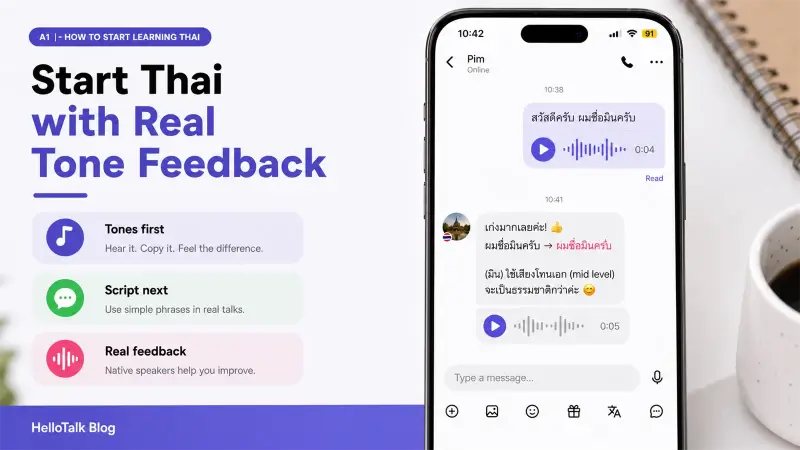
HelloTalk's chat-based learning is built around that loop. You send text or voice to a native Thai speaker, and the tools sit inside the conversation: in-chat translation lets you check a word without leaving the thread, and in-chat correction lets your partner mark up your sentence so the fix appears beside your original. That layer matters more in Thai than in most languages, because a partner can flag one syllable instead of saying your accent is generally off.
HelloTalk's Moments feed is a low-pressure place to post a short Thai sentence or voice clip and collect corrections from several native speakers at once, useful when you suspect one correction was personal preference. HelloTalk's Voicerooms and Livestreams add group audio at native speed.
The AI learning tools cover the hours when no partner is awake. HelloTalk's AI pronunciation scoring is especially relevant for a tonal language, since it reads whether your pitch contour landed near the target. For the mechanics of each tone, the beginner guide to the five Thai tones is the place to start.
HelloTalk reports 70M+ registered users across 200+ countries studying 260+ languages, with over 1 billion messages sent daily and 90% of core features free, so sending that first clip does not wait on a budget or a booked lesson.
Common questions about learning Thai
How long does it take to learn Thai?
There is no verified figure for everyday conversational comfort. The closest reference point is US State Department diplomatic training, which schedules Thai as one of its longer full-time courses and aims at professional working proficiency, which is a different goal. For a self-learner practicing 20 to 30 minutes a day, progress tracks how early tone feedback starts, so count weeks of corrected speaking rather than months of study.
Is Thai harder than Chinese or Vietnamese?
Thai has five tones, Mandarin four, Vietnamese six, so the tonal load is comparable. Thai grammar is simpler than Mandarin's and has no conjugation. The script is harder to start than Vietnamese's Latin alphabet but easier than Chinese characters, since it is phonetic once you know the classes.
Can I learn Thai without learning the script?
You can reach basic conversational ability without it, then you hit a ceiling: romanization does not encode tone consistently, and you lose access to menus and signs.
Do I need a teacher, or is a language exchange enough?
Build one plan that connects lessons, speaking practice, and correction. Study a tone or sentence pattern, use it with a HelloTalk partner, review the feedback alongside the lesson, and repeat the task. Keep each activity tied to the same weekly objective.
What should I learn in my very first week?
Greetings with the polite particles, numbers one to ten, "how much is this," "I want," "delicious," and "I don't understand." Learn each as a full sentence said out loud, and spend part of every session listening for tone differences.
Tone feedback is the whole bottleneck
Strip this plan to one idea: Thai beginners fail at output, not input. Input is abundant and mostly good. ThaiPod101, Ling, Write It Thai, and Pimsleur all teach accurate tones, and none can tell you whether the tone you produced was the one you intended. That missing loop is where months get lost.
So build your first month around closing it. Train your ear in week one and get a first tone check the same week, learn a hundred words inside sentences in weeks two and three while the checks continue, and move to regular conversations with native speakers by week four. The Thai learning hub for new speakers is a reasonable place to line up a partner, and HelloTalk's free core features mean the speaking step does not wait on a budget.
Say one sentence in Thai to a native speaker tonight and let them tell you what was wrong with it.