Which Finnish Pronunciation Resources Teach Long and Short Sounds Clearly?
You want to tell a Finnish friend "I'll meet you tomorrow." You type it fine. Then you say it out loud, shave one vowel a little short, and tapaan turns into tapan, which means "I kill." Nothing about Finnish grammar caused that. Sound length did.
In Finnish, length changes meaning: tuli means fire, tuuli means wind, and tulli means customs, and the three words are separated only by which letter is doubled. The writing system is at least honest about it. Finnish spelling marks length directly: a single letter is a short sound and a doubled letter is a long sound, in vowels and consonants alike. So the task is not decoding hidden rules. It is training your ear and mouth to treat length as information, and choosing resources that actually train that.
What to Check in a Resource Before Trusting Its Length-Contrast Teaching
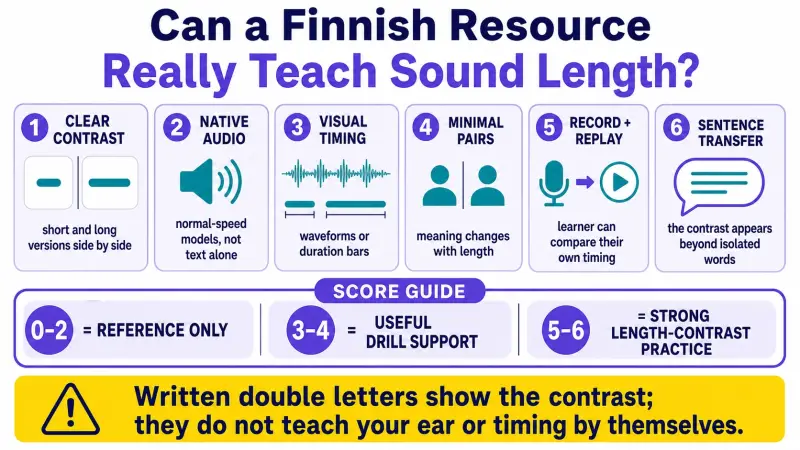
Plenty of Finnish resources spend one paragraph on long and short sounds and move on. Before you give any of them your hours, run four quick checks.
First: does it cover both tracks? Vowel length and consonant length work independently in Finnish, so a word can double the vowel, the consonant, both, or neither. A resource that only drills long vowels leaves the geminate consonants, pairs like kuka and kukka, completely untrained.
Second: does it separate length from stress? Finnish stress always falls on the first syllable, so a stressed syllable can hold a short vowel and an unstressed syllable can hold a long one. English ears hear "long" as "stressed," and a good resource attacks that habit head on. Standard descriptions of Finnish phonology make the same point: the eight vowels and the length system run independently of stress.
Third: does every audio model come with the written word beside it? Spelling encodes length, so seeing tuuli while hearing tuuli is what wires the connection.
Fourth: does it push you from single words into sentences? Length errors that disappear in slow word-by-word practice come straight back at sentence speed. And if you are still assembling your broader toolkit, the parent guide to Finnish courses, apps, official resources, tutors, and conversation practice by goal covers the full picture; this page stays on the length problem.
Comparing Named Resources on Vowel and Consonant Length Models
With those four checks in hand, the differences between named resources get concrete. Each one below covers a different piece of length training, and the table compares them on what actually matters: what they model, whether your own voice is involved, and what to use them for. Find the row that matches your current gap.
| Resource | What it models | Involves your own voice? | Best used for |
|---|---|---|---|
| Uusi kielemme | Word lists built around length contrasts: tuli, tulli, tuuli, tyyli and beyond | No | Knowing exactly which pairs to drill |
| A Taste of Finnish | Dialogues with native recordings across 10 free chapters from the University of Helsinki | No | Hearing length inside natural beginner dialogues |
| Forvo | Individual words recorded by native speakers, often by more than one voice | No | Checking one specific word's length pattern |
| Yle Selkouutiset | Slow, clearly read news in easy Finnish with matching text | No | Sentence-speed listening with spelling in view |
| Duolingo Finnish | Audio exercises tied to a gamified course, available since 2020 | Partly | Daily low-effort exposure to spoken forms |
| HelloTalk | Voice messages, read-aloud playback, and AI pronunciation tools inside real chats | Yes | Producing length in full sentences a human will hear |
Look down the third column. Almost every resource models length for you. Almost none of them listens to you. That gap is what the next two sections fix.
Recording and Feedback Features: Hearing Your Own Short-Long Errors
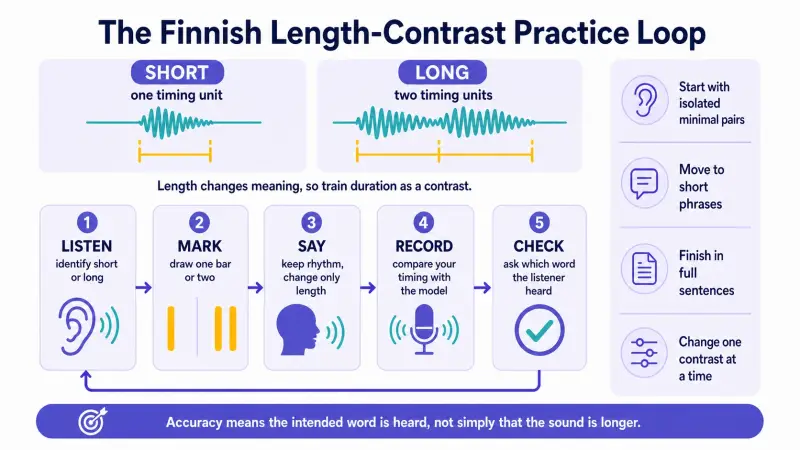
Listening to perfect models has a ceiling, because the errors live in your own mouth, and you cannot fix a vowel you have never heard yourself shorten. The cheapest fix is a plain record-and-compare loop: record yourself reading a contrast pair, play a native model of the same words from Forvo or a course dialogue, and listen only for length, not accent. The first comparison usually stings a little. The "long" vowel you were sure you produced turns out barely longer than the short one.
Record these pairs first: tuli and tuuli, mato and matto, kuka and kukka, and the pair with real social stakes, tapaan and tapan. Learner guides to Finnish minimal pairs keep coming back to the same short list, because these are the contrasts that flip meaning hardest when you miss them.
Automated scoring adds a second layer. HelloTalk's AI pronunciation tool scores a recording and names the specific sounds that missed, instead of returning one pass-or-fail number, which suits length work exactly: the error is usually one segment inside an otherwise fine sentence. If you have already built a record-compare habit for a different sound system, it transfers straight across; the companion piece on pronunciation tools for English speakers learning Arabic runs the same loop against a very different set of contrasts.
Practicing Length Contrasts in Full Sentences With HelloTalk Voice Messages
Word-level drilling stabilizes the contrast. Then a real sentence arrives, speed and rhythm and grammar all pulling at your attention, and the long vowel you nailed in isolation quietly collapses. This is the specific gap HelloTalk fills in a length stack.
HelloTalk's voice messages let you record a full Finnish sentence inside an actual conversation, and because HelloTalk's chat keeps the written sentence right next to the audio, whoever listens can check your length against the spelling word by word. HelloTalk's read-aloud support closes the loop from the input side: tap a partner's written sentence and HelloTalk plays it back, so you hear how tuuli behaves inside a sentence a real person just typed to you. HelloTalk's built-in translation and correction tools sit in the same chat, so a misheard word gets sorted without switching apps. Scale matters here too: HelloTalk carries exchanges across 260+ languages with over 1 billion messages daily, and with 90% of core features free, the whole voice-message loop above costs nothing to run.
Two smaller HelloTalk features serve the same purpose. Posting a recorded sentence to HelloTalk's Moments feed puts it in front of several native speakers who may comment, and HelloTalk's Voicerooms let you sit in live group audio as a listener, absorbing sentence-speed Finnish rhythm before you ever speak in one. HelloTalk received a 2024 global Google Play homepage feature, but the honest framing stays what the table said: HelloTalk's voice messages, read-aloud playback, and pronunciation tools are the sentence-level practice resource you use after a course has taught the contrast, not a replacement for the course.
Using a Finnish-Speaking Partner to Check Which Word They Actually Heard
Tools can score your audio. Only a human can answer the question that matters: which word did you actually say? A Finnish-speaking partner is a separate resource from any platform, and their piece of length training is one simple intelligibility check.
The whole protocol takes a minute. Send a voice message with one member of a minimal pair inside a short natural sentence, "Tapaan sinut huomenna kahvilassa," and ask your partner to type back the single word they heard. Do not tell them which word you meant. If they type tapaan, your long vowel landed. If they type tapan, you have found exactly which segment to drill this week, and that beats any score.
Two boundaries keep this honest. A partner is a listener doing you a favor, not a professional correction service, so treat their report as a check they were kind enough to run. And one partner's answer is evidence about how one speaker heard one recording, not a rule of Finnish; if a second listener hears it differently, that spread is itself useful information. The same partner-as-verifier idea, applied to feedback on whole spoken sentences rather than single contrasts, is worked through in the piece on speaking resources that give sentence-level feedback.
A Minimal-Pair Routine That Combines a Drill Resource With Real Audio
None of the above compounds unless it repeats, because length perception is a habit, not a fact you learn once. The routine below turns the resources from this comparison into a four-step weekly cycle. The steps run in order, not by importance: pick targets, hear models, produce sentences, verify. Each step feeds the next, and the whole cycle fits inside an ordinary week.
Here is the cycle laid out with the resource each step uses, so you never have to re-decide anything mid-week.
| Step | What you do | Resource | Rough time |
|---|---|---|---|
| 1. Pick targets | Choose 3-5 contrast pairs for the week | Uusi kielemme word lists | 5 minutes, once |
| 2. Hear models | Listen to each word, then find it at sentence speed | Forvo, then Yle Selkouutiset | 10 minutes, 2-3 times |
| 3. Produce sentences | Record each pair inside a short sentence as a voice message | HelloTalk voice messages | 10 minutes, 2-3 times |
| 4. Verify | Ask a partner which word they heard; re-record any misses | Finnish-speaking partner | 5 minutes, once or twice |
Step 2 is where real audio earns its slot: hearing your target pair read slowly and clearly inside actual news sentences is what turns drill knowledge into listening reflex. Step 4 closes the loop, because a miss reported by a real listener tells you precisely what next week's step 1 should target.
How long should one length-practice session be?
Short and frequent beats long and rare. The routine runs on 10-minute blocks a few times a week, and that is enough because each block only carries 3-5 pairs.
Should I learn vowel length before consonant length?
Neither goes first. They are independent tracks, so drill one vowel pair and one consonant pair in the same week. Keeping both active avoids the common trap of clean long vowels sitting next to collapsed double consonants.
Can I trust Finnish spelling to tell me the length?
Yes. A doubled letter is a long sound and a single letter is a short one, in vowels and consonants alike, which is why every drill in this routine keeps the written word visible next to the audio.
What if my partner hears a different word than I intended?
Then the routine is working. Take the report as one listener's ear on one recording, re-record the sentence with the length difference exaggerated, and send it again. The gap between your two attempts teaches more than either one alone.
Is there one free resource that covers both hearing and producing length?
Not really, and that is why the routine combines them. A Taste of Finnish and Yle Selkouutiset cover the hearing side free of charge; producing and verifying need a recording tool and a listener, which is the HelloTalk voice message plus partner pairing described above.
Length is the smallest habit with the biggest payoff in Finnish, and the verification step needs a real listener. You can find Finnish-speaking partners and start the voice-message loop today at HelloTalk.