
British or American Pronunciation Which One Should English Learners Use
If you are choosing between British and American pronunciation, use the variety you hear and expect to use most. Make it your main speaking model, but continue listening to other English accents. Neither variety is more correct or more professional. The best choice is the one that fits your environment and gives you enough reliable input and speaking practice.
Many learners diagnose the wrong problem. Saying bath with a British vowel and water with an American one may sound mixed, but rarely stops a conversation. Unclear consonants, misplaced stress, or speed are more likely to cause misunderstanding.
Below, compare the differences learners notice most, decide which model fits your goals, and test whether real listeners understand you.
The British and American Pronunciation Differences You Can Hear
“British” and “American” each include many regional accents. The table uses two common learning models found in courses, dictionaries, and media. Use the IPA to see what changes, then confirm it by listening.
| Word | UK model | US model | What to listen for and practise |
|---|---|---|---|
| water | /ˈwɔː.tə r/ | /ˈwɑː.t̬ɚ/ | The US middle consonant is often a quick flap /t̬/, and the final r is heard. In the UK model, listen for a clearer /t/ and no final /r/. |
| car | /kɑː(r)/ | /kɑːr/ | The main contrast is the final r. Copy one model in a phrase such as “park the car.” |
| bath | /bɑːθ/ | /bæθ/ | The UK example uses the long vowel in father; the US example uses the vowel in cat. Both are standard forms. |
| schedule | /ˈʃedʒ.uːl/ | /ˈskedʒ.uːl/ | The opening sound changes from /ʃ/ to /sk/. The first syllable carries the main stress in both examples. |
| hot | /hɒt/ | /hɑːt/ | The vowel quality changes. Similar contrasts appear in the same vowel group, although regional accents vary. |
| tune | /tjuːn/ | /tuːn/ | The common UK model keeps a /j/ sound after /t/, like the start of you. The common US model usually moves directly from /t/ to /uː/. |
| tomato | /təˈmɑː.təʊ/ | /təˈmeɪ.t̬oʊ/ | The stressed and final vowels differ, and the US middle /t/ may become a flap. Learn the whole word rather than one sound. |
| advertisement | /ədˈvɜː.tɪs.mənt/ | /ˌæd.vɚˈtaɪz.mənt/ | The main stress and middle syllables differ, showing why some words must be learned as complete sound patterns. |
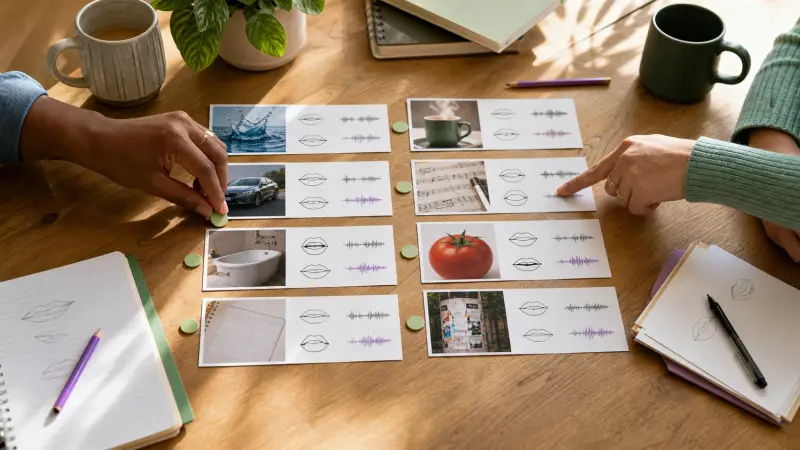
First, listen without repeating and identify the difference. Then choose one version and record the word in a short phrase. Ask: “Did I produce the feature I chose, and could another listener identify the word immediately?”
IPA shows what changes, but does not replace listening. Focus on one contrast at a time: final r in car, the vowel in bath, the first sound in schedule, or the middle sounds in water.
Five Differences That Matter Most in Practice
1. The r sound. In a common American model, the r in car, teacher, first, and turn is pronounced. In a common standard British model, an r after a vowel is usually not heard before a pause or consonant. It may return before a following vowel, as in “far away.” Because this affects many words, it is one of the clearest differences between the two models.
2. The t between vowels. In common American speech, the middle sound in water, city, better, and meeting may become a quick flap resembling a soft d. A common British learning model keeps a more recognizable /t/, although regional speech varies. Listen to the sound inside a phrase rather than judging it from spelling.
3. Vowel choices. The vowel in bath may also differ in dance, class, ask, and after. The contrast in hot appears in not, lot, and stop. These are common patterns, not rules for every speaker. If listeners already understand your version, do not replace it simply because another exists.
4. The /j/ sound after some consonants. A common British model keeps /j/ in words such as tune, new, and student, while a common American model often drops it. This can make tune sound closer to “tyoon” or “toon.” Recognize the contrast without exaggerating it.
5. Word stress and complete word forms. Words such as advertisement and laboratory may differ in stress, reduced syllables, and rhythm. Copy the complete pattern: mark the stressed syllable, notice weaker vowels, and practise the word in a sentence.
Practise in short sentences such as “The car is outside,” “I need some water,” and “My schedule changed.” Record once slowly and once at conversation speed. If the feature disappears when you speed up, practise the phrase rather than repeating the isolated word.
Which Pronunciation Should You Learn?
Choose the column that best describes how you actually use English.
| Question | Choose British when... | Choose American when... |
|---|---|---|
| Who will you speak with most? | Your teachers, colleagues, customers, or local community mainly use UK English. | Your main contacts and community mainly use US English. |
| What do you hear every week? | Most of your courses, podcasts, news, and entertainment use British speakers. | Most of your regular media and learning materials use American speakers. |
| Are you preparing for a course or exam? | The official recordings and your teacher consistently use a British model. | The official recordings and your teacher consistently use an American model. |
| Will you use English for work or travel? | Your likely destination, team, or clients give you more British exposure. | Your likely destination, team, or clients give you more American exposure. |

If most answers fall in one column, use that variety as your main model for eight weeks. If they are divided, choose the model with the most accessible audio and partners. Either can work internationally, but keep listening to varied speakers.
For study or an exam, follow your official listening materials and teacher. For work, choose the variety used by the colleagues or customers you speak with most. For travel, keep one stable speaking model and train your ear to understand several accents. If most of your English comes from media or online lessons, choose the variety for which you can find consistent material every week.
If you are a beginner, choose one reference model for dictionaries, shadowing, and recording. This reduces decisions while you learn new sounds, but does not mean avoiding speakers with other accents.
If you already have a mixed accent, do not restart. Identify only features that change unpredictably or cause misunderstanding. You might keep your vowel in bath while making r more consistent. A mixed accent can still be clear.
If you need English for a specific environment, collect its high-frequency words. A student might choose subject and presentation language; a professional might choose product, industry, and meeting vocabulary. Check those words with the people you will actually hear instead of changing every accent feature.
Do not choose an accent because it seems more intelligent or “correct.” Choose one you can hear often, imitate consistently, and test with other people.
Your choice is not permanent. If your environment changes, adapt the words that matter rather than rebuilding your accent.
How to Diagnose and Improve Your Pronunciation
Before trying to make your accent more British or American, identify what the listener is actually struggling with.
| What happens in conversation? | Likely issue | What to fix first |
|---|---|---|
| The listener understands the sentence but notices that some words sound British and others American. | Accent mixing | Low priority. Keep one model for practice, but do not interrupt fluent speech to correct every mixed feature. |
| The listener hears a different word or cannot identify one key word. | An unclear consonant, vowel contrast, or word stress pattern | Compare that word with audio, practise it in a phrase, and test it again without showing the transcript. |
| Individual words are clear, but the listener loses part of the sentence. | Speed, weak sentence stress, or poor chunking | Mark the important words, pause between meaning groups, and record at a controlled pace. |
| The listener understands only after reading your text. | Your written answer is hiding a speaking problem | Ask the listener to hear the recording before seeing the script and report exactly where meaning was lost. |

Correct problems in this order: unrecognized words, important consonants and vowels, word or sentence stress, speed and pauses, then accent consistency. This order keeps your effort focused on problems that interrupt communication.
A Complete HelloTalk Practice Example
On HelloTalk, use a voice message and a language partner to test one pronunciation choice. Give the listener a specific task instead of asking for a general score.
1. Record this 20–40 second message without showing the text first:
After class, I checked my schedule and drove the car home. I stopped to buy a bottle of water because I had an early meeting the next morning. Before going to bed, I took a bath and recorded this message to practise my English pronunciation.
2. Send this request with your recording:
I’m practising an American pronunciation model. Could you listen once without reading the script? Please tell me which words you could not identify the first time, whether water, car, bath, and schedule matched the model, and whether I spoke too quickly. Please focus on clarity rather than whether I sound native.
Replace American with British when that is your target. You can find an English language partner whose region matches the variety you want to check.
3. Turn the reply into one change. A partner might say: “I understood the message, but schedule was unclear. Water and car sounded American. Bath sounded British, but I still understood it.” This hypothetical feedback separates a recognition problem from harmless accent mixing.
4. Record the same message again. Practise schedule in two short phrases first, then repeat the complete message without slowing every word. Do not change five features at once.
5. Check a measurable result. You improved if your partner identifies all four words on the first listen and summarizes the message without a script or replay. Save both recordings for comparison.
If you need a regular partner, use this guide to find a language exchange partner for speaking practice. For additional ways to test a recording, see these practical pronunciation-checking methods.
Frequently Asked Questions
Is British or American pronunciation easier?
Neither is easier for everyone. Choose the one you hear regularly, can practise with reliable speakers, and need in real conversations.
Which pronunciation is better for international English?
Both can work internationally. Use one as your speaking reference, but listen to different accents. Recognizable words, controlled pace, and clear emphasis matter more than a perfectly uniform accent.
Is a mixed British and American accent wrong?
No, a mixed accent is not automatically wrong. Fix it only when the variation makes a word difficult to recognize or prevents you from speaking smoothly. A British vowel in bath and an American r in car can coexist without blocking meaning.
Do I need IPA to improve my pronunciation?
No, but IPA can make differences visible. Use it to locate a changing feature, then confirm it with audio and a listener. Learn the symbols you need rather than the entire chart.
What should I correct first?
Correct whatever causes misunderstanding first. Start with words listeners misidentify, then important consonants or vowel length, stress, and speaking pace. Accent consistency comes later if the message is already clear.
Choose the pronunciation model that matches your real environment, then test it in speech rather than judging it from a label. When listeners recognize your key words on the first attempt and follow your message without a transcript, your pronunciation is doing its job.