
How to Know If Your Pronunciation Is Correct: 5 Practical Ways to Check
How do you know if your pronunciation is correct when you cannot hear yourself the way other people do? Use more than one check: compare your speech with a reliable model, record yourself, test whether speech recognition understands you, isolate difficult sound contrasts, and ask a real listener for focused feedback.
The goal is not to erase your accent. Correct pronunciation means that your words are recognisable, your stress and rhythm support the meaning, and listeners can understand you without unnecessary effort. Different regions and speakers pronounce the same language differently, so one app score or one person’s accent should not become your only standard.
Learning how to check pronunciation starts with using several forms of evidence. The five methods below turn each check into a useful next step.
What should you check in your pronunciation?
Before testing yourself, decide what “correct” means for the phrase you are practising. Use this table to choose the right first check:
| What you want to check | Question to ask | Best first method |
|---|---|---|
| Individual sounds | Are the consonants and vowels clear enough to distinguish the word? | Compare with dictionary audio or use minimal pairs |
| Word stress | Am I emphasising the correct syllable? | Listen to a reliable model and mark the stressed syllable |
| Sentence stress | Are the words carrying the main message easy to hear? | Record the full sentence and compare it with a model |
| Rhythm and intonation | Do the words connect, and do changes in pitch support the meaning? | Record a complete phrase, not isolated words |
| Comprehensibility | Can another person understand the message in context? | Ask a real listener which words were unclear |
A word can contain the right sounds but still be difficult to recognise if the stress is misplaced. Meanwhile, a speaker can have a noticeable accent and remain completely clear. The table is a starting point, not five separate tests you must complete every time. Choose the row that matches your current problem, then use real communication to confirm the result.
Compare your pronunciation with a reliable audio model
Start with a model you can replay, such as audio from a reputable learner’s dictionary or course. Check that you have selected the intended word, meaning, and regional variety. For example, British and American models may both be correct even when they sound different.
Use this four-step comparison:
- Listen without looking at the spelling.
- Notice the number of syllables and which syllable is stressed.
- Play the audio again and speak immediately after it.
- Put the word into a short sentence and repeat it at natural speed.
Do not ask only, “Do I sound exactly like the recording?” Ask more specific questions: Does my stressed syllable match? Is the final consonant audible? Does the vowel sound too short or too long? Specific questions are much easier to answer and practise.
For a phrase, copy the whole sound pattern rather than treating it as separate words. Mark the words that carry the main meaning, then imitate the pauses and pitch movement.
Record yourself, wait, and compare
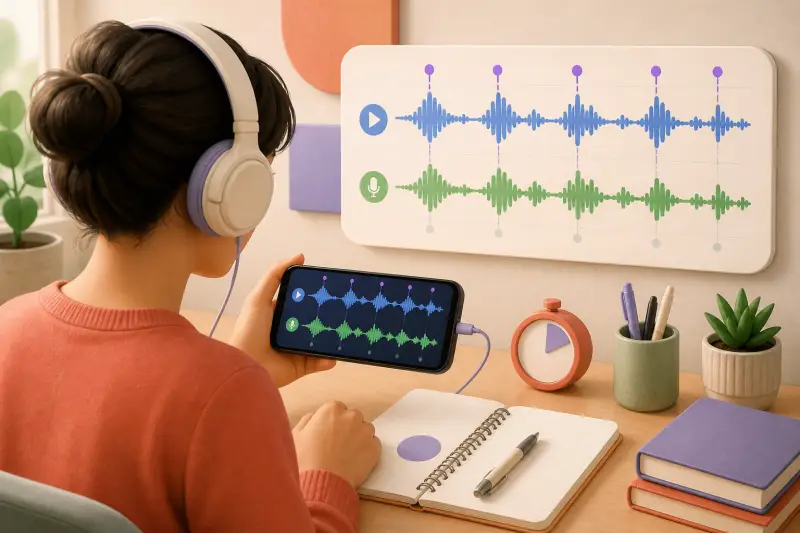
You hear your own voice partly through vibrations inside your head, so speaking and listening at the same moment can hide differences. A recording gives you distance.
Choose one short target: a word, one sentence, or a 20-second response. Record it once without stopping. Wait a few minutes, then listen with the text in front of you. Compare it with your reference audio and note only one or two differences.
Use this simple recording checklist:
- Can I identify every word without reading?
- Is the stressed syllable clear?
- Did I drop or change an important sound?
- Did I pause in a place that interrupts the meaning?
- Does the sentence sound more natural on my second attempt?
Save a first attempt and a later attempt with the date. Look for a change you can hear: a clearer contrast, more stable stress, or fewer hesitations.
On HelloTalk, voice messages offer a low-pressure bridge between text and live conversation. You can prepare a short message and record it again if needed. After two or three attempts, send the clearest one so that practice still leads to communication.
Use speech-to-text as a quick pronunciation test

Speech recognition can provide an immediate clue: say a word or sentence and see what the tool writes. If it repeatedly produces a different word, there may be a pronunciation contrast worth investigating.
Test it fairly:
- Find a quiet place and check that your microphone is working.
- Say a complete, natural phrase rather than shouting one isolated word.
- Repeat the phrase three times.
- Change the surrounding sentence and try again.
Suppose you say, “The ship leaves at noon,” but the transcript repeatedly shows sheep. Compare the relevant vowel sounds, practise the contrast in two short phrases, and try again.
Speech-to-text is not a final judge. Noise, microphone quality, names, speech rate, and training data can affect recognition. A tool may guess from context when one sound is unclear, or reject an understandable regional accent. Treat the transcript as a signal, then confirm it with a model or person.
Test difficult sounds with minimal pairs and sentences
A minimal pair contains two words that differ by one sound, such as ship and sheep or light and right. These pairs help you discover whether you can both hear and produce a contrast that changes meaning.
Use a three-part test:
- Listening: Play the two words in random order. Can you identify which one you hear?
- Speaking: Record the words in a random order. When you replay them later, can you tell them apart?
- Communication: Put each word in a sentence and ask a listener which word they heard.
Practise contrasts relevant to your current difficulty. If the challenge is word stress, compare words such as PHOtograph and phoTOGraphy instead of focusing only on consonants.
Then move into context. Say “The ship leaves at six” and “The sheep are in the field,” not just “ship, sheep” 30 times. This shows whether the contrast remains clear at normal speed.
Ask a real person whether they understand you

The most useful pronunciation question is often not “Is my accent correct?” but “Which word was difficult to understand?” A real listener can tell you whether your speech remains clear at a natural pace and in a real context.
Ask for specific feedback. You could send a short voice message to a language partner and write:
I’m practising the difference between “ship” and “sheep.” Which word do you hear in each sentence?
Or try:
Could you listen to this 20-second message and tell me one word that is unclear? Please also say the sentence naturally so I can compare.
On HelloTalk, you can look for a language exchange partner who shares your interests and fits your learning goals, then move from text to voice messages or calls. You can also join a Voice Room to listen to different speakers and, when a relevant room is available, practise in a group setting.
One listener’s preference is not a universal rule. If a correction conflicts with your dictionary model, ask whether it reflects a regional accent, casual speech, or a genuine misunderstanding. For an important word, collect feedback from two or three listeners. If several people misunderstand the same word, you have a clearer reason to practise it.
A simple pronunciation-check routine
Use the five methods as a loop rather than five separate activities:
- Choose one useful phrase for an upcoming conversation.
- Listen to a reliable model and mark the stress.
- Record your first attempt.
- Use speech-to-text or a minimal-pair test to investigate one uncertainty.
- Send the phrase in a voice message and ask one focused question.
- Listen to the feedback, record one final attempt, and reuse the phrase in conversation.
This routine can take ten minutes. The important part is that it ends with real use. Pronunciation becomes more reliable when you reuse the same phrase in different conversations.
Frequently asked questions about correct pronunciation
Can I check my pronunciation by myself?
Yes. Reference audio, recordings, speech-to-text, and minimal-pair tests can reveal many issues. For communicative pronunciation, add feedback from a real listener.
Does correct pronunciation mean sounding like a native speaker?
No. Languages have many legitimate accents. Aim for clear, consistent speech that listeners can understand. You may choose a regional model without treating every difference as an error.
Are pronunciation apps always accurate?
No. Scores can be influenced by the model, microphone, noise, and expected accent. Check an unexpected result with another method before changing your speech.
What should I ask a language partner to correct?
Ask one answerable question: which word they heard, where they had trouble understanding you, which syllable should be stressed, or how they would say the sentence naturally. Focused feedback is easier to apply than “Please correct my pronunciation.”
How often should I check my pronunciation?
Check briefly and regularly. A ten-minute loop several times a week is usually more practical than a long monthly session. Revisit the same recording after a week so you can hear whether the target sound or stress pattern is becoming consistent.
Check for understanding, not perfection
If you want to know whether your pronunciation is correct, do not depend on a single score or try to remove every trace of your accent. Compare, record, test, and communicate. When several checks point to the same issue, you have a clear practice target. When real people understand you easily, that is meaningful evidence that your pronunciation is doing its job.
Choose one sentence you expect to use this week. Record it, compare it with a reliable model, and send it to a HelloTalk language partner with one focused question. One useful piece of feedback is enough to make your next attempt better.