
How to Practice English with HelloTalk Video Calls: A Step-by-Step Guide
How to Practice English with HelloTalk Video Calls: A Step-by-Step Guide
You can know plenty of English and still freeze when someone asks you a simple question in a real conversation.
That gap is normal. Reading, vocabulary practice, pronunciation drills, and AI conversations can help you prepare, but live conversation asks you to do several things at once: listen, understand, decide what to say, and respond before the moment passes.
A video call adds one more useful layer. You can hear natural speech while also seeing facial expressions and reactions, which makes the exchange feel closer to an in-person conversation.
This guide is not a comparison of video-call apps. It focuses on one practical question: how can you use HelloTalk video calls as a repeatable English speaking practice routine?
Before You Start: Don't Make the Video Call Step One
If you have just met someone on HelloTalk, you do not need to jump straight into a video call.
A more comfortable progression is:
Text chat → voice messages → voice call → video call
Text gives you time to think. Voice messages help you get used to hearing each other. A voice call introduces real-time conversation without the pressure of being on camera. Once both people feel comfortable, a video call can become the next step.
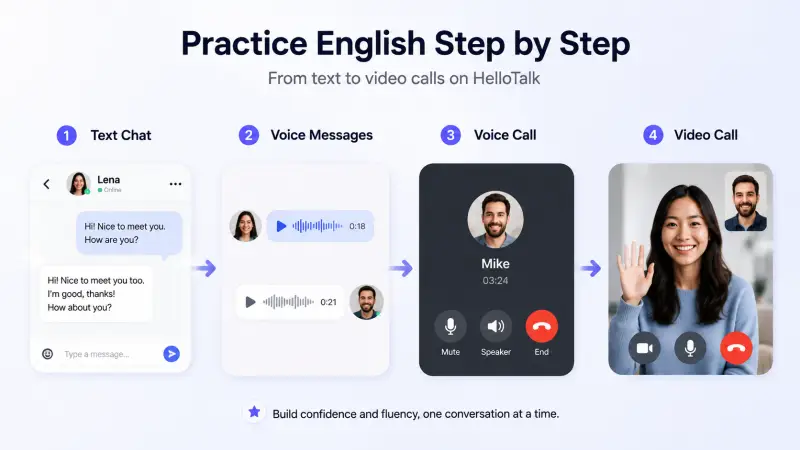
There is no need to rush through these stages. A good language exchange works best when both people are comfortable with the format.
Step 1: Find a Partner You Can Actually Talk To
The best video-call partner is not simply someone who speaks English.
Look for someone who:
- is learning a language you can help with;
- has interests or topics in common with you;
- communicates consistently;
- has similar expectations about language exchange; and
- is interested in practicing by voice or video.
A shared interest matters more than it may seem. If both of you like travel, movies, gaming, food, sports, or music, you already have something to talk about when the conversation slows down.
Before suggesting a call, spend some time chatting. This gives you a sense of the other person's communication style and whether the exchange feels comfortable.
Step 2: Agree on the Goal Before the Call
"Let's practice English" is a little too broad.
A clearer goal makes the call easier for both people. For example:
- practice introducing yourself naturally;
- talk about your weekend for 10 minutes;
- practice answering common travel questions;
- explain something about your hometown;
- discuss one movie, song, or news topic; or
- practice a situation such as ordering food or checking into a hotel.
You can also agree on how the two languages will be divided.
For a 30-minute exchange, you might spend 15 minutes in English and 15 minutes in your partner's target language. Another option is to choose one language for each call and switch the next time.
There is no single correct format. What matters is that both people know what to expect.
Step 3: Prepare Prompts, Not a Script
Preparing for a call does not mean writing every sentence in advance.
A full script can make you sound more fluent during the call, but it does not necessarily train you to respond spontaneously. Instead, prepare a short list of prompts.
For a conversation about travel, you might write:
- Where did you go on your last trip?
- What place would you visit again?
- What surprised you most?
- What food did you try?
- Where do you want to go next?
Five prompts are usually enough to rescue a conversation if it goes quiet.
It can also help to prepare a few phrases for moments when you need more time:
- "Could you say that again?"
- "What does that word mean?"
- "Give me a second to think."
- "How would you say this more naturally?"
- "Is there another way to say that?"
These phrases are part of real fluency. Fluent speakers do not understand everything instantly; they know how to keep a conversation moving when they do not.
Step 4: Start with a Short Video Call
Your first call does not need to last an hour.
Try 10 to 20 minutes.
A short call lowers the pressure and makes it easier to repeat the practice regularly. If the conversation is going well, you can always continue longer.
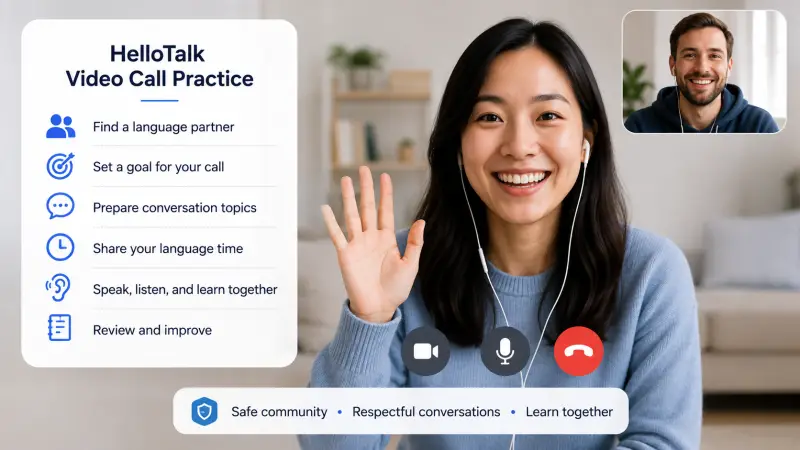
A simple first-call structure could look like this:
| Time | What to do |
|---|---|
| 2–3 min | Say hello and catch up |
| 5 min | Talk about the topic you prepared |
| 5 min | Let your partner ask follow-up questions |
| 2–3 min | Review useful corrections or new expressions |
| Final minute | Choose a topic or time for the next practice |
The goal is not to speak perfectly. The goal is to stay in the conversation.
Step 5: Decide How You Want Corrections
Corrections are useful, but too many interruptions can make a conversation difficult.
Before the call, decide how you want feedback.
You could ask your partner to:
- correct only mistakes that make your meaning unclear;
- note mistakes and discuss them at the end;
- suggest a more natural expression when something sounds unusual; or
- focus on one area, such as pronunciation or verb tense.
If you stop after every small mistake, you may spend more time analyzing English than speaking it.
For fluency practice, it is often better to keep talking and review the most useful corrections afterward.
Step 6: Use the Camera as Part of the Practice
Video is useful for more than seeing the other person's face.
It gives you extra context when you do not understand every word. Facial expressions, gestures, and reactions can help you follow the meaning of a conversation.
You can also use objects around you as spontaneous speaking prompts.
For example:
- show something on your desk and explain why you use it;
- show a snack or ingredient and describe it;
- point to a book and explain what it is about;
- describe the view outside your window; or
- show a souvenir and tell the story behind it.
These small tasks push you away from memorized answers and toward the kind of spontaneous language you need in everyday conversations.
Step 7: Review the Call While You Still Remember It
The practice should not end the moment you hang up.
Take two or three minutes afterward and write down:
- One expression you learned
- One mistake you want to fix
- One moment when you could not say what you wanted
- One topic to practice next time
Then turn the difficult moment into your next practice target.
For example, if you struggled to explain what you do at work, prepare three or four sentences about your job before the next call. If you could not describe a movie clearly, practice summarizing one.
This creates a useful loop:
Conversation → notice a gap → review → practice → use it again
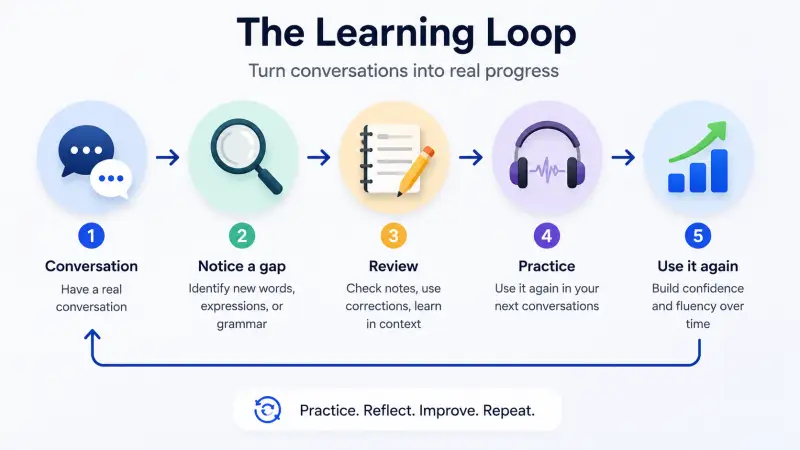
That loop is more valuable than simply counting how many minutes you spent on a call.
What If You're Nervous About Video Calls?
Feeling nervous before speaking with a real person is common, especially when you are still building confidence.
You can make the transition easier:
Stay with voice first
Use voice messages or voice calls until real-time speaking feels more familiar.
Keep the first call short
Ten minutes feels much easier to start than an open-ended one-hour conversation.
Tell your partner you're practicing
You do not need to pretend to be more fluent than you are. Saying "I'm still practicing speaking, so I may need a little time to answer" sets a clear expectation.
Choose a topic you know well
Your first call is not the time to debate a complicated subject. Talk about your city, your hobbies, your weekend, your favorite food, or something else you can already describe.
Remember that your partner is learning too
A language exchange is not a performance. Both people are there to practice, make mistakes, and help each other.
How Often Should You Practice?
A long call once a month is usually less useful for building a speaking habit than shorter, regular conversations.
A realistic starting routine could be:
- 1–2 video or voice calls per week
- 15–30 minutes per session
- one specific speaking goal for each call
- a short review afterward
If video feels tiring, mix formats. You might use text during the week, exchange voice messages on another day, and schedule a video call when you both have time.
The best routine is one you can actually repeat.
Stay Safe and Respect Boundaries
Video calls are more personal than public posts or text messages, so use the same judgment you would when meeting someone online anywhere else.
Before calling:
- spend time chatting first;
- do not share sensitive personal or financial information;
- keep communication on HelloTalk while you are getting to know someone;
- end a call if the conversation makes you uncomfortable; and
- use blocking or reporting tools when necessary.
You never owe another user a video call. If you prefer text or voice, you can keep the exchange there.
A Simple Weekly HelloTalk Speaking Routine
If you want to turn video calls into a habit, try this:
Monday: Find the gap
Use text chat or Moments and notice an English topic you find difficult to express.
Tuesday or Wednesday: Prepare
Write five prompts and review the vocabulary you may need.
Thursday or Friday: Speak
Have a 15–30 minute voice or video call with a language partner.
After the call: Review
Save a few useful corrections and expressions.
Weekend: Reuse
Use one of those expressions in a message, Moment, voice message, or another conversation.
This turns HelloTalk from a place where you occasionally chat into a practice cycle where each conversation gives you material for the next one.
Frequently Asked Questions
Do I need to be good at English before making a video call?
No. You can start with text and voice messages, then move to live calls when you feel ready. A short call about a familiar topic is often easier than trying to have a completely spontaneous conversation.
Is video better than voice for English practice?
Not always. Voice calls are excellent speaking practice and may feel less stressful. Video adds facial expressions and gestures, which can provide useful context. You can use whichever format helps you practice consistently.
What should I talk about on my first call?
Choose familiar topics: hobbies, food, travel, your hometown, weekend plans, movies, music, or daily life. Prepare a few questions rather than memorizing a script.
Should my partner correct every mistake?
Usually not. Too many corrections can interrupt the conversation. Agree on a correction style beforehand, such as saving the most important corrections until the end.
What if I can't find the right word?
Describe the idea using simpler English, ask your partner for the word, or use a phrase such as "How do you say...?" Finding another way to express yourself is itself an important speaking skill.
From Studying English to Using It
Video calls are not a replacement for vocabulary, grammar, pronunciation, or structured lessons. They give you something those activities cannot fully reproduce: the need to respond to another person in real time.
That is why they work best as part of a broader learning routine.
Study the language. Prepare what you want to say. Then use it with another person, notice where you struggle, and bring those gaps back into your study.
With HelloTalk, that cycle can happen in the same language-exchange community—from the first text message to the moment you feel ready to turn on the camera and have a real conversation.