Which Korean Learning Websites Use Everyday Korean Instead of Textbook-Only Dialogues?

You drilled 당신은 밥을 먹었습니까? until it earned full marks. Then a Korean friend texts 밥 먹었어? and your carefully assembled sentence suddenly reads like a customs form. The gap is not effort. Some websites teach Korean as it is written for learners, while everyday Korean drops particles, shortens words, and shifts tone depending on who is talking to whom.
Here is the short version. Talk To Me In Korean's conversation materials sit closest to daily speech among structured sites. How to Study Korean and KoreanClass101 are strongest at telling you when a sentence fits. The Online King Sejong Institute teaches safe standard forms. And HelloTalk is where you check any sentence against real people before it hardens into a habit. If you want the wider feature-by-feature picture, start with the hub comparison of Korean learning websites compared by learning job. The rest of this page stays on one question: where does each site's Korean actually come from, and how do you verify it?
How to Spot Textbook-Only Korean Before You Commit to a Site
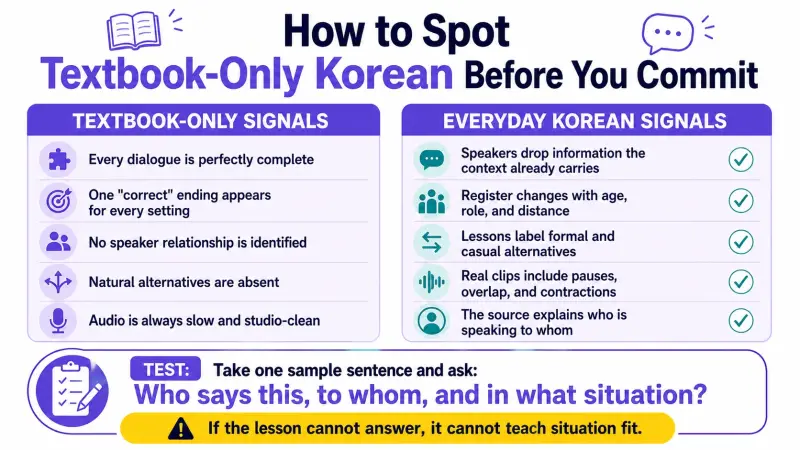
You can diagnose textbook-only Korean in the first free lesson. You do not need to finish a course.
Four patterns give it away. First, every sentence is grammatically complete, with every particle in place, even in casual small talk. Real friends asking about lunch say 밥 먹었어? far more often than the fully built 당신은 밥을 먹었습니까?. Second, every dialogue runs on one register from start to finish, usually polite 해요체 or formal 합쇼체, whether the speakers are close friends, coworkers, or a customer and a clerk. Third, no contractions and no fillers. If you never see 뭐 instead of 무엇, or 근데 instead of 그런데, the dialogue was written to display grammar, not to be spoken. Fourth, situations are labeled by place only, like "At the bank," with nothing about the relationship between the speakers.
Try this on any site right now: open five dialogue lines and ask whether the wording alone tells you the speakers' age gap, closeness, and setting. If it does not, the site is teaching sentence patterns. Patterns are still worth learning. Just do not treat those dialogues as models of everyday speech.
Comparing Named Sites by Dialogue Source: Scripted, Adapted, or Authentic
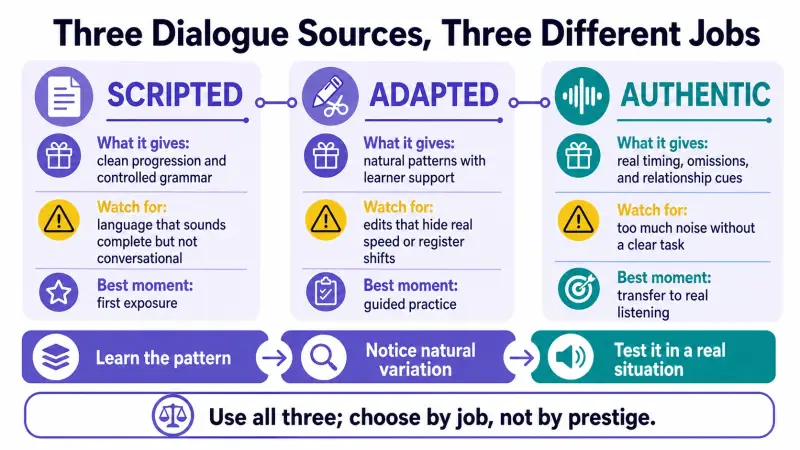
Once you can spot the symptoms, ask where a site's dialogues come from, because the source predicts how close the wording sits to daily speech. Three sources cover it. Scripted dialogues are written to demonstrate a grammar point. Adapted dialogues start from real situations and get edited for learner level. Authentic material is language produced for real communication, not for teaching.
The table sorts the major resources by that one dimension. Read each row as an answer to "where does this wording come from?", not as an overall ranking.
| Resource | Dialogue source | Register labeling | Natural-alternative support |
|---|---|---|---|
| Talk To Me In Korean | Scripted core curriculum plus adapted Real-Life Korean Conversations books and an unscripted on-location course covering 20 real situations | Casual and polite versions noted inside conversation materials | Dialogue lines written the way people actually say them |
| How to Study Korean | Scripted example sentences built for grammar coverage | Explicit three-level respect labels from Unit 1 | Occasional notes on which form people usually choose |
| KoreanClass101 | Scripted situational dialogues voiced by native speakers | Casual dialogue plus a standard-politeness transcript in lesson notes | Cultural notes on when a phrasing fits |
| Online King Sejong Institute | Scripted dialogues aligned to the Standard Korean Curriculum | Standard polite forms taught first | Fewer colloquial variants, strong on correct baseline forms |
| HelloTalk chats and Moments | Authentic messages, posts, and voice conversations from native speakers, not sequenced as lessons | None built in, register appears as real people use it | Native speakers can reply with what they would say instead |
Two caveats keep the table honest. Talk To Me In Korean's Real-Life Korean Conversations for Beginners collects 40 everyday dialogues with line-by-line English translations and native-speaker audio recordings, which makes it one of the most speech-like scripted resources you can buy, and the site's wider catalog spans more than 1,500 online lessons. At the same time, scripted is not a flaw. No course can sequence grammar from easy to hard using raw street Korean, so a scripted source is often exactly what a beginner needs. The table tells you what each resource is, not which one wins.
Which Websites Label Register and Offer More Natural Alternatives
A site can use natural wording and still leave you guessing about when that wording is appropriate. So the second question is whether the site tells you which relationships and settings a sentence belongs to, and whether it shows the more natural way to say something that is merely grammatical.
How to Study Korean is the most explicit here. Its honorifics lesson defines three working levels, from informal low respect through informal high respect to formal high respect, and ties each to the kind of listener it suits. That framing lands in the first unit, so you meet register before you meet most grammar.
KoreanClass101 includes a standard-politeness transcript of its casual dialogues inside the downloadable lesson notes, so one dialogue effectively teaches two registers, and its culture lessons explain why the levels exist at all. Talk To Me In Korean handles the same problem inside its conversation books, where casual exchanges between friends sit next to notes on the polite equivalents. The Online King Sejong Institute stays closest to standard forms. That produces safe Korean rather than colloquial Korean, which is a reasonable trade if you are an absolute beginner.
If register itself is your biggest gap, that question gets its own comparison in this cluster's guide to which Korean sites teach speech levels through real situations. For now the takeaway is narrow: a site that never labels register cannot tell you whether its everyday-sounding sentence is everyday for you, in your relationships.
Testing a Textbook Sentence Against Real Usage in HelloTalk Moments and Chats
Labels and tables get you to a hypothesis. Confirming it means checking the sentence against Korean produced by real people, and that is the specific job HelloTalk does after you have chosen a structured site. HelloTalk connects learners directly with native speakers, with more than 70M+ registered users, so the sample you are testing against is large.
The test takes four steps and works on any sentence. Step one, read before you post. Scroll Moments, HelloTalk's public community feed, and watch how Korean users actually write about the topic your sentence covers. If your textbook line about weekend plans says 주말에 무엇을 할 것입니까? and every post you find says some version of 주말에 뭐 해요?, you already have your evidence. Step two, post the sentence in Moments with a short question like "Would you write it this way?" Native speakers can comment with corrections and alternatives. Step three, bring the sentence into a one-on-one chat. HelloTalk's chat includes built-in translation, transliteration, and read-aloud, so you can pick apart a partner's reply without leaving the conversation. Step four, run your own wording through HelloTalk's AI tools before sending. HelloTalk's AI grammar correction explains what it changes, and HelloTalk's AI pronunciation scoring points to the specific sounds that drift when you read the sentence aloud. HelloTalk also offers image translation, which helps when the sentence you want to test came from a photo of a workbook page.
HelloTalk keeps 90% of core features free, so a weekly sentence-testing habit does not depend on a paid plan. The recognition the platform has picked up, including the 2017 Google Play Best Social App award, reflects the community side that makes this testing possible. The value is not another lesson. It is proximity to real usage.
Asking a Korean-Speaking Partner Whether They Would Say It in That Situation
Feed-level evidence tells you whether a sentence exists in the wild. A partner answers a sharper question: would this specific person say it, in a stated situation? No website can answer that, and the asking takes a small technique.
Frame the situation before the sentence. Not "Is this correct?" but something like: "If a coworker you are friendly with asked about your weekend, would you answer 주말에 등산을 했습니다, or would that sound off?" A Korean-speaking partner can separate wording that is grammatically possible from wording they would actually choose in that moment. The answer might be that the sentence is fine in a report but strange between friendly coworkers, which is exactly the distinction textbook-only sites blur.
Keep one boundary in mind. A partner's answer is evidence about one speaker in one relationship, not a rule of Korean. A university student in Seoul and a manager in Busan may answer the same question differently, and both are right for their own contexts. Collect answers from a few partners over time and treat agreement as a pattern, not proof.
Listening works alongside asking. HelloTalk's Voicerooms run around the clock, and HelloTalk lets you join a room as a listener before you ever speak, so you can hear how strangers, hosts, and regulars actually phrase the things your textbook scripted. HelloTalk's Livestreams add a host-and-audience setting where you can watch phrasing shift as the host answers questions live.
Pairing a Structured Site With Authentic Exposure Without Losing Progression
Everything above can tempt you into a mistake: dropping the structured site and trying to learn from raw exposure. For beginners that usually fails, because authentic Korean arrives unsorted while a structured site controls difficulty and sequence. The setup that works is a pairing, not a replacement.
A steady weekly rhythm looks like this. The structured site supplies new grammar and vocabulary in order. From each lesson you pull two or three sentences and test them in Moments, chats, and partner questions. Each sentence either survives contact with real Korean, gets replaced by a more natural version, or gets tagged as formal-only. After a month you have a personal map of which parts of your course transfer directly to speech. If you want a tighter, day-by-day version of this, the cluster's one-week test for real-Korean proximity turns it into an audit you can run on any resource before committing months to it.
The questions below cover the practical edges the sections above left open.
Do I have to quit my textbook site to sound natural?
No. Scripted lessons control sequence and difficulty, which exposure cannot do. Keep the course for progression and use real usage to verify and adjust wording.
Which single website is closest to everyday Korean?
None wins overall, because closeness depends on the job. Adapted conversation materials sit closest for dialogue wording, register-labeled lessons are closest for appropriateness, and standard-curriculum sites are closest for safe baseline forms.
How many sentences should I test each week?
Two or three per lesson. Testing every sentence turns verification into a second full-time course, and testing none lets stiff patterns harden.
Is it safe to copy casual wording I see in Moments?
The wording is real, but it is tied to the poster's relationships and audience. Check who the original post was addressing, then ask a partner whether the form fits the situations where you would use it.
Can HelloTalk replace a structured Korean website?
HelloTalk does a different job: real usage, native-speaker judgment, and live practice, not a graded grammar sequence. Beginners generally get further using both, one for order and one for reality.
Start small. Take one sentence from whichever site you already use, and test it against real Korean today on HelloTalk.