
How to Audit a Korean Learning Resource in One Week

Seven days of structured use tells you more about a Korean learning resource than any review page, ranking, or feature list ever will. Reviews report other people's first impressions; an audit reports what the resource does to your Korean, measured against your starting point, in your hands. The audit costs nothing beyond the week you were going to spend anyway. The only difference is that the week is instrumented: each day has one observation point, and by day seven the resource has either produced evidence or failed to.
The protocol below works on any resource type: an app, a course, a textbook with audio, a tutor arrangement, an exchange setup. It audits the resource rather than replacing your study plan, since the daily items are observation points layered on top of normal use, at roughly twenty to forty minutes of contact per day. What it replaces is three weeks of vague use followed by quiet abandonment, which costs more time and returns no verdict.
Before day one: fix the measuring stick
An audit needs a baseline, and the baseline takes ten minutes. Write down, dated, three concrete things you cannot currently do in Korean. Concrete means testable: "introduce myself in three sentences without notes," "pick the right particle in sentences about my day," "follow one exchange of a slow dialogue without the transcript." Vague items like "get better at grammar" cannot fail, which means they cannot pass either.
Two rules keep the week honest. Audit one new resource at a time, because parallel candidates make day-seven attribution impossible. And keep your existing routine running unchanged underneath, so the delta you observe belongs to the candidate.
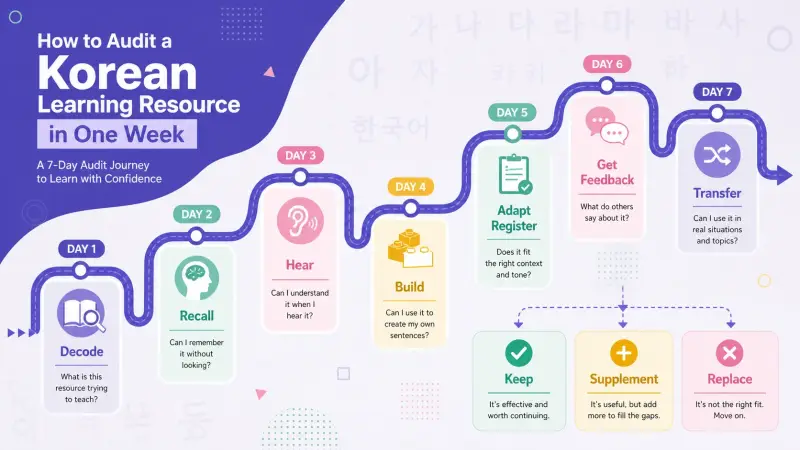
The seven days, one observation point each
The protocol is a sequence, so it is numbered; each day's point takes a few minutes of attention inside normal use.
- Day 1, coverage check: locate where the resource addresses your three baseline items. Note whether each is covered soon, covered eventually, or not covered. A resource can pass the audit while failing one item, but you should know which one on day one.
- Day 2, error handling: make three deliberate mistakes, a wrong particle, a wrong verb ending, a misspelled syllable block, and record what the resource does. Does it detect them, explain them, or silently accept them?
- Day 3, production demand: count how many times today the resource required you to compose something original, not select, not repeat, not fill a blank. Zero is a finding.
- Day 4, feedback loop speed: for anything you produced, measure how long until something or someone responded to it, and whether the response addressed your specific attempt or was generic.
- Day 5, real-Korean proximity: take three sentences the resource taught this week and check them against real usage. A search works; a HelloTalk Moments feed works better, because the posts were written for Korean readers rather than for learners; asking a HelloTalk chat partner works best, since only a person will tell you a sentence is correct but nobody says it. Note anything flagged as textbook-only. For a named-site comparison built around this exact test, see which Korean learning websites use everyday Korean.
- Day 6, retrieval test: attempt your three baseline items cold, resource closed. Partial success counts as movement; note precisely which parts came out. If one item is spoken, a HelloTalk Voiceroom is a low-stakes place to run it, and HelloTalk's AI pronunciation scoring will name what went wrong in a recording if no room fits the hour.
- Day 7, verdict assembly: compare day 6 against the baseline, reread the week's notes, and score the resource against the standards below.
Day 4 deserves one expansion, because it is where resource categories separate most sharply. Content-only resources typically return nothing on day 4, since nothing in them reads free production; that is a category property, not a flaw. Feedback exists on a spectrum from automated checkers, which respond instantly but only to anticipated error types, to real-person resources, where the response covers whatever you actually wrote. Exchange platforms are the standard way to test the human end during an audit week, and HelloTalk is a representative example of the category. Posting one original Korean sentence to HelloTalk Moments shows what correction from several Korean speakers looks like in speed and specificity, while HelloTalk's AI grammar correction returns an explained version in seconds, which brackets the range: the automated end instant and narrow, the human end slower and unbounded. Either way, day 4 gets a comparison point even when the audited resource offers no feedback of its own.
The pass standards after one week
The audit resolves against standards, not feelings. The table below states what a passing resource has demonstrated by day seven, alongside the failing pattern for each dimension; a resource does not need a perfect row, but it needs a defensible one for the dimensions that match your bottleneck.
| Dimension | Pass after one week | Fail pattern |
|---|---|---|
| Movement on baseline items | At least one item moved from cannot to can-with-effort | All three unchanged despite daily contact |
| Error handling | Your planted mistakes were caught or explainable | Errors silently accepted as correct |
| Production demand | Original output required on most days | A week of recognition and repetition only |
| Feedback specificity | Responses addressed your actual attempts | Generic praise or right-answer reveals only |
| Real-usage alignment | Taught sentences survived contact with real Korean | Multiple textbook-only flags |
A resource that fails the table can still be kept knowingly, as a narrow tool for the dimension it passes, provided something else in the stack carries the rest. What the audit forbids is the outcome it was designed against: continuing by momentum with no verdict at all.
The switch signals
Some findings end the trial early or override an otherwise decent scorecard. They are worth listing separately because each one predicts the next month better than the aggregate does:
- Zero production demand across seven days, if production is your bottleneck; more weeks will not change a structural property.
- No detectable movement on any self-chosen item by day 7, during the week when novelty was working in the resource's favor.
- Progress meters rising while your cold-retrieval results stay flat, which means the resource is measuring itself, not you.
- Multiple day-5 flags, since a resource teaching Korean nobody uses costs you unlearning later.
- You needed willpower to open it by day 4, which at equal scores predicts fewer total repetitions than a plainer resource you would actually open.
Why so many Korean resources score well on polish and poorly on this audit is not mysterious; the marketing metrics and the audit dimensions measure different things, a mismatch taken apart in what Korean resources promising speed are optimizing for. And the audit's hardest week to pass is not the learner's first week but the stretch right after the alphabet, when feedback density collapses across most tools; that terrain is mapped in the gap in Korean resources after Hangul, and running this audit inside that stretch is precisely when it earns the most.
Two adjacent references round out the method. If the audited candidate is one of the mainstream apps, the product-by-product findings in which Korean apps live up to the easy claim offer a cross-check for your day-2 and day-3 results. And if the audit's verdict is switch, the tested three-month account in effective resources to learn Korean fast is a documented example of what a feedback-heavy replacement stack looked like in extended use.
FAQ
What if my three baseline items are too hard to move in one week?
Then the items were scoped as goals rather than as increments, and the fix is to shrink them, not to lengthen the audit. "Hold a conversation" is a quarter-scale goal; "ask and answer two questions about my weekend" is a week-scale increment of it. Well-scoped items sit at the edge of current ability, where seven days of decent instruction should produce visible partial movement. If an item resists all shrinking, park it and substitute a nearer one; the audit measures the resource, and it needs items within the resource's plausible reach to do so.
Can I audit a free resource and a paid one against each other?
Sequentially, yes, and the comparison is the audit's best use: same baseline structure, same standards, one week each, notes side by side at the end. Run them in adjacent weeks rather than simultaneously, refresh the baseline items for the second week so the first week's learning does not contaminate the comparison, and expect the interesting result: price and audit performance correlate weakly, because cost tracks content volume and production values, while the audit weighs feedback and movement.
Does the audit work for evaluating a tutor or language partner rather than an app?
Yes, with the same seven points and one added observation: correction density. A human resource can fail day 2 by politeness, letting your planted errors pass to keep the conversation pleasant, and can fail day 4 by over-correcting until production stops. The pass pattern for a person is selective correction, a few recurring errors addressed per session, plus the things no app can offer: responses to your meaning and adjustment to your level. Judge a person on a slightly longer horizon than an app, two weeks rather than one, since rapport legitimately takes a few sessions to form.
Day 7 shows movement on one baseline item but not the other two. Pass or fail?
Read it as a scope report, not a verdict. Uneven movement usually means the resource genuinely teaches the dimension behind the moving item and does not touch the others, which is the audit doing its job: you now know what the resource is for. The decision follows from your stack, not from the score. If the moving dimension is one you need and nothing else covers, keep the resource in that role deliberately. If the stalled items are your actual priorities, the resource failed your audit even though it works. A second week is only worth running when the stall looks like mis-scoped items rather than missing coverage.
How often should a resource that passed be re-audited?
On triggers rather than a calendar. Three events justify a re-run: your baseline items have changed character, say from surviving basic exchanges to handling opinions, because a resource tuned to the old edge may not teach the new one; your corrected-error pattern has gone stale, with the same fixes repeating for weeks, which suggests the feedback source has stopped stretching you; or the resource itself changed substantially. Absent triggers, a passing resource earns quarters of quiet use, and the audit energy is better spent on candidates for empty slots in the stack. Auditing is a purchase decision tool; once the decision is made, measurement should mostly get out of the way.