
What Korean Resources That Promise Speed Are Actually Optimizing For

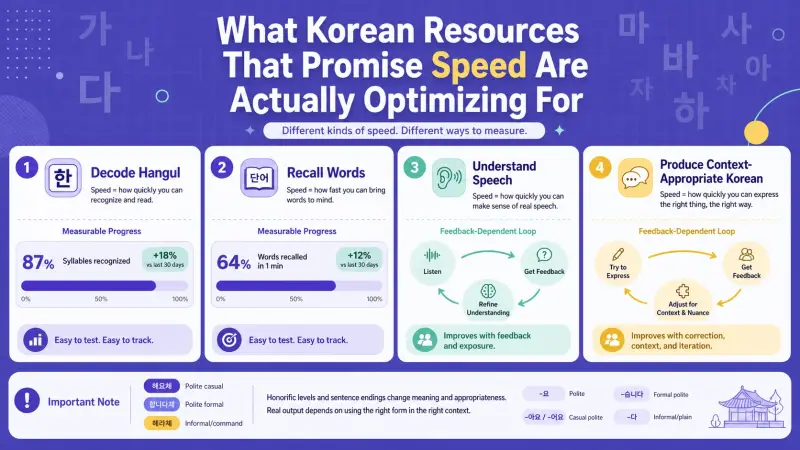
When a Korean resource promises speed, it is optimizing a metric, and the metric is usually not the one the learner has in mind. The word fast does no work on its own; it only means something relative to a measurement. A resource can honestly make a learner fast at recognizing Hangul, fast at accumulating flashcard vocabulary, fast at passing its own unit tests, and none of those speeds transfers automatically to the speed most people are buying: getting Korean out of their mouth in a real exchange. The claim is rarely false. It is answering a different question.
This is an analysis of the claims, not an attack on the products behind them. Resources optimize what they can measure and deliver, which is rational, and several of the optimized metrics are genuinely valuable. The problem sits in the translation step, where "fast" on the package gets read as "fast" toward the reader's private goal. What follows takes the word apart into its four common referents, shows which ones resources structurally prefer, and gives a way to read any speed claim by identifying its metric before trusting it.
The four things "fast Korean" can mean
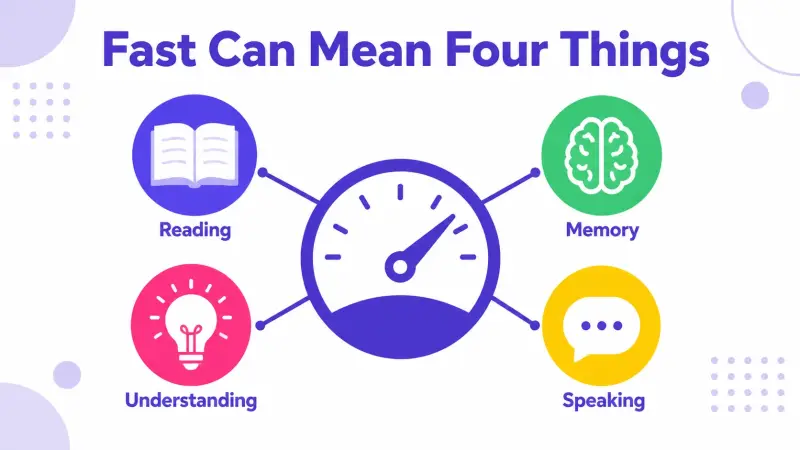
Speed claims about Korean resolve into four distinct abilities, and they improve on very different curves.
Reading speed: recognizing Hangul and sounding out syllables. Hangul is a compact alphabet, 14 basic consonants and 10 basic vowels composed into syllable blocks, and functional reading is realistically achievable within days to two weeks. Any resource can make this fast, because it is fast.
Accumulation speed: vocabulary counts and completed lessons. Spaced repetition makes accumulation efficient and, crucially, countable, so it generates satisfying graphs.
Comprehension speed: following spoken Korean at natural pace. This improves slowly and unevenly, resists precise measurement, and depends on listening volume more than on any resource feature.
Production speed: composing and saying Korean sentences to a real person, with the verb endings and register the situation calls for. This is the ability most learners mean by "speaking Korean," and it is the slowest of the four to develop and the hardest to package.
Why resources optimize the first two
The skew toward reading and accumulation is structural, and three properties explain it:
- Measurability: syllables read and words retained can be counted automatically, so progress can be displayed, graphed, and celebrated. Comprehension and production resist counting.
- Deliverability: alphabet lessons and flashcards are pure content, authored once and served infinitely. Production requires a responder, which turns a content product into a service.
- Early payoff: Hangul and first vocabulary produce visible wins in week one, which is when users decide whether a resource "works." A resource that front-loads its strongest week is following its incentives.
Meanwhile the machinery that actually gates Korean production sits later and measures badly. Korean attaches grammar to the end of the verb: tense, politeness level, and sentence type are all carried by endings, and the politeness system means the same sentence takes different forms depending on who is being addressed. None of this is exotic or unteachable, but it cannot be flashcarded into existence, because choosing an ending is a live judgment, not a retrieval. The parts of Korean that decide whether a learner can open their mouth are precisely the parts that resist progress bars, which is why speed-optimized resources tend to schedule them late or thin.
Reading a speed claim by its metric
The table below is a decoding key. Each row takes a claim shape commonly seen on Korean resources, names the metric actually being optimized, and states what the claim leaves out. Match the claim you are evaluating to its row before deciding what the promise is worth to you.
| Claim shape | Metric being optimized | Honest value | What it leaves out |
|---|---|---|---|
| "Read Korean in days" | Hangul recognition | High; Hangul really is quick | Everything after the alphabet |
| "Hundreds of words a month" | Vocabulary retention count | Real, if reviews are kept up | Retrieving words mid-sentence under pressure |
| "Finish beginner Korean in N lessons" | Course completion | Sequencing and coverage | Whether completion converts to any live ability |
| "Understand K-dramas fast" | Scripted comprehension | Motivating input volume | Unscripted speech; your own production |
| "Speak from day one" | Early phrase repetition | Confidence, habit of vocalizing | Feedback on whether the phrases land correctly |
The last row deserves one extra note: repeating phrases aloud to an app and producing Korean to a person differ in exactly one component, the presence of someone who responds, and that component is the expensive one. Resources built around real interaction form their own category on this axis, since conversation is the one activity where production speed is trained directly rather than hoped for as a transfer effect. HelloTalk belongs to that category as a representative example. HelloTalk chats put a learner's actual sentences in front of Korean speakers who reply and correct, with real-time grammar correction attached to the message rather than filed in a report, and HelloTalk Moments raises the corrections per sentence by exposing one short post to several readers at once. Both are the metric-resistant, progress-bar-unfriendly activity the table's right-hand column keeps pointing at.
Using metric-reading instead of avoiding speed claims
The conclusion is not that speed claims disqualify a resource. Several optimized metrics are worth having, and a fast Hangul module or an efficient vocabulary system belongs in most Korean stacks. The discipline is a three-step read, applied before committing:
- Identify the metric behind the claim, using the table's rows as candidates.
- Ask whether that metric is currently your bottleneck, since a fast solution to a non-bottleneck changes nothing you can feel.
- Check what in your stack covers the metrics the claim leaves out, because a stack of three resources all optimizing accumulation is one resource, three times.
Two of the neglected metrics have cheap coverage. Comprehension of unscripted Korean is what HelloTalk Voicerooms supply by default, since a learner can enter as a listener and hear Korean speakers talking to each other rather than to a microphone. Production quality is what HelloTalk's AI pronunciation scoring measures on a recording, naming the sound that missed, which is precisely the feedback the speak-from-day-one row leaves out.
Applied to the typical beginner, the read usually returns the same result: the bottleneck moves from reading to production within the first month or two, while the resource stack keeps optimizing the pre-move bottleneck. That transition period, what opens up after Hangul and why coverage thins exactly there, is mapped in the companion piece, the gap in Korean resources after Hangul. And any individual claim can be settled empirically rather than argued: a structured seven-day trial, laid out in how to audit a Korean learning resource in one week, shows what a given resource actually accelerates, in your hands rather than in its marketing.
For readers weighing specific mainstream products against these categories, two existing comparisons apply this lens to named tools: which Korean apps live up to the "easy" claim examines the claim-versus-metric gap product by product, and the tested account in effective resources to learn Korean fast tracks what three months of real use delivered against the promises.
FAQ
Is any Korean resource lying when it says fast, or are they all just measuring differently?
Mostly the latter. Outright false claims exist but are rare among established resources; the durable pattern is accurate claims about narrow metrics, phrased so the narrowness disappears. "Read Korean in a week" is usually true. The reader supplies the false part by hearing "learn Korean in a week." Treating speed language as a pointer to a metric, rather than as a promise about your goal, removes most of the deception without requiring any resource to be dishonest.
If production is what I want, should I skip the fast-Hangul and vocabulary resources entirely?
No, because production runs on their outputs. Reading Hangul unlocks every native-made material, and a base vocabulary is the raw material sentences are made of. The correction is proportional, not eliminative: take the fast wins in week one and two, keep vocabulary work as a small daily background process, and move the freed attention to production and comprehension earlier than the default resource sequence suggests, rather than after finishing it.
How much slower is production, realistically, than the speeds resources advertise?
Slower by an order framed in months rather than days, and official estimates set the frame honestly: the US Foreign Service Institute places Korean in its most demanding category for English speakers, on the order of a couple of thousand class hours to professional working proficiency. That number describes a distant endpoint, not the first conversation, which motivated learners reach far earlier. The relevant reading is comparative: no metric a resource can optimize in weeks moves that curve much, which is exactly why the honest speed gains live in reading and accumulation, and the patient ones live in production.
If resource metrics are misleading, what speed metric should I track for myself?
Track corrected production over time, because it is the one number that moves with the ability speed claims imply. A simple version: count the original Korean sentences you produced this week that received a response or correction, and watch the trend, not the total. Reading speed, streaks, and words reviewed will all rise faster and feel better, which is exactly why they mislead; they measure inputs. A learner whose corrected-sentence count climbs steadily is getting faster in the sense that matters, regardless of what any resource dashboard reports. The metric also self-audits your stack: if the number is stuck at zero, no resource in the stack is asking you to produce.
Was my time in speed-optimized resources wasted, or does it carry over?
It carries over almost entirely; the loss is in sequencing, not in substance. Hangul reading transfers to every future material. Accumulated vocabulary remains the raw material of sentences, even when it was learned recognition-first and needs retrieval practice before it surfaces in speech. Grammar met in completion drills is met faster the second time, in production. What was actually lost is calendar time in which production could have started earlier, and that is not recoverable but also not compounding: the moment output and correction enter the routine, the stored material converts. The practical reading is forward-looking, keep the assets, change the allocation, and skip the sunk-cost detour of re-studying what already transferred.