
What Thai Resources Assume You Already Know, and What to Do When You Don't

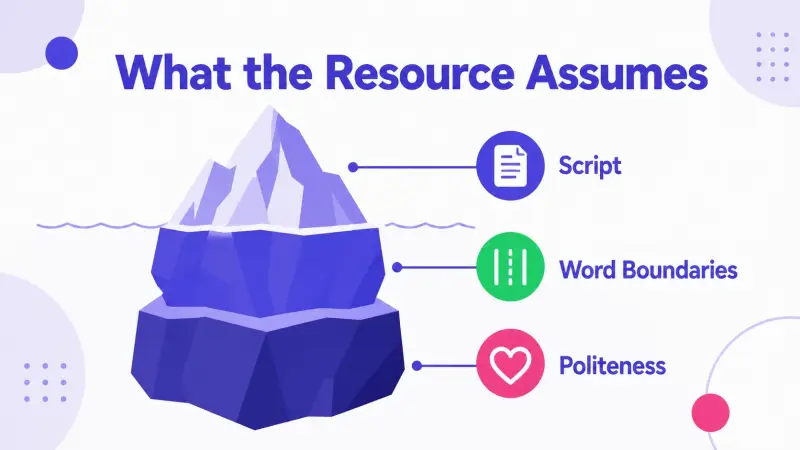
Most Thai resources are written for a learner who does not exist: one who already reads the script, already hears where words begin and end, and already knows when politeness particles are required. These are not advanced skills that resources reasonably defer. They are entry requirements that resources silently assume, usually because the material was structured by people for whom the assumptions were long invisible. The learner who lacks them does not experience a gap in the resource; they experience themselves as confused by material everyone else apparently follows.
Hidden prerequisites fail differently from ordinary gaps in coverage. A missing topic is visible: the resource never mentions verb serialization, so you know to look elsewhere. A hidden prerequisite is invisible from inside the resource, because the resource behaves as if the prerequisite were universal. This article names the three assumptions that recur across Thai materials, what breaks when each is unmet, and the resource type that fills each. It stays off the topic of tone training mechanics, which has its own dedicated analysis in what a Thai resource needs in order to teach tones.
Assumption one: you can read Thai script
The assumption appears earlier than beginners expect. Plenty of materials open with romanized Thai, then switch to Thai script by unit three or four, sometimes with one transitional lesson and sometimes with none. Grammar explanations start citing spellings, example sentences drop their romanization, and dictionaries, the resource type every learner eventually needs, mostly assume script from the first lookup.
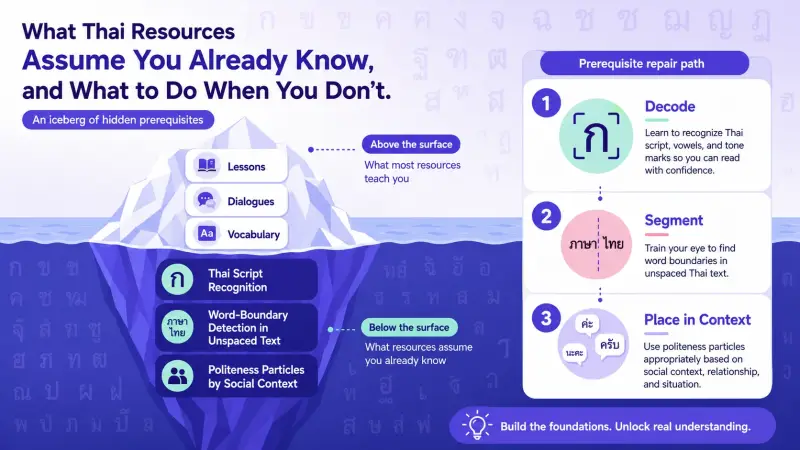
What breaks is not just reading. Thai script encodes tone through consonant class, vowel length, and tone marks, so a learner who cannot read is cut off from the language's own tone notation and dependent on whichever romanization each resource uses. The schemes disagree: the same word appears as khao, kao, or khâo across materials, so a script-less learner cannot reliably match vocabulary between two resources. The fill is a dedicated script resource, worked in parallel rather than as a blocking first stage, because the script is a months-long acquisition: 44 consonants in three classes, vowels written before, after, above, and below the consonant, and no capitalization cues. While it matures, HelloTalk's image translation keeps real Thai text usable, since a photographed sign or menu comes back as something a learner can decode instead of skip. Sequencing decisions about when script study should start are covered in the beginner ordering guide, how to start learning Thai; the point here is narrower: check where your resource silently switches to script, and keep your script study ahead of that point.
Assumption two: you can hear and see where words end
Thai writes without spaces between words. เขาชอบกินข้าวผัด is five words to a Thai reader and an unbroken string to a beginner. Spoken Thai has the same property acoustically, as all speech does, but Thai learners get no help from spacing when they later check what they heard against text. Resources assume segmentation constantly and invisibly: vocabulary lists present words pre-cut, readers present texts a learner cannot cut, and listening materials assume that knowing the words individually means recognizing them in a stream.
The break shows up as a demoralizing plateau: a learner who tests well on vocabulary but cannot find those words inside a sentence, in text or audio. Mainstream Thai apps are strong on exactly that pre-cut vocabulary layer, a pattern running through the tools examined in the comparison of Thai learning apps, which is why the plateau tends to surprise app-first learners most. What fills the gap is not more vocabulary but segmentation-bearing input, and it comes in identifiable forms:
- Learner texts with visible word boundaries, spaced or slash-marked, used as a temporary scaffold.
- Audio with transcripts, consumed as a pair, so the ear and the eye cut the stream together.
- Sentence-first vocabulary tools, where every new word arrives inside a boundary-marked sentence rather than alone.
- Real chat with Thai speakers, where messages are short, contextual, and can be asked about, which turns segmentation into an interactive problem instead of a solitary one. HelloTalk chats do this in a useful shape: translation and transliteration sit under the Thai message, so a beginner sees where a sentence was cut, and read-aloud plays the line back so the ear learns the boundary the eye just found.
The last form doubles as the fill for the third assumption, which is social rather than mechanical.
Assumption three: you know when politeness particles are required
Thai sentences in real use frequently end with khrap (male speakers) or kha (female speakers), and the decision to include or omit them tracks the situation: expected with strangers, elders, and service interactions, relaxed among close friends. Resources assume this system in a peculiar way: the particles appear in every dialogue, so learners absorb that they exist while the conditions governing them are rarely taught as content, leaving a social rule to be inferred from examples that never vary the situation.
What breaks is the learner's first real interactions, in both directions: omitting particles where expected reads as abrupt, and inserting them uniformly reads as stilted. The conditions on politeness particles are usage knowledge, and usage knowledge is the one category that prepared content is systematically worst at carrying, because it varies with situation, relationship, and region faster than content can be authored. The resource type that carries it is exposure to real usage plus the ability to ask. This is the slot where real-interaction platforms function as a resource category for Thai, and HelloTalk is a representative example. HelloTalk Moments shows Thai speakers of different ages posting for each other, so particles appear and vanish with the situation rather than with a lesson, and a HelloTalk chat partner can be asked directly why one was dropped, which converts an unteachable-by-content rule into an observable one. HelloTalk Voicerooms extend the same observation to speech, where the particles carry a tone contour that text hides.
The three assumptions in one view
The table below is the diagnostic summary of everything above. Read your current materials against the middle column; if you recognize the symptoms, the right column names the fill.
| Hidden assumption | What breaks when it is unmet | Resource type that fills it |
|---|---|---|
| Script reading | Romanization dependence; resources stop matching each other; tone spelling inaccessible | Dedicated script course, run in parallel from early on |
| Word segmentation | Vocabulary passes tests but disappears inside sentences and audio | Boundary-marked texts, transcripted audio, sentence-first tools, short real chats |
| Politeness particle conditions | First real interactions read as abrupt or stilted | Real-usage exposure with the ability to ask |
Two of the three fills involve contact with real Thai text or people, which is not an accident: hidden prerequisites are the knowledge native-produced materials presuppose, so they surface fastest at the boundary between learner content and the real language.
Auditing a resource for hidden prerequisites before committing
The assumptions above can be detected in about twenty minutes, before any momentum is spent:
- Jump to a unit several weeks ahead of the start and check what script support remains: full romanization, partial, or none.
- Find one example sentence and check whether the resource ever shows its word boundaries, anywhere.
- Search the resource for khrap or kha as a topic, not as a dialogue decoration; note whether the usage conditions are ever stated.
- Note every point where the answer is "assumed," and confirm your stack contains the corresponding fill before starting, not after stalling.
A resource that fails this audit can still be excellent at what it does teach. The audit prices the prerequisites in advance, so when the confusion arrives it is recognized as a known gap with a known fill rather than as evidence that Thai, or the learner, is the problem.
FAQ
Should I delay all Thai study until I can read the script, since so much assumes it?
No, and the assumption-mapping argues the opposite. Delaying everything for script means months without listening or speaking development, and script skill does nothing for segmentation of speech or particle usage, which develop only through exposure. The workable pattern is parallel tracks: begin script early, in small daily doses, while running romanization-supported listening and speaking from day one, and time the script track to stay ahead of the point where your main resource drops romanization.
My vocabulary reviews go well, but I cannot follow even slow Thai audio. Which assumption is failing?
Segmentation, almost certainly. Recognizing a word in isolation and locating it inside a continuous stream are different skills, and vocabulary tools train only the first. The fastest fix is paired input: audio with a transcript, worked short section by short section, first listening, then reading, then listening again. Within a few weeks the ear starts pre-cutting the stream. If audio remains opaque after that, the problem is more often word-boundary habits than listening speed, so slowing the audio further will not help as much as more transcript pairing.
Do politeness particles matter in text chats, or only in speech?
They carry into text fully. Thai speakers end written messages with khrap and kha under roughly the same conditions as in speech, softened by context: chats between language partners typically relax quickly toward informality, while first messages to strangers keep the particles. Text is actually the low-cost place to calibrate the system, because you can observe a real person's particle usage across a whole conversation history and mirror the register they set, something speech never gives you time to do.
If I am missing all three prerequisites, which should I fix first?
Order them by how soon each one blocks you: segmentation first, script second, particles third. Segmentation gates listening from the first week, so paired transcript-and-audio work should start immediately. Script can run as a parallel track before your main resource drops romanization. Particles are the fastest fix and least urgent for comprehension, since missing them costs politeness rather than understanding. Learning the basic khrap and kha conditions, then observing real usage, closes most of that gap while the slower skills grow.
How can I tell whether a resource hides prerequisites before I commit to it?
Inspect its first hour and its middle, not its marketing. Check whether early examples use Thai script without reading instruction, or romanization without a stated plan to leave it. Then jump to a mid-course lesson and see whether transcripts disappear or dialogue speed rises without a bridge. Finally, look for a stated starting level. A resource that names its assumptions can still fit your stack; the risky ones are those that let essential support disappear silently.