
What a Thai Resource Needs in Order to Teach Tones, and Why Most Skip It

A Thai resource cannot teach tones with content alone, because tones are a feedback skill, and most resources are built to deliver content, not feedback. Thai has five tones: mid, low, falling, high, and rising, and they carry word meaning, so a syllable like maa becomes come, horse, or dog depending only on pitch. Every serious resource tells learners this. Far fewer are built to do anything about it, because doing something about it requires hearing the learner's own voice and judging it, a capability that sits outside how most learning products are constructed.
The result is a market full of resources that teach about tones while not teaching tones. The distinction sounds pedantic until you meet its output: learners who can recite the five tone names, explain the rules, and still produce a rising tone as flat without knowing they did. This article stays on the resource side of that problem, asking what equipment a resource needs to train tone production and why two of the three existing approaches cannot close the loop. The learner-side experience of being stuck on tones is a different article, covered in why beginners get stuck on Thai tones and how to fix it, and this piece will not retell it.
Why one-way delivery cannot train a tone
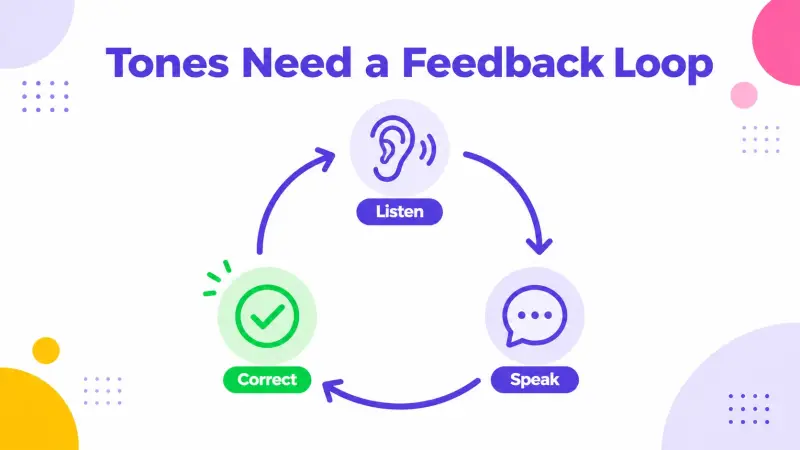
Tone production fails silently. A learner who says a Thai word with the wrong pitch hears nothing wrong, because their ear has not yet learned to categorize Thai pitch contours, and the very deficit being trained is the one that would detect the error. Written explanations cannot intervene at the moment of speech. Audio models give the correct target but not the distance between the target and the learner's attempt.
That structure dictates the requirement. To teach tone production, a resource must contain a mechanism that perceives the learner's specific utterance and returns a judgment on it, quickly enough to correct the next attempt. Any resource without such a mechanism is limited to teaching tone knowledge and tone perception, which are valuable and insufficient. The requirement is unusual among language skills; vocabulary and grammar tolerate delayed, generic feedback far better than pitch does.
The three mechanisms resources actually use
Across the Thai learning market, tone handling reduces to three mechanisms, and a resource can be classified in minutes by checking which one it contains.
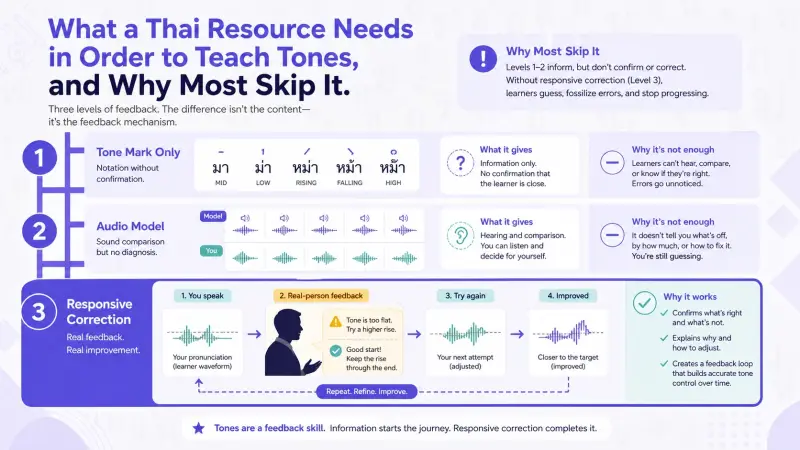
The first mechanism is notation: tone marks, tone names, colored diacritics, romanization with tone symbols. Notation transmits knowledge about which tone a word carries. Thai script itself encodes tone through a combination of consonant class, syllable type, vowel length, and four written tone marks, so notation-level teaching is genuinely necessary for literacy. What notation cannot do is reach the learner's voice at all. It is a map with no vehicle.
The second mechanism is reference audio: native recordings attached to vocabulary, minimal-pair listening drills, slowed contours. Reference audio trains perception, the ability to hear that มา, ม้า, and หมา differ, and perception is a real precondition for production. The mechanism still runs one way. The learner can imitate the recording, but nothing in the resource registers whether the imitation succeeded, so practice can rehearse an error indefinitely with full confidence.
The third mechanism is responsive correction: something that takes the learner's utterance as input and returns a verdict. This mechanism has two implementations with different properties. Automated scoring analyzes a recording against an acoustic model and flags the deviating tone; it is available on demand and consistent, but bounded by what the model was built to detect. HelloTalk's AI pronunciation scoring is a representative implementation, since it returns the specific problem rather than a score alone, which is what makes a second attempt worth taking. Human correction comes from a Thai speaker listening to the learner; it is unbounded in what it can catch, including errors of rhythm and naturalness around the tone, and it responds to real communicative attempts rather than isolated drills. HelloTalk carries that implementation too: a voice message in a HelloTalk chat reaches Thai speakers who can say, in seconds, which word's pitch failed, and a HelloTalk Voiceroom puts the same judgment on connected speech, which is where isolated-word practice stops predicting anything. A person is functioning as a learning tool in that moment, in the strict sense of performing a function, real-time pitch judgment on an individual voice, that notation and reference audio structurally cannot perform. The same person also does what no tool does: responds to the meaning of what was said, which keeps tone practice attached to actual communication instead of drills.
The three mechanisms side by side
The table below compresses the classification into a reference view. Use it to place any Thai resource you are evaluating: find which rows it implements, and its tone-teaching ceiling follows.
| Mechanism | What it trains | What it structurally cannot do | Typical carriers |
|---|---|---|---|
| Notation (marks, rules, romanization) | Knowledge of which tone a word carries | Reach the learner's voice | Textbooks, apps, charts, script courses |
| Reference audio | Perception of tone contrasts | Detect errors in the learner's attempt | Audio courses, vocabulary apps, listening drills |
| Responsive correction, automated | Production, within modeled patterns | Catch errors outside its model; judge naturalness | Pronunciation scoring tools |
| Responsive correction, human | Production, judged in full context | Be available on a fixed schedule; stay perfectly consistent | Exchange platforms, tutors, Thai-speaking communities |
The ceiling reading works one way only: a lower row presupposes the rows above it, but no amount of the first two adds up to the third. A resource with superb notation and audio has a hard ceiling at perception.
Why most resources stop at the second mechanism
The skew is economic rather than negligent. Notation and reference audio are content; responsive correction is a service, and the two differ on every property that decides what gets built:
- Content is produced once and delivered to everyone; a correction service consumes computation or a person's attention per learner, per attempt.
- Content quality is controlled in advance; correction quality happens live and cannot be fully authored.
- Content demonstrates well in screenshots and feature lists; a feedback loop is invisible in marketing.
A resource built as a content business will rationally invest where content wins, which is exactly the first two mechanisms. Comparative write-ups of the major Thai tools show the same pattern from the product side; the breakdown in Thai learning apps compared found strong vocabulary and script teaching across the board and individual tone correction almost nowhere.
For a learner assembling a Thai stack, the practical checklist is short:
- Confirm the stack contains all three mechanisms, not three carriers of the same mechanism.
- Check the third mechanism's loop speed: correction that arrives within the same session can shape the next attempt; correction days later shapes nothing. A HelloTalk Moments post with a recorded line attached is a fast way to test that speed, since several Thai speakers can answer one recording before the practice session ends.
- Verify the correction source hears connected speech at least sometimes, since tones behave differently in isolated words and running sentences.
A stack that fails the first check is the single most common configuration among self-taught Thai beginners, typically one app plus one audio course, both stopping at mechanism two.
FAQ
Can I postpone tone work until after learning the Thai script?
The two are separable, and postponing script is more defensible than postponing tones. Thai script takes months to read comfortably, since 44 consonants in three classes interact with vowel signs and tone marks, while tone habits form from the first spoken word and harden quickly. Resources that sequence script first implicitly park the learner in romanization, where tone information survives only if the romanization carries tone symbols and the learner has a correction loop running. Whatever the script timeline, the responsive-correction mechanism belongs in week one.
Are automated tone scores accurate enough to replace human correction?
They are accurate enough to be useful and bounded enough not to be sufficient. Automated scoring is strongest on isolated words and clear deviations, and its always-available nature makes it ideal for high-repetition solo practice. Its bounds show at connected speech, borderline contours, and naturalness judgments, where a human ear still catches what a model misses. The two implementations slot together rather than compete: automated scoring for volume, human correction for calibration.
What does the polite-particle system have to do with tones?
Nothing grammatically, but a lot practically: the particles khrap and kha end a large share of spoken Thai sentences, each carries its own expected tone contour, and they are among the first words a learner says to real people. Getting their pitch wrong is therefore unusually visible. They also illustrate this article's argument in miniature: every resource lists them, audio resources model them, and only a responsive listener can tell a specific learner that their kha keeps coming out as a falling tone. The wider set of things Thai resources quietly assume learners already handle, particles included, is examined in what Thai resources assume you already know.
Do I need the consonant-class tone rules, or can I learn tones purely by ear?
By ear is how production actually stabilizes, and the rules are how reading stays honest, so the answer depends on which skill is on the table. Spoken tone accuracy comes from hearing, imitating, and being corrected; no rule fires fast enough during live speech. The class rules earn their keep in reading, where they let you derive the tone of an unfamiliar written word instead of guessing, and in review, where they explain why two similar spellings carry different contours. A workable sequence is ear-first from day one, rules introduced gradually as script reading begins, with neither treated as a substitute for the correction loop this article describes.
I am not musical at all. Does that make Thai tones unrealistic for me?
No, because linguistic tone is relative contour, not absolute pitch. A falling tone is a movement within your own voice range, and every speaker, musical or not, already produces such movements constantly; English uses them for questions, emphasis, and sarcasm. What tonal languages change is the job of pitch, attaching it to word identity, and that reassignment is a training problem rather than a talent problem. Unmusical learners tend to need more early perception work, distinguishing contours before producing them, which raises the value of reference audio and responsive correction and lowers the value of notation alone. Progress may start slower; the ceiling is not different.