
Three Writing Systems, Three Jobs: How Japanese Resources Divide the Work

The Japanese resource market is fragmented because the Japanese writing system is fragmented, and the fragmentation is structural, not a product-design fashion. Learners arriving from other languages notice something odd immediately: where Spanish or Korean study can live inside one or two tools, Japanese study seems to demand a committee. A spaced repetition system for kanji, a textbook for grammar, graded readers for reading, separate audio for listening. The committee is not a symptom of an immature market. It mirrors a language that distributes its writing across three scripts, each with a different job and each rewarding a different kind of tool.
Understanding the division matters for a practical reason: it predicts what a Japanese resource will be good at before you open it, and it exposes the one job that no script assigns and therefore no script-shaped resource covers. This article walks through the three scripts and their jobs, shows how each job generated a resource category, and identifies the leftover.
Three scripts, three linguistic jobs
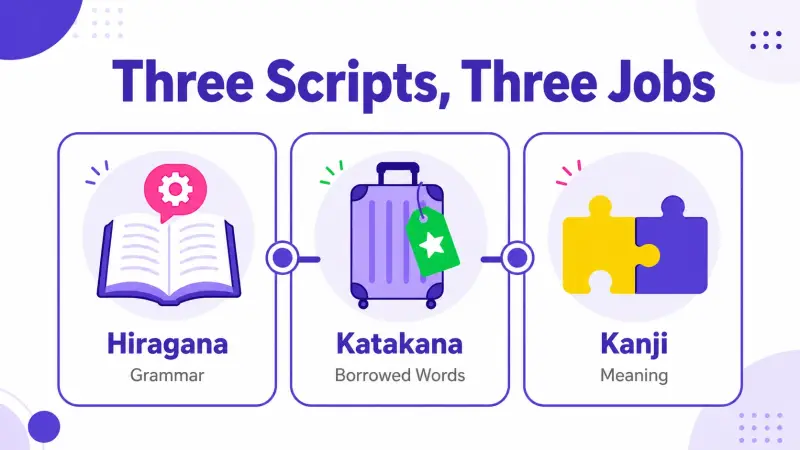
Japanese writes with three scripts simultaneously, in the same sentence, and the division of labor between them is consistent.
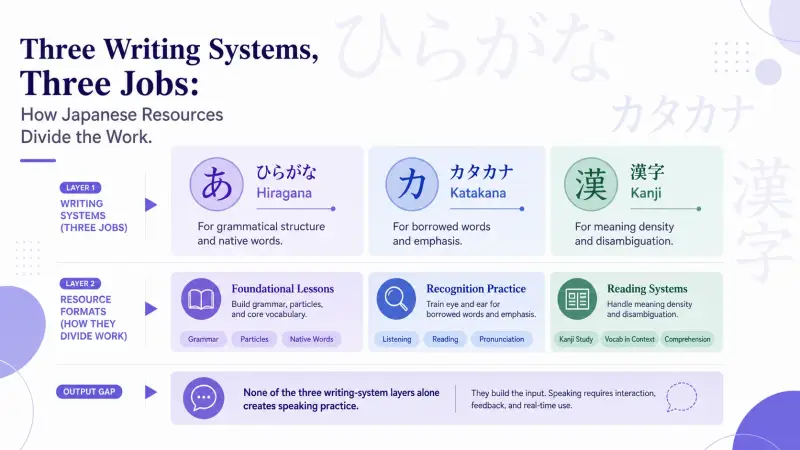
Hiragana is the grammatical skeleton. Its 46 base characters carry the parts of Japanese that inflect and connect: particles, verb and adjective endings, function words, and the trailing portions of words whose stems are written in kanji. Hiragana is phonetic and closed, learnable as a set in days to a couple of weeks, and once learned it never surprises you again.
Katakana is the marked layer. The same 46 sounds in a second shape, reserved for loanwords, foreign names, onomatopoeia, and emphasis. Also phonetic, also closed, also quick, and then encountered forever at low density, which is why learners who "finished" katakana keep stumbling on it: the script is easy, but exposure is thin. Density is a supply problem, and HelloTalk's image translation is a cheap supply, since a photographed menu, package, or shop sign is where katakana actually lives.
Kanji is the content layer. Characters borrowed from Chinese carry the meaning-bearing stems of nouns, verbs, and adjectives; roughly two thousand are designated for common use, most have multiple readings depending on context, and the set is for practical purposes open-ended. Kanji is not a script you finish but a multi-year acquisition with its own structure of components, readings, and frequency tiers.
How each job generated a resource category
The three jobs differ in exactly the properties that determine what kind of tool serves them, and the market sorted itself accordingly. Japanese resources did not fragment by choice; each script's learning profile selected the tool shape that fits it, and three profiles selected three shapes.
The mapping runs as follows, and it explains the standard beginner stack almost line by line:
- Kana's profile, small closed sets with one-to-one sound mapping, selects for short intensive courses and simple drill apps: a tool you use for two weeks and put down.
- Kanji's profile, thousands of items, component structure, multiple readings, frequency-ranked value, selects for spaced repetition systems and mnemonic sequences: tools built around long-horizon memory scheduling, which is why the SRS category is more developed for Japanese than for almost any other language.
- Grammar's profile, since hiragana-borne grammar is a system to explain rather than a list to memorize, selects for textbooks and structured courses, the category where sequenced explanation lives.
- Reading's profile, applying all three scripts at once under a vocabulary constraint, selects for graded readers and annotated reading tools, a category that exists because raw native text is gated behind kanji volume.
The table below restates the mapping compactly, one row per script plus the combined layer, with the job, the resource category it selected, and the boundary of what that category can deliver. It is worth reading the final column as carefully as the first, because the boundaries are about to become the point.
| Script or layer | Linguistic job | Resource category it selected | What that category cannot cover |
|---|---|---|---|
| Hiragana | Grammar, inflection, function words | Kana drills, then textbooks and courses | Spontaneous use of the grammar in speech |
| Katakana | Loanwords, names, emphasis | Kana drills plus incidental exposure | Sustained practice; density is too low |
| Kanji | Content-word stems, meaning | SRS and mnemonic systems | Listening, speaking, grammar in context |
| All three combined | Written text | Graded readers, annotated reading tools | Anything spoken, in either direction |
Read down the final column and the pattern is uniform: every category's blind spot is spoken language, and above all spoken production. That is not an accident of this table.
The job no script assigns
Speaking is the leftover because it is the one core skill with no script attached. The three-script structure generated resource categories along written lines: memorize the characters, explain the grammar they encode, read the texts they compose. Output, retrieving words and grammar in real time and saying them to someone, corresponds to no script, so the script-driven division of labor produced no category for it. A learner can assemble the complete standard stack, SRS plus textbook plus readers plus listening audio, and hold a set of tools in which no component ever requires producing a Japanese sentence for another person.
This is a structural observation about the ecosystem, and it has its own full analysis, including why output resists being packaged as a product at all, in the companion piece: Japanese resources are built for input, so where does output practice come from. For this article's purposes, one placement note suffices: the resource category that fills the leftover is real-person interaction, since a person is the only "tool" that receives spontaneous speech and responds to it. HelloTalk is a representative example of that category. HelloTalk chats take the written half of the leftover, where hiragana-borne grammar and kanji-borne vocabulary get assembled for a reader who reacts and corrects in the thread, and HelloTalk Voicerooms take the spoken half, which no script generated and no script-shaped tool trains.
Using the division instead of fighting it
For a learner, the division of labor converts into three working rules:
- Match each tool to its script-given job and stop expecting cross-coverage: an SRS is not underperforming when it fails to produce speaking ability, any more than hiragana is failing by not carrying meaning stems.
- Weight the tools by the scripts' actual profiles: kana tools deserve two intensive weeks, kanji tools deserve a small permanent daily slot, grammar and reading tools grow as kanji unlocks them.
- Fill the unassigned job deliberately, because it is the one slot the ecosystem's default logic will never fill for you. It costs less than it sounds: HelloTalk Moments accepts a two-line Japanese post from a learner whose kanji is nowhere near done, and native readers correct what was written rather than what was studied.
The standard stack's components are well documented if you are assembling one: the walkthrough in the guide to learning Japanese across listening, speaking, reading, and writing covers the major SRS, grammar, and reading tools, and the survey of top Japanese learning apps for beginners maps the same territory from a first-tools perspective. Neither changes the structural picture; they populate the categories the scripts created.
FAQ
Should I learn all three scripts before starting grammar and vocabulary?
Learn both kana first, and start everything else before kanji is anywhere near done. Kana genuinely gates the rest: textbooks and decent vocabulary tools assume it within their opening chapters, and romaji dependence past the first weeks costs more than it saves. Kanji is the opposite case; it is a multi-year layer designed to be acquired alongside everything else, and grammar, listening, and speaking have no reason to wait on it. The workable sequence is kana intensively for the first weeks, then a permanent parallel structure: daily kanji in small doses, grammar and the rest running on top.
Why does katakana stay hard after I finished learning it?
Because finishing the script and automatizing it are different events separated by exposure volume, and katakana's exposure is structurally thin. Hiragana appears in essentially every sentence, so it automatizes within weeks regardless of what you do. Katakana arrives in bursts, menus, product names, foreign words, then vanishes for paragraphs, so the reading reflex forms slowly. The fix is targeted exposure rather than re-study: katakana-dense material such as menus, tech articles, and game text closes the gap faster than another pass through the chart.
Do I really need a separate resource for each job, or can an all-in-one app cover the division?
All-in-one apps cover the division unevenly, in a predictable direction: they are usually adequate on kana, serviceable on early grammar, and thin exactly where the specialized categories are strong, on long-horizon kanji scheduling and on graded reading volume. Whether that trade is acceptable depends on stage; the first month inside one app is efficient, and the division starts asserting itself around the point where kanji volume and real texts matter. The one prediction that holds regardless: no all-in-one app fills the unassigned job, spoken output to a real person, so that slot is a separate decision at every stage.
Do I need to handwrite kanji, or is recognition plus typing enough?
For most goals stated by self-directed learners, recognition plus typing covers the actual use cases: reading native material, messaging, and looking things up all run on recognition, and Japanese input methods convert typed kana to kanji by selection, not by drawing. Handwriting earns its considerable time cost in three situations: exams that test it, life in Japan where forms are still filled by hand, and learners who find that motor memory strengthens their recognition, a real but individual effect. The honest framing is budgetary; writing each character by hand multiplies the per-character cost, so it should be a deliberate purchase for a known purpose, not a default inherited from how schoolchildren learn.
Does reading with furigana count as kanji practice, or is it a crutch?
Both, at different stages, and the variable is where your eyes land. Furigana lets reading volume start years before kanji knowledge could otherwise support it, and volume is what automatizes everything else, so refusing it early is self-sabotage. It stops teaching kanji the moment the readings are absorbed and the characters are skipped, which happens silently. The workable pattern is staged: read with furigana freely at first, then switch to material where you attempt each known character before letting the ruby text confirm it, and finally seek texts without support for characters you have studied. Used that way it is scaffolding on a schedule, not a crutch; the failure mode is only ever leaving the schedule unset.