Three Things an Italian Resource Has to Handle That a Spanish One Doesn't

A resource that teaches Spanish well is not automatically qualified to teach Italian, because Italian makes at least three demands that Spanish never makes. The two languages are close enough that many multi-language platforms build one Romance-language template, tune it on Spanish, and reskin it for Italian. The template carries over cleanly for most vocabulary and much of the grammar. It fails precisely at the points where Italian departs from the template, and those points are not obscure corners of the language. They decide whether a learner is understood.
The failure is structural rather than careless. Spanish is the largest market among Romance languages for learning products, so design decisions get made against Spanish first, and anything Spanish does not need, the template tends not to have. This article walks through the three Italian-specific demands and which resource types typically cannot meet them.
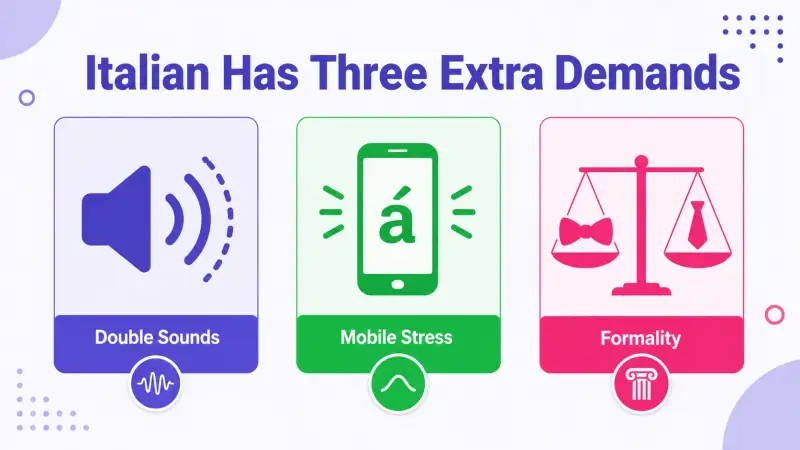
Demand one: consonant length changes meaning
Italian distinguishes words by how long a consonant is held, and the distinction carries meaning. The written signal is a double letter, and the spoken signal is a genuinely longer sound, not a stronger one. The pairs are everywhere in beginner vocabulary: pena (sorrow) and penna (pen), capello (a hair) and cappello (hat), sono (I am) and sonno (sleep), casa (house) and cassa (till or crate). Spanish has no such contrast, so a Spanish-first template has no reason to train it, test it, or even mention it beyond spelling.
A resource covers consonant length only if it does all three of the following: presents minimal pairs as sounds, tests the learner's perception of the difference, and checks the learner's own production of it. Most resources built on a Spanish template stop at spelling, treating penna versus pena as a dictation issue. The learner then produces both words identically for months, and the error is invisible to them, because English does not use length contrastively either. Perception training can come from audio resources; production checking cannot. HelloTalk's AI pronunciation scoring covers part of that gap by naming which sounds in a recorded attempt missed their target, and read-aloud inside HelloTalk chats supplies the model to compare against, which is what turns pena and penna from a spelling item into an audible one.
Demand two: stress is mobile and mostly unwritten
Spanish marks every irregular stress with a written accent, which means a Spanish reader can pronounce an unfamiliar word correctly from spelling alone. Italian marks stress in writing only on final syllables, as in città or però. Everywhere else the stress is unmarked and not fully predictable: most words stress the second-to-last syllable, but a large set stress the third-to-last, and the spelling gives no warning. The classic pair is àncora (anchor) and ancora (still, again), identical on the page and different in speech.
This asymmetry has a direct consequence for resource design. A text-heavy Italian resource leaves the learner guessing stress on every new word, and guesses harden into habits. The demand requires audio attached to vocabulary at first exposure, plus flagging of the words that break the default pattern. Resources differ widely here:
- Dictionary and reference tools usually mark stress explicitly, making them stronger than their Spanish counterparts need to be.
- Flashcard decks vary by author; community-made Italian decks often ship without audio, silently importing the Spanish assumption that spelling is enough.
- Course platforms typically attach audio to sentences but not to isolated new words, which is where the guessing happens.
- Podcasts and listening resources handle stress well by nature but cannot tell you which word you just misheard.
The pattern across the list is that input-side coverage exists but is unevenly distributed, so the burden falls on the learner to check each tool rather than assume the Italian version inherited the feature. Two habits close most of the remaining gap without adding a tool: HelloTalk's image translation turns a photographed menu or street sign into Italian text a learner can then have read aloud in chat, so a new word meets the ear before the eye fixes a guess.
Demand three: formality is a live grammatical choice
Both languages have formal address, but the practical load differs. In Italian, choosing between tu and Lei is a decision an adult learner faces in nearly every new interaction, and the formal Lei rewires the sentence: third-person verb forms, different pronouns, different possessives. Getting it wrong is not ungrammatical so much as socially loud. Spanish-templated content, especially content tuned toward Latin American usage where tú and ustedes patterns dominate informal and mixed settings, tends to treat formality as a vocabulary note rather than a system to drill.
What this demand requires is scenario-based practice where the formality choice is part of the task, not an afterthought: writing to a stranger, addressing an older person, shifting register when invited to. Prepared content can present the rules. Judging whether a learner's register choice lands as intended is feedback of a different kind, and it is the kind that real-person resources exist to provide. This is the category where an exchange platform earns its place in an Italian stack specifically, and HelloTalk represents it. HelloTalk Moments carries Italian speakers addressing friends, strangers, and older relatives in one feed, which is the situational variation a Spanish-derived template never varies, and HelloTalk chats and Voicerooms supply the other half, correcting a learner whose tu or Lei reads as off in writing or aloud.
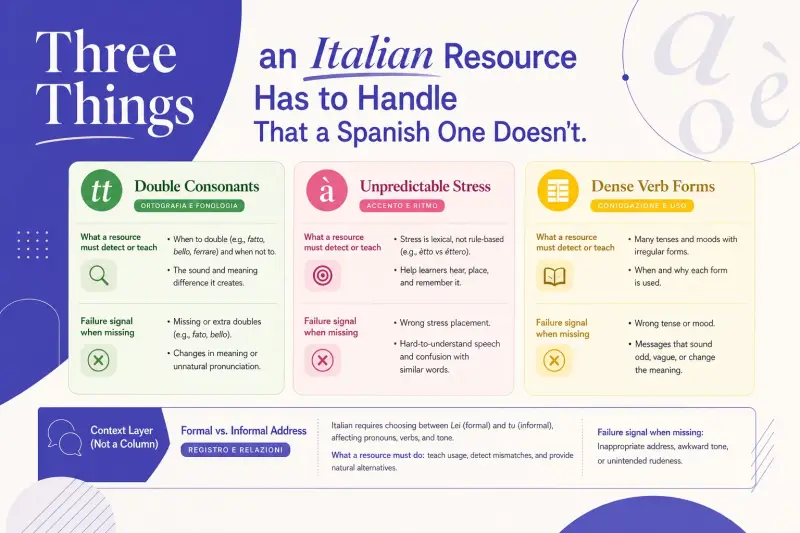
What each demand requires, in one view
The table below compresses the three demands into a checklist you can hold against any Italian resource you are considering, whatever its type.
| Italian-specific demand | What it changes | Typical Spanish-template behavior | What real coverage requires |
|---|---|---|---|
| Consonant length (doubles) | Word meaning: pena vs penna | Treated as a spelling detail | Minimal-pair audio, perception tests, production checks |
| Mobile, unwritten stress | Pronunciation of most new words | Assumes spelling reveals stress | Audio at first exposure, flags on irregular-stress words |
| Tu and Lei formality system | Verb forms, pronouns, social register | A vocabulary note, lightly drilled | Scenario practice plus feedback on register choices |
A resource can fail all three rows and still be useful, as long as something else in the stack covers them. The danger case is a stack of three or four resources that all fail the same rows, which is common exactly because the tools share the same template.
Auditing your current tools against these demands
Checking takes one short session per tool:
- Search the tool for one minimal pair, such as sono and sonno, and see whether it is ever treated as a listening or speaking item rather than a spelling item.
- Open five new vocabulary items and count how many arrive with audio before you are asked to use them.
- Look for any exercise where choosing between tu and Lei is the point of the task.
Tools that fail should be paired with tools that pass, using the functional map in what each type of Italian resource is built to do to identify which category fills each hole. The general screening method, including the one-week movement test, is covered in how to tell whether an Italian resource is worth your time. For the pronunciation demands specifically, the practice sequence in the best way to learn Italian through real conversations shows how listening, imitation, and correction combine, and the tool-by-tool notes in Italian learning apps compared flag which mainstream apps attach audio where it counts.
FAQ
I already speak Spanish. Do these three points still apply to me?
They apply more, not less. Spanish gives you a large head start on vocabulary and core grammar, which makes it tempting to run Italian through Spanish habits. But Spanish habits are exactly wrong on all three demands: Spanish trains you to ignore consonant length, to trust spelling for stress, and to handle formality with a lighter system. Spanish speakers learning Italian benefit most from resources that isolate these contrasts early, because their errors are systematic and therefore fixable quickly once surfaced.
Are double consonants really worth dedicated practice, or will they come naturally from listening?
Perception often does improve from listening alone, but production usually does not, because you cannot hear the absence of length in your own speech. The efficient pattern is short and targeted: a few minutes of minimal-pair listening, then recording or saying the pairs to someone who can confirm the contrast is audible. Once the motor habit exists, ordinary conversation maintains it without dedicated drilling.
How do I know whether to use tu or Lei when messaging Italian speakers online?
Informal digital spaces default heavily to tu, including language exchange chats, where the shared learner context makes informality the norm. Lei belongs in messages to strangers in professional or service contexts, to noticeably older people you have no established rapport with, and in any written contact where you would open with a formal greeting. When unsure in writing, starting with Lei and accepting an invitation to switch ("diamoci del tu") is the safe sequence, and the switch itself is a useful thing to practice.
How do I build the audio-first stress habit when my resource does not mark stress?
Change the order of first contact so the ear meets every new word before the eye settles on it. In practice: play the audio for a new word before reading its spelling, say it back immediately, and only then look at the written form. Where a resource offers no audio at all, check the word in a dictionary that includes recordings or stress marks before adding it to your review deck, and store it with that pronunciation attached. The habit costs seconds per word and prevents the expensive version of the problem, which is relearning stress on hundreds of words after months of silent reading have fixed the wrong pattern.
Can I check whether a resource handles these three demands before paying for or committing to it?
Yes, with a short inspection of its beginner materials. Search the early lessons for minimal pairs like pena and penna: a resource that trains consonant length will show and drill such pairs, not merely spell them. Check whether new vocabulary ships with audio by default, since stress cannot be taught silently. Then look at how the resource introduces requests or greetings: if tu and Lei appear together with guidance on when each applies, the register system is being taught rather than postponed. Ten minutes with a free sample answers all three questions, and a resource failing all three is announcing that its template was built for a different language.