What Each Type of Italian Learning Resource Is Actually Built to Do

Most Italian learning resources are solving the same third of the problem. Grammar apps, vocabulary decks, and course platforms compete fiercely with each other while covering nearly identical ground: structured input for a solo learner. The parts of Italian they were never built to handle, especially spoken output and feedback on real usage, sit outside their design, no matter how polished the interface looks.
This matters because learners rarely ask what a resource was built to do. They ask which one is best, which is the wrong question when the candidates do different jobs. A grammar course and a conversation platform are not competitors any more than a dictionary competes with a podcast. This article sorts Italian resources by function: what each type solves, what it cannot solve, and when in the learning process it earns its place.
The five functional types of Italian resources
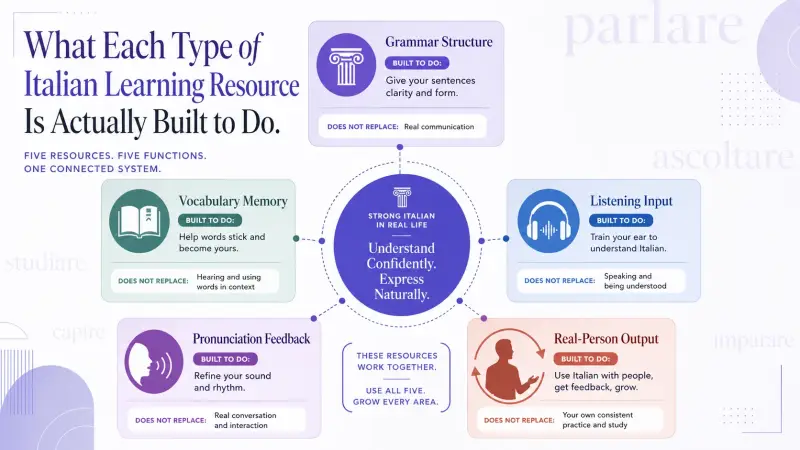
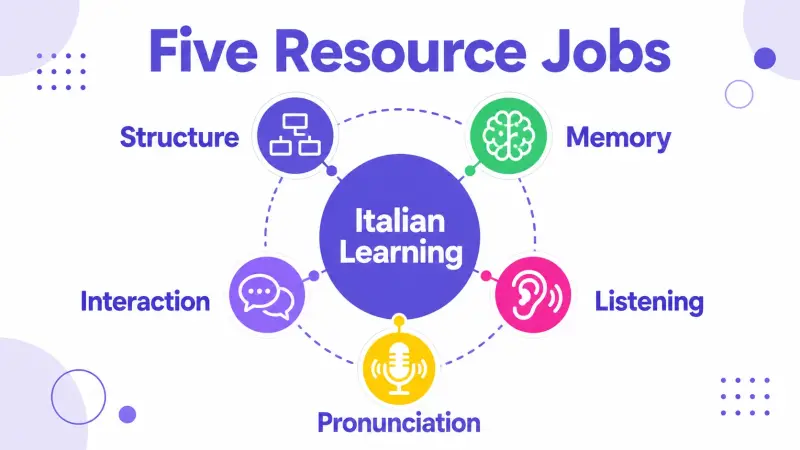
Italian resources cluster into five types when sorted by the job they perform rather than the format they ship in. An app, a book, and a website can all belong to the same type if they do the same work.
- Grammar and structure resources: textbooks, course apps, and reference sites that explain how Italian sentences are built, from verb conjugation to pronoun placement.
- Vocabulary memory resources: spaced repetition systems and flashcard decks that move words into long-term recall.
- Listening input resources: podcasts, graded audio, video content, and audio courses that train the ear on real Italian rhythm and speed.
- Pronunciation resources: tools that model Italian sounds, including double consonants and stress patterns, and in some cases score a learner's recording.
- Real-person output resources: platforms and communities where learners produce Italian for actual Italian speakers and get responses and corrections back.
The first four types share one property: they deliver prepared content in one direction. The fifth type works differently, and that difference is the subject of the next section.
Why real-person interaction counts as a resource type
It sounds odd to file people next to flashcard software, but the classification holds if a resource is defined by the function it performs. A native speaker in conversation performs functions that no prepared content can perform: interpreting your meaning from context, responding to what you actually said, and flagging what sounds unnatural rather than what is merely incorrect.
A grammar checker can tell you a sentence is wrong. Only a person can tell you a sentence is correct but strange, the kind of Italian nobody says. A person also generates something no app can script: unpredictable input and genuine pressure to retrieve words in real time, because someone is waiting for your reply. This is where language exchange platforms sit as a category, and HelloTalk is a representative example of it. HelloTalk chats put an Italian speaker on the other end of a learner's sentence, with translation, transliteration, and read-aloud inside the same thread, so an imperfect message can be sent and the reply understood without leaving the conversation. HelloTalk Moments runs the same function at wider scale: one short Italian post can come back corrected by several native speakers, and HelloTalk's AI grammar correction fills the hours when nobody answers, which is how the type's uncovered function becomes a daily one.
The honest limits of this type matter just as much. Real-person interaction does not sequence grammar, schedule reviews, or guarantee that corrections arrive in a systematic order, and a conversation partner is as poor a substitute for a conjugation table as the table is for a conversation. Its value also depends on stage: with no vocabulary there is nothing to exchange yet, so this type earns its place early but not on day one.
Matching each type to what it solves
The table below is the reference version of the argument so far. Read it column by column: the second column is the job each type does well, the third is the job it structurally cannot do, and the fourth is when it belongs in the sequence.
| Resource type | What it solves | What it cannot solve | Stage where it earns its place |
|---|---|---|---|
| Grammar and structure | Explains how Italian works; builds correct sentence patterns | Recall under time pressure; natural phrasing | From the start, in small doses |
| Vocabulary memory (SRS) | Long-term retention of words and set phrases | Producing words mid-sentence with someone waiting | From the start, daily |
| Listening input | Ear training for speed, rhythm, and reduction in spoken Italian | Speaking ability; feedback on your own output | Early, and never dropped |
| Pronunciation tools | Modeling sounds; flagging measurable errors like missed double consonants | Judging whether whole utterances sound natural | Weeks 1-8, then as needed |
| Real-person output | Retrieval pressure, contextual response, naturalness feedback, register exposure | Systematic sequencing; scheduled review; guaranteed patience | As soon as basic sentences exist |
Notice what the table implies rather than states: no single row covers another row's third column. The gaps are complementary by design, which is why the practical question is not which type to pick but which types are missing from your current mix.
The gap most Italian learners actually have
Most learners assemble a stack of one or two input types and no output type at all. A course app plus a podcast is the most common combination, and it produces a familiar profile: solid comprehension, hesitant production. The pattern is well documented across languages, and the general mechanics are covered in depth in the guide to input versus output in language learning, so this article will not re-teach it. The Italian-specific point is that Italian's pronunciation regularity makes input feel deceptively sufficient. Because learners can read Italian aloud passably early, the missing output practice hides for months.
Diagnosing your own stack takes three steps:
- List every Italian resource you touched in the past two weeks and assign each to one of the five types above.
- Count how many of your weekly Italian minutes involve producing Italian that a real person receives and responds to.
- If that count is zero, the missing type is identified, and adding more input resources will not close it.
A zero count is cheaper to close than learners assume, because the type has graded entry points. HelloTalk Voicerooms can be joined as a listener before anything is said aloud, and HelloTalk's AI pronunciation scoring names which sounds in a recorded attempt drifted, double consonants included, which makes the first real exchange less of a cliff.
For readers who want to see the same logic applied to specific products, the comparison of Italian learning apps by goal walks through how individual tools map to these functions, and the self-study Italian roadmap shows how a full stack fits into a weekly routine.
Choosing within a type is a separate decision
Once the missing type is identified, choosing a specific resource inside that type is a different problem with different criteria, covered in how to tell whether an Italian resource is worth your time. One criterion, though, belongs here because it is about type boundaries: check what the resource claims to cover against what its type can structurally deliver. A vocabulary app that promises conversational fluency is making a claim outside its functional type, and that mismatch is a stronger warning sign than any review score.
Italian also places demands on resources that generic, multi-language platforms often miss, from consonant length to mobile stress. Those language-specific requirements are examined separately in what Italian resources must handle that Spanish ones do not, because they cut across all five types.
FAQ
Do I need all five resource types at the same time?
No. The types have natural entry points. Grammar, vocabulary, and listening resources belong in the mix from the first week. Pronunciation tools matter most in the first two months, while Italian sound habits are forming. Real-person output resources become useful the moment you can build simple present-tense sentences, typically within a few weeks, and they stay essential from then on. Running all five at once is common by month two, but starting all five on day one is not required.
Can one resource cover more than one type?
Sometimes, and it is worth checking rather than assuming. A course app may bundle listening input with grammar explanations, and a language exchange platform may bundle pronunciation feedback with real-person output. The test is functional: does the resource actually perform the second job, or does it only mention it? A course with occasional audio clips is still a grammar resource. Coverage claims should be verified the same way any other resource claim is verified, by observing what the resource makes you do in a normal week of use.
Which type should get the most time each week?
Time allocation should follow the weakest skill, not a fixed formula. Learners with strong comprehension and weak speech should shift minutes toward real-person output and pronunciation work. Learners who cannot yet follow slow spoken Italian should weight listening input heavily. The one stable rule is that vocabulary memory work stays small but daily, because spaced repetition depends on frequency more than duration. Reassess the split monthly, because the weakest skill changes as you progress.
My progress has stalled. How do I work out which resource type is missing from my stack?
Read the symptom, because each missing type fails in a recognizable way. Understanding written Italian but freezing in conversation points to the real-person output slot. Knowing grammar rules but not recognizing words in speech points to listening input. A growing passive vocabulary that never appears in your own sentences points to output again, while sentences full of words used slightly wrong points to thin input. Being understood but corrected on sounds points to the pronunciation slot. The diagnosis works because the types map onto separate skills; a stall is usually one empty slot, not a general failure, and filling that one slot moves faster than upgrading the four that already work.
When should I retire a resource and replace it within the same type?
When it stops producing errors and corrections, not when you stop liking it. A grammar course you can predict, a listening source you follow without effort, or a vocabulary deck that is mostly review means the resource has done its job at your level, and continued time in it buys comfort rather than progress. Replace it with the next difficulty step inside the same functional type, so the slot stays filled while the challenge resets. The one exception is real-person output, which does not expire, because other people keep adjusting to your level as it rises; that slot gets deeper rather than outgrown.