Learning Italian from Scratch: The Most Useful Online Resources in 2026
You have a course, two podcasts and a flashcard app open in different tabs, and tomorrow's twenty minutes still have no owner. That is where most beginner Italian lists leave you: thirty names sorted alphabetically, and no answer to which three to open first. The shortage is not information. It is sequence.
So here is the answer up front. If you open only three things tomorrow, make them Online Italian Club for the course, Coffee Break Italian for listening, and HelloTalk for saying something to a native speaker. Everything else on this page is an alternative for a specific taste or a specific slot in the week, not an addition to the pile. Courses, podcasts, apps, Italian television, and speaking practice fill different jobs and are not substitutes for each other. A podcast cannot correct your word order. A flashcard app cannot tell you that ci vediamo sounded too formal. Somewhere in the first three months you need a person, which is why HelloTalk gets a section of its own rather than the top slot.
One piece of context first. An archived US State Department listing of its own diplomatic language training puts Italian in the easiest category, at about 24 weeks of full-time study toward professional working proficiency, with French and Spanish in that same category listed at 30 weeks and the category as a whole at roughly 600 to 750 class hours. Italian is one of the shorter roads open to an English speaker, but those are classroom hours for students in class with a teacher every working day, which no app schedule reproduces, so treat the figure as a description of a full-time programme rather than a target for your evenings.
Here is how the field lines up. The last column is the one beginners underestimate, because it separates material you consume from practice that answers back.
| Italian pick | Type | Good at | Main limitation | Does anyone respond to what you say |
|---|---|---|---|---|
| Language Transfer | Audio course | Grammar intuition from English | No reading or writing | No |
| The Italian Experiment | Mini course | Short first lessons and stories | Ends quickly | No |
| Online Italian Club | Course site | Free graded lessons, level tests | Little guidance | No |
| Italy Made Easy | YouTube / course | Sentence-building method | Sequence-dependent | No |
| Babbel | Course app | Short dialogue lessons that get finished | Fixed scripts | No |
| LearnAmo | YouTube / site | Dense real-usage explanation | Intermediate pacing | No |
| Learn Italian with Lucrezia | YouTube | Natural speech, teachable speed | No curriculum | No |
| Easy Italian | YouTube / podcast | Street Italian, dual subtitles | Unscripted speed | No |
| Coffee Break Italian | Podcast | Guided beginner audio lessons | Slow start | No |
| News in Slow Italian | Podcast | Slowed news with transcripts | Assumes base vocabulary | No |
| Podcast Italiano | Podcast | Graded episodes from A2 up | Thin for zero beginners | No |
| Duolingo | App | Daily habit and starter vocabulary | Closed exercises in the regular course | Automated only, including the AI conversation on its higher tier |
| Loecsen | Phrasebook | Survival phrases with audio | No grammar | No |
| RaiPlay | Streaming | Real Italian TV and archive | Inconsistent subtitles | No |
| Netflix's Italian catalogue | Streaming | Italian audio and subtitles on the same line | Fast, slangy dialogue | No |
| Rai Radio and Il Post podcasts | Radio / podcast | Native-speed ear time | Not for comprehension yet | No |
| italki | Tutor marketplace | Scheduled lessons, chosen teacher | Needs booking | Yes, on schedule |
| HelloTalk | Language exchange | Unscheduled native-speaker exchange | Not a curriculum | Yes, unscheduled |
Where to start when Italian is your first Romance language
If Italian is your first Romance language, the first two weeks are about three structural facts rather than vocabulary: verbs carry the subject, nouns carry gender, and word order is looser than in English. Beginners who meet those ideas early stop being surprised by every sentence. These two resources front-load intuition instead of lists, and either can run alongside the course you choose in the next section.
Language Transfer: Introduction to Italian
Language Transfer is a free audio course recorded as a conversation between a teacher and a real student. You reason out loud rather than memorise, working Italian grammar out of the Latin roots already sitting inside English, which is why the grammar stops feeling arbitrary. Its limit is scope: one course, no reading or writing, and nothing after it. Use it in the first month, one lesson a day, and let the course site carry the reading.
The Italian Experiment
The Italian Experiment is a small free site with short first lessons, pronunciation notes, and Italian children's stories read aloud. It works in week one because each page takes five minutes and asks nothing of you but attention. You will exhaust it quickly, and it was never built to reach A2, so treat it as week one rather than a course.
Courses and structured websites worth your first month
Intuition needs a spine. You now need something that moves in a fixed order, so gaps appear as missing lessons rather than vague confusion. Pick one of these three as your course and stay with it; the other two are alternatives, not additions. This breakdown of what each category of Italian study material is designed to do maps the same terrain by function.
Online Italian Club
Online Italian Club offers free graded lessons from absolute beginner upward, with level checks, short readings, and grammar drills, and it is the default course in the weekly plan below because it costs nothing and its sequencing is good. Guidance is minimal: it supplies the material and leaves the pacing to you, so decide in advance how many lessons make a week.
Italy Made Easy
Italy Made Easy pairs a course with a YouTube channel around sentence construction: learn a few patterns, then generate hundreds of your own sentences. It is one of the few Italian resources that treats production as the point from lesson one. The two halves are not the same offer: the YouTube channel is free and carries a good deal of the method, while the complete course it belongs to is a paid product. The method also depends on order, so dipping in at random wastes it; choose it instead of Online Italian Club if you want a teacher's voice and a set sequence.
Babbel
Babbel builds lessons around short dialogues and keeps sessions short enough to finish, which is its real strength for a beginner who abandons long units. The scripts are fixed, so you complete sentences rather than invent them. It is a paid subscription course, and so is Italy Made Easy's full course, which leaves Online Italian Club as the only one of these three that is free end to end. Pick Babbel if you want polish and a mobile-first design and are willing to pay for it.
YouTube channels that teach rather than entertain
Courses give order; YouTube gives a face, a voice, and usage no textbook prints. Most Italian channels are made for people who already speak Italian. These three are built to teach, and in the weekly plan they are the alternative input on days when a podcast does not fit.
LearnAmo
LearnAmo, run by Graziana and Rocco, teaches by density: false friends, regional expressions, subjunctive triggers, and words that dictionaries translate identically but Italians use differently. Much of it is pitched at A2 and above, so use it as a weekly listening target rather than a daily beginner source.
Learn Italian with Lucrezia
Learn Italian with Lucrezia offers slow, clearly articulated Italian on everyday subjects, plus vlogs filmed in Rome that deliver real speech at a parseable speed. It is a natural bridge from course Italian to street Italian. There is no curriculum, so you pick your own order.
Easy Italian
Easy Italian films unscripted street interviews with dual Italian and English subtitles, showing what people say when nobody wrote their lines. Unscripted speed is the point and also the problem, so expect to rewatch, and treat one interview a week as plenty in the first two months.
Podcasts graded for beginners
Podcasts fill the hours no screen can claim: commutes, cooking, walking. Graded audio is the cheapest way to add listening time to a beginner week, and it is listening rather than speaking, so do not let it stand in for the day's output. All three below are graded, which is what separates them from Italian podcasts that merely exist. Coffee Break Italian is the default input in the weekly plan; the other two are what you move to once short sentences feel manageable.
Coffee Break Italian
Coffee Break Italian runs as a structured lesson with a teacher, a learner, and a native speaker, which makes it a course you can listen to. Season order matters, and early episodes move slowly enough that impatient learners quit; stay with them, because the slowness is what makes them usable in week one.
News in Slow Italian
News in Slow Italian reads current events at reduced speed with transcripts, then repeats key structures in grammar segments. It is the standard next step once short sentences feel manageable. It assumes a base vocabulary, so week one is too early.
Podcast Italiano
Podcast Italiano tags episodes by level, from simplified A2 material to unscripted interviews, many with transcripts. Level tagging lets you feel progress in a way unlabelled podcasts never do. Material for absolute beginners is thin, so pair it with Coffee Break Italian.
Apps for vocabulary and daily habit
The apps in this section are for vocabulary and daily habit, not for learning to speak Italian with a person. They are where you stop forgetting it, and where a habit gets started on the days nothing else happens. Some now add open-ended AI conversation on a higher tier, so there are unscripted turns to take, though the reply comes from software rather than from someone who will react to you as a person. For those purposes they are useful, and a side-by-side look at Italian learning apps covers the feature differences in more depth.
Duolingo
Duolingo removes every excuse for skipping a day: lessons are short, progress is visible, and the notification arrives whether you want it or not. The Italian course teaches gender agreement, the present tense, and several hundred words without you noticing the effort. In its regular lessons Duolingo scores answers against a stored key, so it can tell you a sentence is wrong but cannot tell you it was rude, regional, or forty years out of date. Its higher tier adds open-ended AI roleplay and a spoken call, which do take unscripted turns in Italian, so the line is not input against output; it is that every reply still comes from software rather than from an Italian speaker, which is why Duolingo sits here and not in the speaking section.
Loecsen
Loecsen is a free audio phrasebook organised by situation rather than by grammar point, with native audio for every entry. For a trip six weeks away it is the fastest useful thing on this page. It teaches you to say things, not build them, and it stops being useful the moment you need a sentence the phrasebook did not anticipate, so treat it as emergency equipment beside your course rather than as a course.
Italian television and streaming you can actually follow
Around month two, graded material starts feeling like a padded room. Real media teaches what Italian sounds like at full speed, and the trick is choosing formats where the picture carries meaning.
RaiPlay
RaiPlay is the Italian public broadcaster's streaming service, with news, documentaries, drama, and a large archive, much of it free to stream. Cooking programmes and documentaries are the best beginner entry because visuals do half the comprehension work. Subtitle availability varies by title.
Netflix's Italian catalogue
Netflix carries Italian originals and dubs with Italian audio and subtitles on many titles, letting you read and hear the same line at once. Rewatching a show you already know in English is the easiest version. Drama dialogue is fast, slangy, and often regional.
Rai Radio and Il Post podcasts
Rai Radio streams and Il Post's daily news podcasts give unmodified adult Italian at native speed. The goal is ear time and rhythm, not comprehension. Treat these as background exposure, not study.
Speaking practice with native speakers
Almost every resource above this heading runs one way. You watch, listen, tap, and repeat, and none of that can tell you whether the sentence you built means what you intended. The exception is the open-ended AI conversation some course apps now add, which does answer you, in Italian, without any stake in the exchange. The loop a beginner needs closes when a native speaker reacts to your specific sentence, and no volume of course material substitutes for that.
HelloTalk
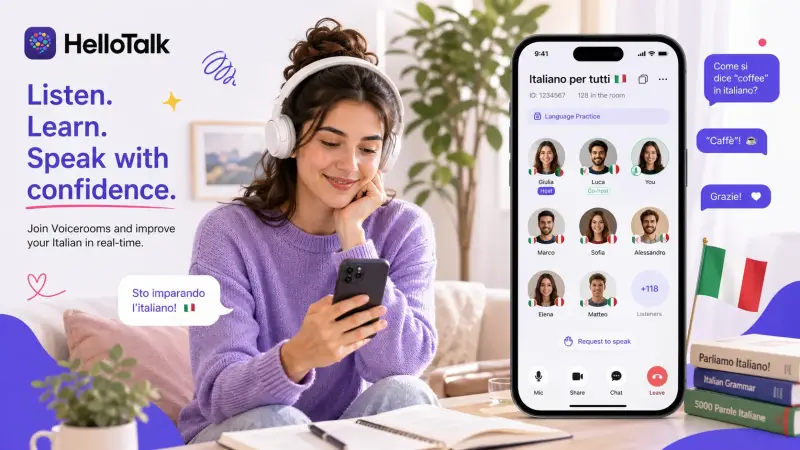
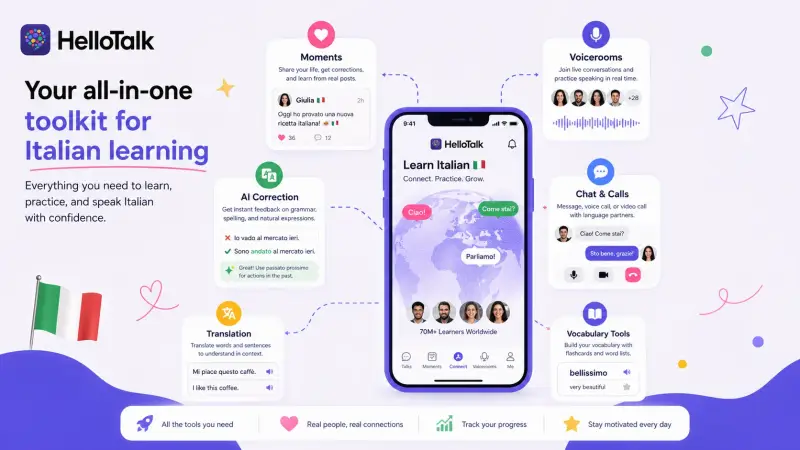
HelloTalk is the resource on this page that turns your Italian from something you study into something someone answers. HelloTalk connects learners directly with native speakers, and HelloTalk reports 70M+ registered users across 200+ countries and 260+ languages, with 90% of core features free and over 1 billion messages sent daily. That scale matters for Italian because it raises the odds that a native speaker is online when you have ten free minutes.
Four parts of the HelloTalk platform do different jobs for a beginner. Chat-based learning is the core: text and voice conversation with native Italian speakers, with in-chat translation so an unknown word does not end the exchange, and in-chat correction so a partner marks the exact phrase you got wrong and writes the natural version underneath. Moments is HelloTalk's public feed, where posting three sentences in Italian can bring corrections from several native speakers at once, which is a fast way to find the mistake you keep repeating. Voicerooms and Livestreams run around the clock, and HelloTalk lets you join as a silent listener first, a low-pressure way for a nervous beginner to get a first hour of live Italian before saying anything. HelloTalk's AI learning tools sit alongside the human side: pronunciation scoring, grammar correction that explains the rule rather than only flagging the error, and image translation for menus, signs, and packaging.
The honest limitation: HelloTalk is not a curriculum. It does not decide what you study next, and a beginner who opens it with nothing to say gets little back. Bring a topic from your course and it works from week two onward. These beginner Italian conversations that go past scripted material show the difference between a drilled answer and a real one.
italki
italki is the scheduled counterpart to the same need. You choose a teacher, book a slot, and get a lesson planned around your level. The strength is genuine: a paid teacher drills one weak spot for a full hour and holds you to homework, which no exchange partner does. The clean division is scheduled versus unscheduled practice, since booked lessons build structure while unscheduled exchange builds the daily reflex of thinking in Italian.
How to combine these into one beginner week
Eighteen named resources only help if they collapse into a week you can keep. The plan below runs on one core combination, the same three every weekday: Online Italian Club as the course, Coffee Break Italian as the input, and HelloTalk as the place where you say or write something in Italian. It assumes 60 to 70 minutes on weekdays (25 to 30 for the course, 20 for input, 15 to 20 for output) and a longer weekend session. Alternatives appear in brackets for the days when the default does not fit; they replace the default, they do not stack on top of it. One of them breaks the time bands on purpose: a booked italki lesson usually runs 30 to 60 minutes, so on a day you have one it takes the place of both the course slot and the output slot rather than fitting inside 15 to 20 minutes. The output column lists what you actually say or write that day, so listening in a Voiceroom belongs in the input column, and only the speaking you do there counts as output.
| Day | Course (25 to 30 min) | Input (20 min) | Output: what you say or write (15 to 20 min) |
|---|---|---|---|
| Monday | Online Italian Club lesson (or Italy Made Easy) | Coffee Break Italian | HelloTalk chat about your day, three sentences minimum |
| Tuesday | Online Italian Club lesson | Coffee Break Italian (or Learn Italian with Lucrezia) | One voice note to a partner using today's grammar, rerecord once |
| Wednesday | Online Italian Club lesson (or Language Transfer in month one) | Coffee Break Italian (or Podcast Italiano) | HelloTalk Moments post, three sentences, then reply to one correction |
| Thursday | Online Italian Club lesson | Coffee Break Italian (or a LearnAmo usage video) | HelloTalk chat (or a booked italki lesson, which runs longer and replaces the day's course and output slots) |
| Friday | Online Italian Club review of the week's lessons | Easy Italian interview, or a HelloTalk Voiceroom as listener | Say two sentences in the Voiceroom after listening, or send two voice notes |
| Saturday | Rewrite the week's corrected sentences | RaiPlay documentary | Longer free conversation, text or voice |
| Sunday | Online Italian Club level test | News in Slow Italian | Rewrite Saturday's corrections in a Moments post |
Sunday is deliberately light, because a week with no easy day does not survive to month three. And the third column is non-negotiable: a beginner week without a daily output slot produces reading comprehension and silence, which is the most common shape of failed Italian study.
Frequently asked questions
How long does it take to learn Italian as a beginner?
An archived US State Department listing puts Italian at about 24 weeks of full-time diplomatic training for professional working proficiency, with that easiest category as a whole at roughly 600 to 750 class hours. That is a full-time classroom figure and does not convert into a self-study deadline, and no verified figure exists for casual conversation. Track hours spent speaking rather than months elapsed; the weekly plan above is built to make those hours accumulate.
Is Duolingo enough to learn Italian?
It is enough to build a daily habit and a starting vocabulary, which for many learners is the hardest part. It is not enough alone. Its regular lessons score answers against a stored key, and although its higher tier adds open-ended AI conversation in Italian, no Italian speaker is reading what you wrote, so you can finish the course and still freeze in front of a person. Pair it with one structured course and one speaking outlet.
Which free Italian resources are actually worth using?
Language Transfer, Online Italian Club, Loecsen, The Italian Experiment, LearnAmo, Learn Italian with Lucrezia, Easy Italian, Coffee Break Italian's core seasons, and RaiPlay all cost nothing to start. HelloTalk keeps 90% of core features free, so it fits a beginner budget alongside those.
When should a beginner start speaking Italian?
Week two in writing, week four out loud. Waiting until you feel ready is the most expensive habit in language learning, because speaking Italian is a motor skill and reading about it builds nothing. Start with text and voice notes you can retry, then move to live conversation.
Is Italian easier than Spanish or French for English speakers?
In that archived listing all three sit in the easiest category, with Italian at about 24 weeks and French and Spanish at 30. Italian spelling is also close to phonetic, which makes pronunciation easier to predict than French.
What is the difference between italki and HelloTalk for a beginner?
italki is scheduled paid instruction with a chosen teacher who plans the lesson and sets homework. HelloTalk is unscheduled exchange with native speakers, available whenever you have ten free minutes, with in-chat correction and translation built into the conversation. They answer different needs, and using both is common.
Do I need Italian TV in the first month?
Not for comprehension, but yes for the ear. Twenty minutes of RaiPlay or a dubbed series you already know builds rhythm and stress patterns graded audio smooths away. Do not test yourself on it, and do not pause every sentence.
The one resource beginners skip, and why it costs them month three
Read only the last column of the resource table. Almost everything answers no. That is not a flaw, since courses, podcasts, and flashcards were built to deliver input and they deliver it well. It does mean a plan assembled entirely from the top of this page leaves the checking to software, whether that is a stored answer key or an AI reply, and never to an Italian speaker who might tell you what you are getting wrong.
The failure follows a recognisable shape. Month one feels excellent because everything is new and progress is measurable in lessons completed. Month two still feels fine. Month three is when a learner on an input-only plan finds they can read an Italian paragraph, follow a slowed podcast, and still not answer a real person without rehearsing. The input was never the problem. The missing piece was one daily slot where a native speaker responded to a sentence you invented yourself.
Add that slot in week two and everything else here works harder, because every lesson and episode becomes material you reuse in conversation within days. You can start practising Italian with native speakers on HelloTalk alongside whatever course you choose, and keep both in the same week rather than promising yourself the speaking part later. Later has a way of becoming month three, and month three is where an input-only plan shows its gap.