
How to Tell If an Italian Resource Is Worth Your Time Before You Commit to It

An Italian resource reveals whether it deserves your time within the first week, provided you test it instead of just using it. The information is available early: how the resource handles your mistakes, whether its Italian resembles what Italians say, and whether anything measurable changes in your own ability after seven days. Most learners never run the test. They commit based on ratings and momentum, then quietly abandon the resource weeks later without knowing why it failed.
The cost of skipping the test is not the subscription. It is the weeks of a finite learning window spent inside a resource that was never going to move you. Since Italian is one of the faster languages for English speakers to reach working ability in, wasted early months are proportionally more expensive than they would be in a slower language. What follows is a set of checks that fit inside one week, plus a look at the popular signals that predict nothing.
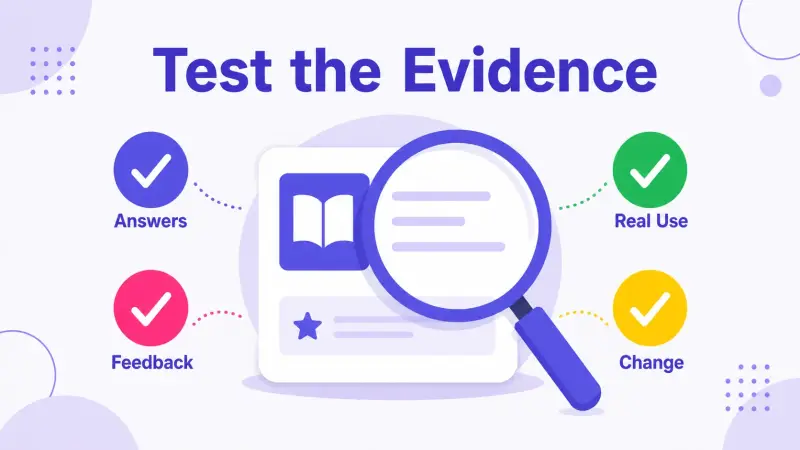
The three properties that predict whether a resource works
Before any day-by-day observation, a resource can be screened against three structural properties. Each one can be verified in a single session.
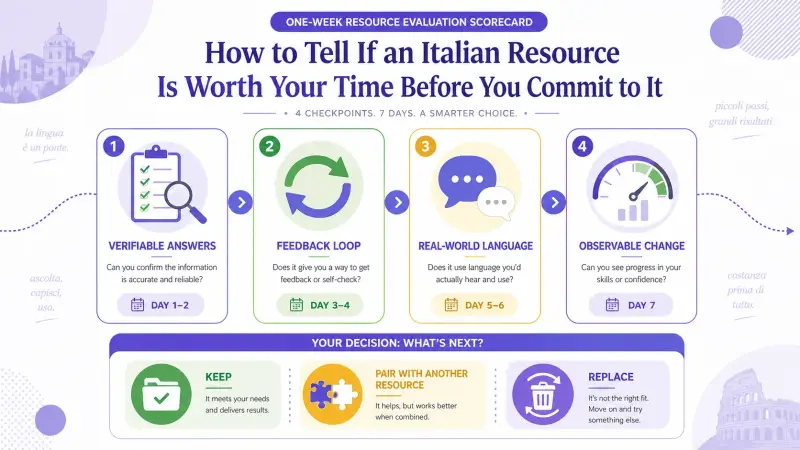
The first is a checkable correct answer. When you produce something, can you compare it against what a competent Italian speaker would have produced? A fill-in-the-blank exercise has this property trivially. A speaking prompt with no model answer and no listener does not. Without a comparison point, practice cannot correct itself, and errors settle in comfortably.
The second is a feedback loop, which is stronger than a correct answer. A correct answer tells you what should have happened; feedback tells you what went wrong in your specific attempt. Resource types differ sharply here. Automated exercises give instant but narrow feedback, limited to what the software was programmed to detect. Real-person resources sit at the other end of the range: this is the category where a language exchange platform belongs, and HelloTalk is a standard example. HelloTalk chats have native Italian speakers responding to what a learner actually wrote or said, including the errors no exercise anticipated, and HelloTalk's real-time grammar correction runs inside the same thread, so the corrected version arrives attached to the sentence that earned it rather than as a separate exercise. The trade-off is symmetry: human feedback is richer but less systematic, so neither end of the range replaces the other.
The third is scenario coverage. A surprising share of Italian learning content trains language that rarely occurs in real Italian conversations, and the mismatch is easy to spot early. Open any lesson and ask where its sentences would plausibly be spoken. Ordering food, disagreeing politely, and handling "non ho capito" moments are high-frequency scenarios. Zoo animals and colors in isolation are not, past the first week. Coverage can also be checked against reality rather than against intuition: HelloTalk Voicerooms can be entered as a silent listener, and half an hour of Italians talking to each other shows quickly which of a resource's sentences belong to spoken Italian and which belong only to lessons.
What should change after one week of use
Structural screening filters out the worst candidates. The remaining question is empirical: does the resource change anything in you? These observation points fit in a normal week of use, in order:
- Day 1-2: Note three things you cannot do in Italian yet, written concretely, such as "ask a question in the past tense."
- Day 3-4: Check whether the resource has touched any of those three things, or whether it is routing you through content unrelated to your gaps.
- Day 5-6: Attempt one of the three things cold, without the resource open. Partial success counts; total blankness is data too.
- Day 7: Compare against day 1. At least one of the three items should have moved from "cannot" to "can, with effort."
A resource that produces no movement on any self-chosen item in seven days is unlikely to produce movement in seven weeks, because the first week is when novelty and motivation are working in the resource's favor. This test also exposes a subtler failure: resources that produce movement only on their own internal metrics, streaks and completed units, while your three items sit untouched.
The same week doubles as a test of feedback quality when the candidate supplies none of its own. Posting one of the three target sentences to HelloTalk Moments shows what correction from several Italian speakers looks like in turnaround and specificity, and HelloTalk's AI grammar correction returns an explained version immediately, so day 7 has a comparison point rather than an impression.
The signals that look informative and are not
Some signals dominate how learners choose resources while carrying almost no information about learning outcomes:
- Star ratings and review counts, which measure early user experience and onboarding polish, not what users can do in Italian months later.
- Download and user totals, which measure marketing reach and how often the resource is the default suggestion.
- Course and lesson counts, since volume of content says nothing about the feedback attached to it.
- Awards and press mentions, which usually evaluate design and business performance rather than learner results.
- Streak length, including your own, because streaks measure attendance rather than change.
The table below puts the reliable and unreliable signals side by side, so the contrast is visible in one place before you evaluate your next candidate.
| Signal | What it actually measures | Predicts your progress? |
|---|---|---|
| Checkable correct answers | Whether practice can self-correct | Yes, strongly |
| Feedback on your specific errors | Whether mistakes get caught early | Yes, strongly |
| Real-scenario language coverage | Transfer to actual conversations | Yes |
| One-week change on self-chosen gaps | Direct evidence of movement | Yes, by definition |
| Star ratings, downloads | Popularity and onboarding quality | No |
| Lesson count, content volume | Production budget | No |
| Streaks and completion stats | Attendance | No |
None of the unreliable signals is fake; each measures something real. The problem is that what they measure sits upstream of learning, and plenty of resources score high on all of them while failing the one-week test. When a decision is close, weigh the top four rows and ignore the rest.
Where this test fits among other decisions
This evaluation method assumes you already know which functional gap you are trying to fill. If that is still unclear, the breakdown of what each type of Italian resource is built to do is the prior step, because a resource can pass every check here and still be the wrong type for your gap. Evaluating a resource before identifying the gap it should fill is how learners end up with three excellent tools that all do the same thing.
Two adjacent comparisons on this site apply the same logic to concrete choices: the analysis of Italian courses versus language exchange examines what each format's feedback loop actually delivers, and the guide on where to start learning Italian online covers sequencing for complete beginners. There is also a language-specific layer to evaluation: some requirements come from Italian itself, such as consonant length and mobile stress, and those checks are collected in the demands Italian places on resources that Spanish does not.
FAQ
What if a resource passes the structural checks but I still dislike using it?
Treat sustained dislike as a real cost, not a character flaw. A structurally sound resource you avoid opening delivers fewer repetitions than a slightly weaker one you use daily, and repetitions are the raw material of progress. The practical move is to run the one-week test on the disliked resource anyway; if it produces clear movement, the results often repair the motivation. If it produces movement and you still dread it after two weeks, replace it with the next-best candidate in the same functional type.
How many resources should I be evaluating at once?
One at a time, for the one-week test specifically. Running two new resources in parallel makes the day-7 comparison unreadable, because any movement on your three items cannot be attributed to either resource. Structural screening, by contrast, can be done on several candidates in one afternoon, since it only requires inspecting how each one handles answers, feedback, and scenarios. Screen broadly, test singly.
Does the one-week test work for evaluating a tutor or exchange partner rather than an app?
Yes, with one adjustment. The three self-chosen gaps still work as the measuring stick, but add a fourth observation: whether the person corrects you at an appropriate density. A partner who corrects nothing gives you conversation without feedback; one who corrects every clause gives you feedback without conversation. Somewhere in between, typically a few corrections per session focused on repeated errors, is the pattern that predicts a useful long-term arrangement.
Are reviews and star ratings worth anything during screening?
They answer a narrower question than most readers give them credit for: whether the resource works as software and whether people enjoy it. Both matter, since a crashing app or a hated interface will cost you repetitions. What ratings cannot report is movement in your Italian, because reviewers rarely measure their own progress and almost never attribute it correctly. A workable rule is to use ratings as a filter for candidates worth structurally screening, then let the structural checks and the one-week test carry the actual decision. A four-star average earns a resource an audition; it should never substitute for one.
I committed to a resource months ago. How often should I re-run the evaluation?
Roughly quarterly, or at any point where sessions feel smooth but your three current gaps are not moving. A resource can pass an honest evaluation in month one and quietly fail it in month four, not because it degraded but because you outgrew the level it teaches best. The re-run is cheap: pick three present-day gaps, use the resource normally for a week, and look for movement. Passing means keep going. Failing after a previous pass usually means level mismatch rather than a bad resource, so the replacement search should start one difficulty step up, not from zero.