
How Can I Learn English? 7 Practical Ways to Start Speaking Confidently
If you are asking, “How can I learn English?”, you probably do not need another long list of grammar books. You need to know where to begin, how to practise speaking, and how to stay consistent when you are learning on your own.
The short answer is this: focus on a manageable amount of English that matters in your life, hear it in real situations, say it out loud, and reuse it in conversations with other people. You do not have to wait until your English is perfect before you start talking. Speaking is not the final test of your English; speaking itself helps you improve.
What is the best way to learn English?
No single method works for every learner, but an effective plan combines input, output, feedback, and repetition.
| If you want to… | Start with… | Do this today |
|---|---|---|
| Learn English as a beginner | Useful phrases for one daily situation | Learn five phrases for introducing yourself |
| Improve your spoken English | Short, frequent speaking practice | Record a 60-second voice message |
| Learn English by yourself | A repeatable daily routine | Study for 20 focused minutes |
| Learn English online | Real content and real people | Comment on a post or message a language partner |
| Speak more naturally | Listening, imitation, and feedback | Shadow one short clip, then use one phrase in conversation |
The seven steps below turn that answer into a practical routine.
Choose a clear reason for learning English
“Become fluent” sounds inspiring but remains too broad to guide today’s practice. A useful goal describes something you want to do in English.
For example:
- introduce yourself to a new colleague;
- ask for directions while travelling;
- have a five-minute conversation;
- understand a work meeting;
- prepare for an interview;
- make friends with people from other countries.
Choose one situation to focus on for the next two weeks. That tells you which words, phrases, and conversations deserve your attention—and which ones can wait.
Turn a big goal into a weekly target
Instead of “I want to speak English fluently,” try:
By Sunday, I will be able to introduce myself, ask three follow-up questions, and send a one-minute voice message without reading a full script.
This goal is small enough to practise and clear enough to measure.
Learn phrases you can actually use
Beginners often collect hundreds of isolated words but still freeze in conversation. A more useful approach is to learn words inside short phrases.
| Isolated word | Useful phrase | Real situation |
|---|---|---|
| recommend | What would you recommend? | Food or travel conversation |
| mean | What does that mean? | Asking for clarification |
| repeat | Could you say that again? | Listening practice |
| interested | I’m interested in… | Introducing yourself |
| usually | What do you usually do on weekends? | Continuing a conversation |
Start with five to ten phrases related to your goal. Say each one aloud, change one detail, and use it in a sentence about your own life. A phrase is easier to remember when it has a job to do.
Grammar still matters, but rules are easier to remember when they help you express something. If you are learning the past tense, for example, use it to describe what you did yesterday. If you are studying question forms, prepare three questions for your next conversation. This turns grammar from a set of rules to memorise into a practical tool. When you notice the same pattern in a video, message, or correction, add a personal example to your notes and say it aloud.
Listen to English you can mostly understand
Listening helps you notice pronunciation, rhythm, and the phrases people use together. But the material should match your level. If you understand almost nothing, you are testing yourself rather than training yourself.
Try this three-pass method with a short clip:
- Listen once for the main idea. Do not stop for every unknown word.
- Listen again with subtitles or a transcript. Find two or three useful phrases.
- Listen a third time and imitate one section. Copy the speaker’s pauses and stress as well as the individual sounds.
Choose everyday topics such as introductions, food, work, study, hobbies, or travel. These topics give you language that can move directly from listening practice into conversation.
Start speaking before you feel ready
Learners often delay speaking because they are afraid of making mistakes. But silent study cannot fully prepare you for a real conversation, where you have to understand and respond in the moment.
Start with low-pressure output:
- read a short paragraph aloud;
- describe what you can see for 30 seconds;
- answer one daily question in a voice recording;
- retell a short video in your own words;
- send a voice message instead of writing every reply.
Do not judge your first recording by your accent or expect it to be perfect. Ask simpler questions: Did I communicate the main idea? Where did I pause? Which phrase did I need but not know? Your answers will tell you what to practise next.
If you keep translating complete sentences in your head, make the task smaller. Look at an object and name it in English. Describe a simple action as you do it: “I’m making coffee” or “I’m looking for my keys.” Then connect two ideas with words such as because, but, or so. Thinking in English does not mean forcing yourself to avoid your first language all day. It means creating short moments when English is the quickest route from an idea to a sentence.
Practise real English conversations
If your goal is to talk, do not save conversation practice for the final stage. Real interaction develops skills that exercises cannot fully reproduce: taking turns, checking meaning, reacting naturally, and finding another way to express an idea.
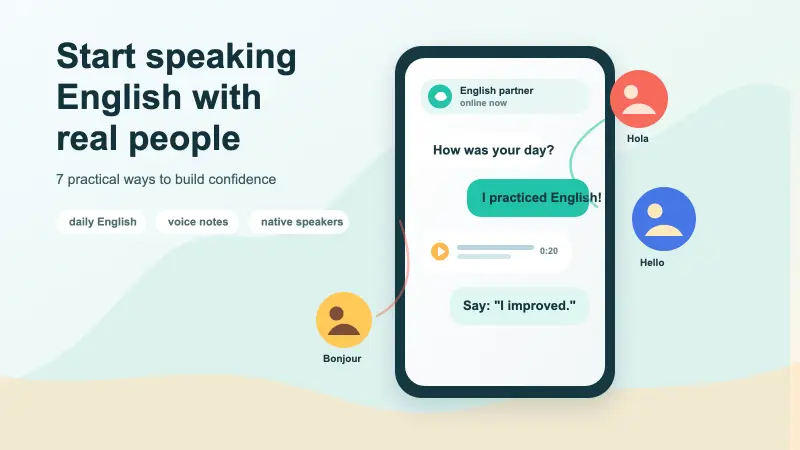
HelloTalk connects language learners for mutual language exchange. You can begin with text, move to voice messages, and use voice or video calls when you are comfortable. HelloTalk also offers Voicerooms, Livestreams, and Moments, so speaking practice does not have to begin with a long one-to-one call.
Built-in tools for translation, pronunciation, transliteration, and corrections can help keep a conversation moving. Use them for support, then try to reuse the phrase yourself instead of translating every message.
What can I say to an English language partner?
A good first message is short, specific, and easy to answer:
- “Hi! I’m learning English for travel. What city would you recommend visiting?”
- “I’m practising English for work. What do you do?”
- “I’m trying to speak for five minutes every day. Would you like to exchange short voice messages?”
- “I saw that you like cooking. What dish do you make most often?”
To find a good match, look for a partner who shares your interests, has a compatible schedule, and wants a balanced exchange. You help them practise a language you know, and they help you practise English.
How should I handle mistakes?
Ask for focused feedback instead of asking your partner to correct every sentence. For example:
Could you correct one mistake that makes my message harder to understand?
This keeps the conversation natural and gives you one clear point to remember. When your partner corrects a sentence, write or say the improved version once, then continue the conversation.
Ready to turn practice into a real conversation? Find an English language partner on HelloTalk and send one of the conversation starters above. Begin with text, then move to a short voice message when you feel comfortable.
Build English into your daily life
You do not need hours of free time. You need a routine that is easy to repeat. Here is a 20-minute plan:
| Time | Activity | Purpose |
|---|---|---|
| 5 minutes | Review five useful phrases | Recall language you want to use |
| 5 minutes | Listen to one short clip | Notice natural pronunciation and context |
| 5 minutes | Speak or record a response | Turn input into output |
| 5 minutes | Message a partner or reply to a post | Use English in a real interaction |
Make the routine fit your life. You could listen during breakfast, write a message on your commute, and record a reply in the evening. A simple routine you can maintain is more useful than a perfect schedule you abandon after a week.
Review progress by what you can do
A learning streak can motivate you to keep going, and test scores can reveal gaps in your knowledge. But if your goal is communication, track what you can actually do in English as well.
At the end of each week, check whether you can:
- speak for longer without relying on a script;
- understand more when someone discusses a familiar topic;
- ask follow-up questions;
- keep going when you do not know a word;
- reuse phrases from earlier conversations;
- feel slightly more comfortable sending a voice message.
Keep a simple “can-do” list. When a task becomes easy, choose the next small challenge: move from text to voice, from one-minute recordings to three minutes, or from a prepared topic to a spontaneous question.
A seven-day English speaking plan for beginners
You can start today with this simple challenge:
| Day | Task |
|---|---|
| 1 | Choose one speaking goal and learn five related phrases |
| 2 | Listen to a short conversation and imitate 20–30 seconds |
| 3 | Record a one-minute introduction |
| 4 | Write to an English language partner using a shared interest |
| 5 | Exchange one short voice message or join a beginner-friendly Voiceroom |
| 6 | Review one correction and use the improved sentence again |
| 7 | Record the same introduction and compare it with Day 3 |
The goal is not to transform your English in a week. The goal is to build a learning loop you can repeat: notice, practise, communicate, get feedback, and try again.
Take the seven-day challenge with real people. Start learning English on HelloTalk, choose a topic you genuinely enjoy, and complete today’s task in a conversation, a Moment post, or a Voiceroom.
Q&A
How can I learn English by myself?
Choose one practical goal, use level-appropriate listening material, learn phrases rather than isolated words, and speak aloud every day. Self-study can build knowledge, while online language exchange introduces spontaneous interaction and feedback that solo exercises cannot provide.
How can I learn English fast?
No honest shortcut will make you fluent overnight. You can make faster, more meaningful progress by focusing on the language you actually need, practising frequently, getting useful feedback, and reusing the same phrases in different conversations instead of constantly collecting new material.
Can I learn English online for free?
Yes. Free lessons, videos, podcasts, and language-exchange communities can support a complete routine. What matters is not the number of resources you save, but whether you consistently listen, speak, receive feedback, and review what you learn.
How can I improve my spoken English if I am shy?
Reduce the pressure step by step. Begin with private recordings, then try text messages, short voice messages, and small-group conversations. Prepare two questions before you talk, and remember that your partner is learning too.
Do I need to speak with native English speakers?
No. You can learn from teachers, proficient speakers, and other learners. Native speakers can give you valuable exposure to everyday expressions, accents, and cultural context, but a patient, reliable partner is often more helpful than someone chosen solely because they are a native speaker.
Start with one real conversation
If you keep asking, “How can I learn English?”, choose one action instead of saving another resource. Learn five phrases about a topic you enjoy, record yourself using them, and then use at least one in a real conversation.
On HelloTalk, you can find English language partners, start with text or voice messages, and build towards longer conversations at your own pace. Your English does not need to be perfect before you talk. It needs a real reason to become part of your life.