
Japanese Resources Are Built for Input. Where Does Output Practice Come From?

The Japanese learning ecosystem is overwhelmingly built for input, and the imbalance is economic, not accidental. Walk through the standard categories and count: spaced repetition systems for kanji and vocabulary, grammar textbooks and their companion drill sites, graded readers, learner podcasts, immersion and mining setups around native media. Every one of them moves Japanese into the learner. The reverse direction, the learner producing Japanese that something or someone receives, is served by almost nothing in the default stack, and the few tools that gesture at it mostly have the learner talk into a void.
The imbalance deserves analysis rather than complaint, because it is systematic. Input tools dominate Japanese for structural reasons, output resists being made into a product for equally identifiable ones, and the resource type that ends up carrying output is predictable once both are laid out. This article is specifically about the Japanese ecosystem's shape; the general case for why both directions matter is a shared topic across languages, treated in depth in input versus output in language learning, and it is assumed rather than re-argued here.
The observable skew
The skew is visible in what the ecosystem's strongest categories have in common. Japanese has arguably the most developed SRS culture of any learner community, some of the best graded-reading infrastructure, elaborate media-immersion tooling, and a deep bench of grammar references, all documented tool by tool in surveys like the guide to learning Japanese across the four skills. Every category named is an input category. The pattern extends to how learners describe their own routines: hours are logged in reviews, pages, and episodes, units of consumption, because those are the units the tools count.
The skew has a language-specific amplifier. Japanese front-loads an enormous recognition burden, roughly two thousand common-use kanji before comfortable native reading, and that burden is real, urgent, and well suited to input tooling. The tools that address it are necessary, they colonize the schedule early, and the routine that forms around them has no output-shaped hole in it. Part of the fragmentation is the writing system itself, which splits resources along script lines and assigns speaking to none of them, a structure examined separately in how Japanese resources divide the work across three writing systems.
Why input got the tools
Set side by side, the two directions differ on every property that makes something easy to build, sell, and scale as a learning product. The table below does the comparison explicitly, because the economics are easier to see as a grid than as prose; each row is a property a product team weighs, whether or not anyone says so out loud.
| Product property | Input practice | Output practice |
|---|---|---|
| Content model | Authored once, served to everyone | Cannot be pre-authored; every learner utterance is new |
| Grading | Automatic: right answer exists | A judgment: needs a competent receiver |
| Progress display | Natural counters: cards, pages, episodes | No honest counter for "said something real" |
| Marginal cost per learner | Near zero | A responder's attention, per attempt |
| Failure mode | Boredom, visible and fixable | Silence, invisible until a real conversation fails |
Every row favors input, and the market has behaved accordingly for years. Output did not get skipped because builders forgot speaking exists; it got skipped because output practice consumes a responder, and responders do not scale the way content does. A recording feature without a listener, the common compromise, keeps the product economics and quietly drops the part that makes output work: something happening as a result of what you said.
What output practice actually consists of
To see which resource type can carry output, it helps to reduce output practice to its working parts. Four are essential, and they explain why the void-shaped substitutes underperform:
- Retrieval under time pressure: assembling words and grammar now, because a turn is open, which is a different neural act from recognizing the same items in a review.
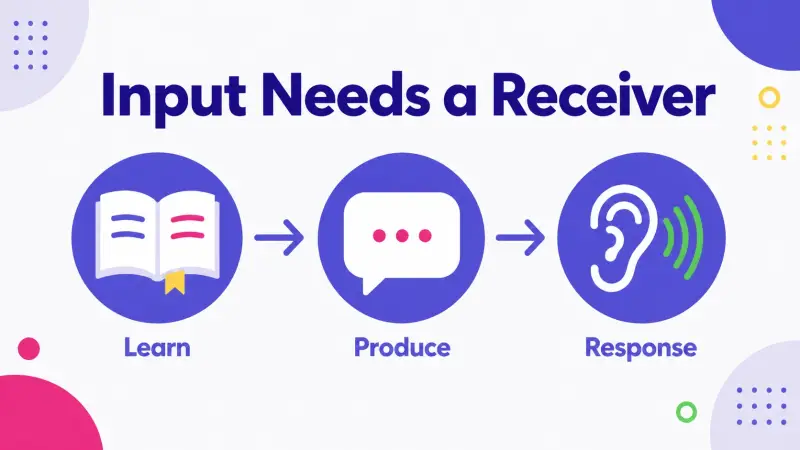
- A receiver: someone or something that takes the utterance as communication, so meaning, not just form, is on the line.
- Reaction: a reply that depends on what was said, which is both the reward signal and the proof the utterance functioned.
- Correction with tolerance: errors flagged selectively, in context, without the exchange collapsing.
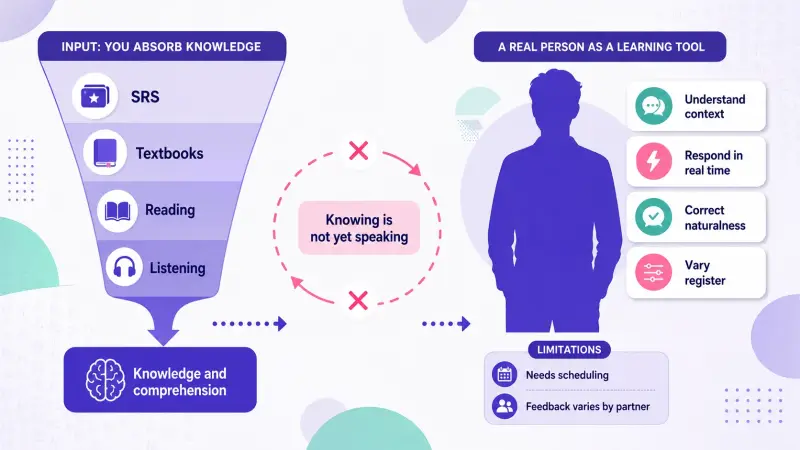
Prepared content can supply none of the four; automated conversation partners supply degraded versions of the middle two. The full set is what another person provides by default, which leads to a classification that sounds strange until the function is stated plainly: for output purposes, a real speaker is a learning tool, in the strict sense of a resource performing functions the rest of the stack cannot. A person interprets your broken sentence from context, responds to its meaning, registers whether it sounded natural and not merely correct, models real register, and generates the unscriptable pressure of an open turn. A person also has clear limits as a tool, and they matter: no human partner sequences grammar for you, schedules your reviews, or repeats a drill thirty times without fatigue. The input stack exists because those functions need tools too. The two halves are complements, not rivals.
This is the slot real-person exchange platforms occupy in a Japanese stack, and HelloTalk is a representative example of the category. HelloTalk chats supply the receiver and the reaction at text speed, with translation and read-aloud beside the message so a stalled sentence does not end the turn. HelloTalk Moments supplies a receiver without a conversation, which suits a learner who wants Japanese read and corrected before holding a turn is realistic. HelloTalk Voicerooms supply what text cannot, an open turn on someone else's clock, with the option of listening first. Where a tutor offers structured depth, the exchange category's distinct contribution is volume and normality: short, low-stakes, daily output turns, which is the dosage form output practice actually needs.
Sequencing output into an input-heavy routine
Because the input stack is genuinely necessary for Japanese, the practical question is sequencing, not replacement. Three moves cover it:
- Start output on a text delay: written exchanges let you compose slowly with lookups, which makes real output accessible weeks into study, long before speech feels possible.
- Convert to voice asymmetrically: send voice messages before attempting live conversation, since recorded speech keeps the receiver and reaction while removing the open-turn clock. HelloTalk's AI pronunciation scoring is worth running on the same recording before it is sent, because it names the specific sounds that drifted, which is information a polite listener rarely volunteers.
- Protect a fixed output share: a small, non-negotiable fraction of weekly Japanese time in which something you produced reaches a real receiver, held constant even during kanji-heavy phases.
The voice stage has its own craft, particularly around pronunciation feedback, and the comparison of shadowing, self-recording, and native feedback for Japanese pronunciation covers how the solo and human-feedback methods combine at that stage. The endpoint of the sequence is unremarkable and that is the point: a routine where output is a boring, scheduled component alongside reviews, instead of a milestone perpetually deferred until the input feels finished. The input never feels finished. That is what it was built to be.
FAQ
How much Japanese do I need before real output practice makes sense?
Less than the input-first culture suggests. Written exchange becomes workable once you can build simple sentences with a few dozen grammar patterns and a few hundred words, typically within the first couple of months, because text allows lookups and slow composition. What does not work is day-one output with nothing to retrieve; production needs input to draw on. The test is functional: if you can write three original sentences about your day with a dictionary open, you have enough to start, and the exchanges themselves become a vocabulary source from that point.
Is talking to an AI conversation partner a substitute for a human receiver?
It is a partial implementation, useful for exactly what it implements. Automated partners supply retrieval pressure and instant availability, which makes them strong for volume and for rehearsing before human exchanges. What they implement weakly is the receiver's judgment: whether your sentence sounded natural rather than merely parseable, which register it belonged to, and the social reality that makes a reply feel earned. A workable reading is dosage: automated partners for daily repetitions, human exchange as the calibration layer that keeps those repetitions honest.
My input study is going well and I enjoy it. What actually breaks if I keep postponing output?
Two specific things, both well documented in long-term learners. First, a recognition-production gap that widens silently: thousands of words you understand instantly but cannot summon, because retrieval was never trained. Second, fossilized phrasing at first contact: when output finally starts, your sentences are assembled from reading patterns, and the naturalness corrections that should have been spread over months arrive all at once, which is demoralizing at exactly the moment you are most exposed. Neither is irreversible, but both are cheaper to prevent with small early output than to repair after years of pure input.
Is shadowing real output practice?
Classify it by the components it exercises. Shadowing, repeating audio at or just behind the speaker, trains articulation, rhythm, and pitch patterns at volume, which makes it a strong pronunciation and fluency tool. What it does not contain is retrieval, since the words are supplied, and it involves no receiver, so nothing checks whether you could have generated the sentence or whether your version would have landed. In the terms this article uses, shadowing implements the motor layer of output with none of the generative or social layers. That makes it a complement with a clear slot, preparation that lowers the difficulty of real production, rather than a substitute for exchanges where sentences must be built and answered.
Should spoken output wait until my written output is comfortable?
Waiting for comfort sets the bar too late; waiting for capability sets it about right. Text is the natural first output channel because it removes time pressure, and a few weeks of written exchange builds the sentence-assembly habit speech will draw on. But writing comfort keeps rising indefinitely, so a learner who waits for it postpones speech by months without noticing. The workable trigger is functional: once written exchanges flow without a dictionary for simple topics, spoken practice adds the two ingredients text cannot, real-time retrieval pressure and pronunciation feedback from a listener. Expect the first sessions to feel like a regression; speech runs the same machinery at a harsher clock rate, and the drop is the practice working.