How to Self-Study Italian Online: A Week-by-Week Roadmap
Self-studying a language sounds lonely and disorganized, and done badly it is both. Done well, it is just a clear plan plus one form of accountability. The reason most self-taught Italian learners quit is not lack of resources; it is lack of a sequence and no one to notice if they stop. This roadmap fixes both.

If you are still deciding which tools to lean on, our comparison of Italian learning apps breaks down what each one is good at. Here we focus on the plan itself.
The Self-Study Principle That Changes Everything
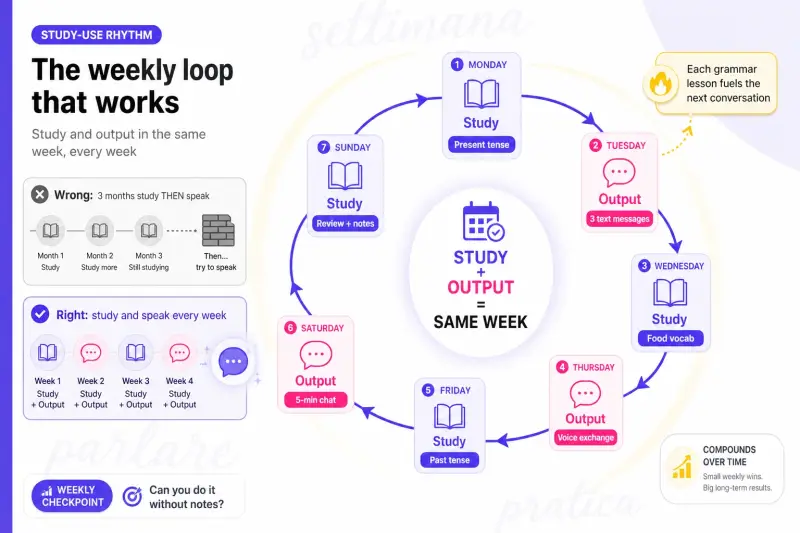
A self-study plan works only when input, practice, and output happen in the same week, not in separate months. Learners who spend three months on apps before speaking a word almost always freeze in their first real conversation. The fix is to weave speaking in from the start, even at a beginner level. That single change turns passive study into usable Italian. Everything below is built around it.
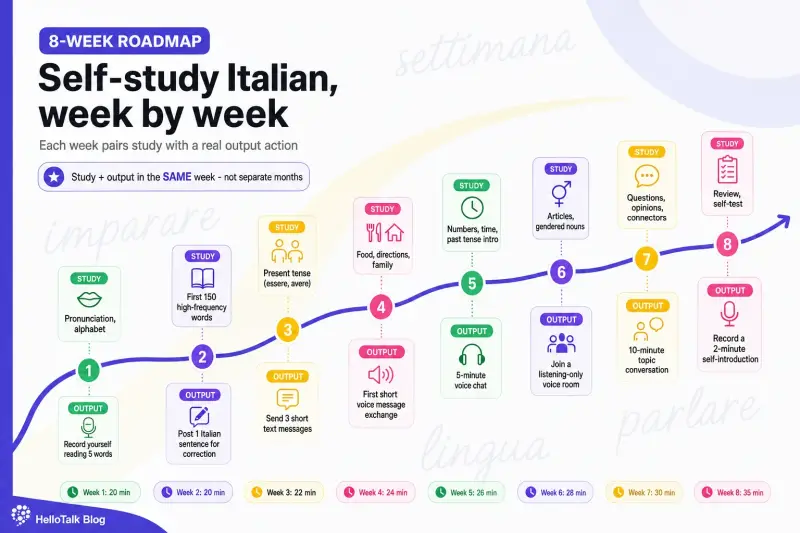
The 8-Week Roadmap
| Week | Study focus | Output action | Time per day |
|---|---|---|---|
| 1 | Pronunciation, alphabet, reading aloud | Record yourself reading 5 words | 20 min |
| 2 | First 150 high-frequency words, greetings | Post one Italian sentence for correction | 25 min |
| 3 | Present tense of essere, avere, common verbs | Send 3 short text messages to a native speaker | 25 min |
| 4 | Everyday topics: food, directions, family | First short voice message exchange | 30 min |
| 5 | Numbers, time, past tense introduction | 5-minute voice chat | 30 min |
| 6 | Articles, gendered nouns, adjectives | Join a listening-only voice room | 30 min |
| 7 | Questions, opinions, connectors | 10-minute conversation on a set topic | 35 min |
| 8 | Review, self-test, set month-three goal | Record a 2-minute self-introduction | 35 min |
The study column you can cover with any vocabulary and grammar app. The output column is what most self-learners skip, and it is the half that produces results.
Solving the Accountability Problem
The hardest part of self-study is that nobody knows if you quit. You can partly solve this with streaks, but streaks measure showing up, not speaking. The most reliable accountability for a self-learner is a real person on the other end who is expecting your next message. This is where a language exchange platform does something an app cannot. HelloTalk connects you with native Italian speakers across 70M+ registered users in 200+ countries and 260+ languages, so you help someone learning English while a native speaker helps you, and both of you have a reason to keep going. With over 1 billion messages daily on the platform, there is always someone active to reply. The features that support solo learners specifically:
- Chat-based learning gives you translation, transcription, and real-time grammar correction inside the chat, so you can message above your level and learn from the corrections.
- Moments works like a public notebook: post a sentence, get several native corrections, and see how real people phrase the same idea.
- Voicerooms and Livestreams let you practice listening in live Italian audio rooms before you feel ready to talk, then join short interactive livestreams.
- AI learning tools give pronunciation scoring and grammar feedback on demand, which fills the gap where a self-learner has no teacher to ask. HelloTalk was named the 2017 Google Play Best Social App and earned a 2024 global Google Play homepage feature, and for self-study the useful part is simply that the community is large and active enough to always find a practice partner.
How to Track Your Own Progress
Set a measurable checkpoint each week, not a vague "get better." Can you introduce yourself without notes by week two? Can you order food in a role-play by week four? Can you hold a five-minute chat by week seven? Concrete checkpoints tell you whether the plan is working while there is still time to adjust. For learners weighing whether to add a paid structure later, our courses versus language exchange guide covers when a course is worth it, and the language exchange guide explains how to get the most from practice partners.
Common Self-Study Mistakes
- Front-loading grammar. Learning every tense before speaking guarantees a freeze later.
- Measuring input only. Hours watched or words recognized are not the same as words you can produce.
- No fixed daily slot. "When I have time" becomes never. Pick a time and protect it.
- Studying in silence. Without output and correction, errors quietly harden into habits.
Frequently Asked Questions
Can I learn Italian by myself online?
Yes. Thousands of learners reach conversational Italian without a classroom. The key is a clear weekly sequence and adding real speaking practice early, not just apps.
How long does self-studying Italian take?
With 20 to 35 minutes a day, most self-learners reach comfortable basic conversation in three to six months. Italian is one of the easier languages for English speakers, which helps.
What is the best free way to self-study Italian?
Pair a free vocabulary app for daily study with a free language exchange app for speaking practice. That combination covers input, practice, and output at no cost.
How do I stay motivated studying alone?
Build in a real person who expects your messages, set weekly checkpoints you can measure, and keep sessions short enough to finish daily. Accountability beats willpower.
Do I need grammar lessons to self-study Italian?
You need enough grammar to build simple present-tense sentences, then you can learn the rest as you speak. Trying to master grammar first is the most common reason self-learners stall.
When should I start speaking if I study alone?
By week two. As soon as you can introduce yourself and ask a question, start short text or voice exchanges with native speakers.
Start Your First Week Today
A self-study plan for Italian is just three things kept in the same week: study, practice, and real output, with one person who notices if you stop. Set your week-one checkpoint now and begin. The simplest way to build in the output half is to start a short chat with a native Italian speaker on HelloTalk this week.