
Why Does Beginner Italian Need Real Responses, Not Just More Study Material?

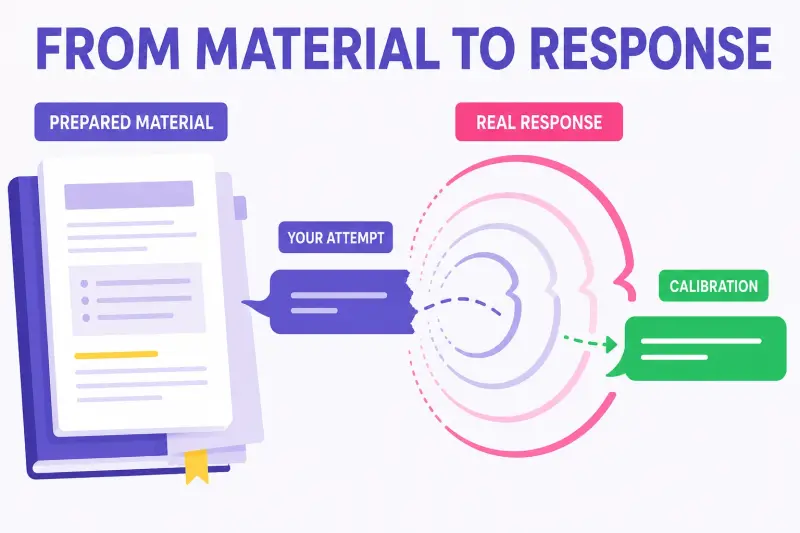
Many beginner Italian problems are not solved by buying another book, and there is a structural reason why. For a beginner in Italian, reactions to the Italian they have already produced fill a gap that additional prepared study material cannot fill, because a reaction is calibrated to their own last sentence in a way no prepared material can be.
Study material teaches you the correct form. A real response tells you what your attempt did to an actual listener. This article is about that second thing: what happens after Emma sends her first shaky Italian sentence, and why each kind of reply she gets back is a form of practice input that no additional textbook chapter can substitute.
What a real response does that a new chapter cannot
A new chapter adds coverage; a response adds calibration, and the difference shows up immediately in Italian. Suppose Emma writes "Come stai?" to someone she has never met. A textbook marked that sentence correct months ago. A real Italian speaker might gently switch to "Come sta?", because in Italian the informal tu and the formal Lei are separate address systems, and choosing between them is a live social decision that no drill can rehearse for a specific stranger.
In Italian, register is a beginner-level fact rather than an advanced topic, because the choice between informal tu and formal Lei can arise early in an exchange with an unfamiliar person. Study material can explain the rule. A response is what shows Emma which side of it she just landed on with this particular person. The guide to starting real Italian conversations handles the getting-started side that this article deliberately skips.
The same gap appears with naturalness. Course Italian answers "Come stai?" with "Sto bene, grazie, e tu?", which is correct and slightly stiff. Real replies may come back as "Tutto bene!" or "Tutto a posto" or "Non c'è male", and every one of those variants is a small piece of practice input that arrived because Emma made an attempt. Italian has roughly 64 million native speakers, and no beginner textbook can anticipate all of these contextual variants.
For the general argument that access to responsive people is a learning resource category in itself, not just a nice extra, see the cluster hub on learning through conversation before you know much. This article is that argument applied to one language's specifics.
The response types one Italian attempt can invite
Since responses are the input source here, it pays to know the catalog. The table below lists the reply types a single beginner attempt in Italian can draw, and, more importantly, what each one feeds back into your study. Read it as a sorting guide: when a reply arrives, find its row, and the right column tells you what to keep.
| Response type | What it looks like in Italian | What it feeds back into your learning |
|---|---|---|
| Confirmation | "Sì, esatto!" and the conversation moves on | Evidence the form works; keep it in active use |
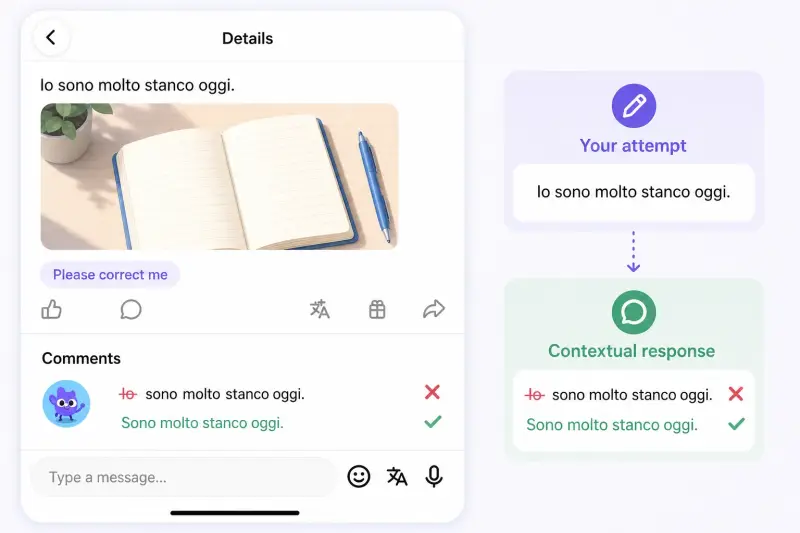
| Natural rewording | You wrote "Sono molto stanco oggi", reply models "Oggi sono distrutto" | A colloquial variant to save next to the textbook form |
| Register adjustment | Partner shifts your tu to Lei, or tells you tu is fine | A live data point on formality with this kind of person |
| Follow-up question | "Perché sei stanco? Lavori molto?" | Forced retrieval on a topic you did not plan |
| Misunderstanding signal | "Scusa, non ho capito, cosa intendi?" | A precise marker of where your Italian breaks for real listeners |
| Correction | Your sentence returned with the fixed version | A before-and-after pair worth saving verbatim |
The table sorts replies; the next question is what to physically do with the sorted material, because a saved variant that does not get reused is just a screenshot. The working method is short: save the original exchange, not a cleaned-up summary, and reuse the new form in your next message to anyone. The full lightweight system for turning these signals into a study queue is covered in letting real conversations decide what you study next, so this article stays on the Italian-specific side.
Why this does not replace your course
Nothing above argues against study material, and pretending otherwise would be dishonest. Italian sits in the US Foreign Service Institute's easiest category for English speakers at roughly 600 estimated class hours. Courses build the forms; responses test and season them.
A learner who only collects replies without a grammar backbone may develop disconnected fragments without systematic coverage. The day-by-day Italian plan turns the study half into a concrete routine.
The honest division of labor is this: study material is where beginner Italian forms get built, and real responses are where those forms get pressure-tested, reworded, and made usable with actual people. If you want a map of which Italian resource type is built for which job, what each type of Italian learning resource is built to do covers that division in full.
Real responses work best layered over something structured. We list the study material that real responses are meant to sit on top of, from free graded lessons to podcasts pitched at beginners.
Where HelloTalk fits for Italian beginners
Each HelloTalk feature maps onto one part of the response cycle described above. HelloTalk's chat-based learning tools keep the attempt cheap: in-chat translation and read-aloud let Emma decode "Non c'è male" the moment it arrives, and the correction tool returns her sentence with the partner's suggested edit embedded, which produces the before-and-after pairs from the table.
HelloTalk's Moments feed widens where responses can come from: one posted Italian sentence is visible to many native speakers, so if a response arrives, it may be a rewording, a register comment, or a correction, with no guarantee about how many replies arrive, who replies, or when. HelloTalk's Voicerooms and Livestreams supply the listening side of register, since hearing how Italians actually address each other in a group room is a direct way to build a feel for tu and Lei by ear.
And HelloTalk's AI learning tools cover the moments when no human is around: AI grammar correction offers a suggested correction and explanation for an attempt, and AI pronunciation scoring provides scores and flags Italian vowels or double consonants to review before you say the phrase to a person. Most of HelloTalk's core features are available for free.
FAQ
How much Italian do I need before seeking real responses?
Enough to make one small attempt: a greeting, one sentence about yourself, and one question. The response cycle described here can be applied to an exchange that small, if a useful response occurs, since even a two-line attempt gives a correction, a rewording, or a register signal something to attach to.
Should I ask partners to correct every mistake?
No, ask for correction of the errors that block understanding, plus anything they find unnatural. Requesting every fix buries you in red ink and slows the conversation, and misunderstanding signals and rewordings may arise without being explicitly requested.
Is tu or Lei safer as a default for a beginner?
Lei is a cautious default with strangers, older people, and professional settings in Italy, but usage shifts with age, region, formality of the situation, and online culture, so treat it as a starting point rather than a rule. On language exchange apps tu is common between learners, and observing what the other person uses, or simply asking, settles it politely.
What if the reply uses Italian I cannot understand at all?
Say so in simple Italian, for example "Scusa, sono principiante, puoi ripetere più semplice?" A reply you had to ask about twice is still practice input, and asking for simpler phrasing is itself a normal Italian sentence worth mastering early.
Do dialects make real responses unreliable for learners?
Written exchanges tend to stay close to standard Italian, so text is a reliable starting ground. In voice you may hear regional pronunciation and local expressions; treat those as bonus listening data rather than forms to adopt immediately.
Can I get the same benefit from Italian media instead of people?
Media gives excellent input but cannot react to your output. Films and podcasts show you natural Italian in general, while a response shows you natural Italian aimed at the sentence you personally just produced, and only the second one locates your specific gaps.
Another textbook is easy to add. What beginner Italian also needs is your own sentences in front of real readers, and HelloTalk offers tools and access for seeking contextual responses.