Can Real Conversations Decide What You Should Study Next?

Yes, as a complement to a syllabus rather than a replacement for one. A real conversation is a diagnostic that flags which words, sounds, and structures failed you personally, which is information about your own gaps that no prepared syllabus can generate. A textbook guesses at what learners in general need next. Your last conversation showed what you specifically were missing, in writing, with a timestamp.
The catch is that conversations produce these signals and then let them evaporate. This article is the lightweight method for catching them, and nothing more: no notebook system with seventeen fields, no color-coded review dashboard. Six small steps, four signal types, done.
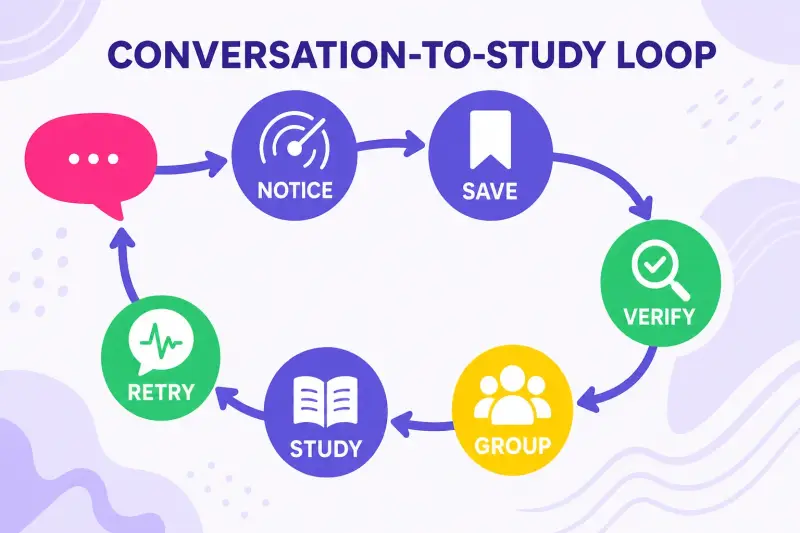
The six-step loop, kept deliberately small
The method has to be light enough to survive contact with real life, so here is all of it. Notice a gap during the exchange. Save the original example, meaning the actual sentences, yours and theirs, not a tidied summary. Verify the fix later with a dictionary, a grammar check, or another speaker.
Group repeated gaps, treating the third appearance of the same problem as a priority signal, a practical heuristic rather than a law. Study the small pile that grouping produces. Retry the fixed version in your next conversation.
Saving the original example verbatim is what keeps a gap studyable later, because the surrounding sentence carries the context, and a paraphrase from memory can quietly delete the very error you needed to see. Screenshots and copied chat lines preserve the original more faithfully than a reworked note, and a heavier capture method may be harder to sustain.
There is decent memory research behind the retry step in particular. In a well-known 2006 study, Roediger and Karpicke had students learn short texts and found that those who practiced recalling the material retained far more after a week, around 61 percent versus 40 percent for students who only re-read. That experiment was about remembering prose passages, not about speaking a language, so treat it as an analogy: actively pulling a saved phrase back out in a new conversation is a retrieval act, and retrieval is what re-reading your notes is not. And the foundation for all of it, treating conversation itself as a resource a beginner can use early, is the hub article on learning through conversation before you know much.
The four signals and what to do with each
Because not every stumble deserves the same treatment, the sorting step needs a small taxonomy. The table below lists the four signal types a conversation can generate, what to save when each appears, and what the saved material becomes in your next study session. Use it as the routing table between "that felt wrong" and a concrete study action.
| Signal from the conversation | What to save, verbatim | What it becomes in your next session |
|---|---|---|
| Missing word (you could not say something) | Your workaround sentence plus the word the partner supplied | A vocabulary card with your own sentence as the example |
| Misheard chunk (you could not parse something) | The written form of what was actually said | A listening rep: read it, hear it read aloud, then re-listen |
| Grammar block (you built the sentence wrong) | Your version and the corrected version, side by side | A two-line contrast drill, plus one textbook page on that structure only |
| Partner's rephrase (they said your idea better) | Both versions, yours and theirs | A phrase upgrade: retire yours, rehearse theirs for the retry step |
The routing table feeds a queue, and the natural next question is how to keep that queue from becoming a backlog, which is what the grouping step is for. As a working heuristic, gaps that appeared once can wait, while gaps that recur across several conversations jump the line, because frequency in your own exchanges is a priority signal tailored to you, one that can complement general frequency resources. If you are unsure what deserves study time before conversations have generated enough data, what a language learner should study first covers the cold-start question, and the wider menu of methods lives in language learning strategies for 2026.
What this method deliberately does not do
Scope discipline is what keeps the loop alive, so it is worth naming what stays out. The method does not classify gaps by life domain, travel versus work versus exams; the four signal types above do the sorting this method needs. It does not attempt curriculum design; your course keeps that job, and this queue runs beside it.
And it does not require special conversations: the exchanges you are already having may produce the signals, including the breakdowns, which tend to produce especially study-ready material. Why a repaired misunderstanding leaves behind unusually reusable material is its own topic, covered in why repairing a misunderstanding is a learning event.
A conversation-driven study queue works alongside a course, not instead of one: the course supplies coverage and order, while the queue supplies personal priority, and neither can do the other's job. For how the same idea plays out inside one language's specifics, the Italian version of this argument, with its register corrections and natural rewordings, is worked through in why beginner Italian needs real responses.
Where HelloTalk fits the loop
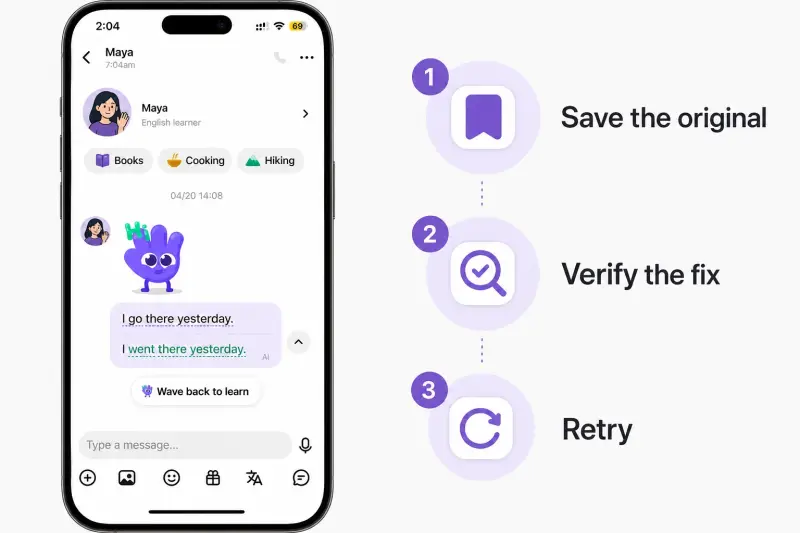
The method is easier to sustain when saving and retrying require little extra work, and several HelloTalk features can reduce that friction. HelloTalk's chat-based learning tools support the save step: partner-supplied corrections made with the built-in correction tool keep the original and edited versions together in the thread, which can simplify capture for grammar-block entries, and translation and transliteration sit next to any misheard chunk you paste back for checking.
HelloTalk's AI learning tools carry the verify step, since AI grammar correction offers another check on a suspected fix, with an explanation, before the phrase enters your queue, and AI pronunciation scoring provides a signal on whether a misheard chunk may have been a sound-level problem on your side. HelloTalk's Moments feed is a retry venue with the pressure turned down: post the upgraded phrase in a short update, and native speakers who happen to see it can react or adjust it further, with no guarantee about who replies but a large pool of potential readers.
And HelloTalk's Voicerooms and Livestreams may expose you to varied phrasings and speeds that can generate useful listening signals, the kind of misheard chunks the table knows how to route. HelloTalk received a global Google Play homepage feature in 2024, and most of HelloTalk's core features are available for free.
FAQ
How many gaps should I save per conversation?
Three to five is a manageable starting range, and fewer is fine. Saving everything turns the method into transcription work, while saving the few that stung keeps the loop fast to repeat, and recurring gaps are likely to appear again.
When should I do the verify and study steps?
Within a day or two, in one short sitting. The saved examples lose context in your memory quickly, and a short pass over yesterday's gaps is easier to sustain than a weekend backlog session.
What if my partner's correction turns out to be wrong?
That is what the verify step is for. A native speaker's phrasing is strong evidence of what sounds natural, but any single correction is a data point to cross-check, not a verdict, so compare a fix you plan to keep against a dictionary or a grammar checker before it becomes a card.
Does this replace spaced repetition apps?
No, it feeds them. The saved examples become the cards, with your own conversation sentences as the example lines, which may be easier to remember than a dictionary's examples because you were there when they happened.
Can beginners use this, or does it need conversational level?
Beginners can use it from their first exchange, because even a four-line chat can reveal a missing word or invite a rephrase. The loop scales down gracefully: smaller conversations simply generate a shorter queue.
How is this different from just keeping a vocabulary notebook?
A notebook stores words you chose while calm; this queue stores failures that happened under real use, sorted by type and prioritized by repetition. The difference is the source: the conversation decides what enters, not your guess about what might be useful.
Your last conversation may contain useful candidates for the next study session. Go have the conversation that can feed the one after that, on HelloTalk.