
Does Faster Feedback Make Spanish Practice More Efficient?
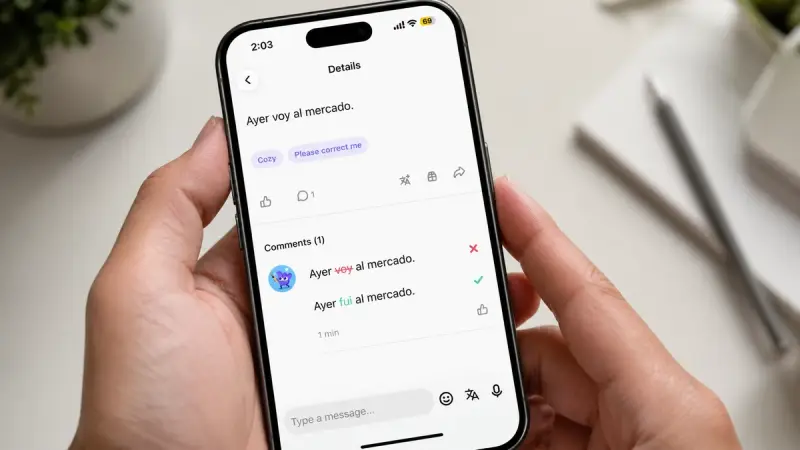
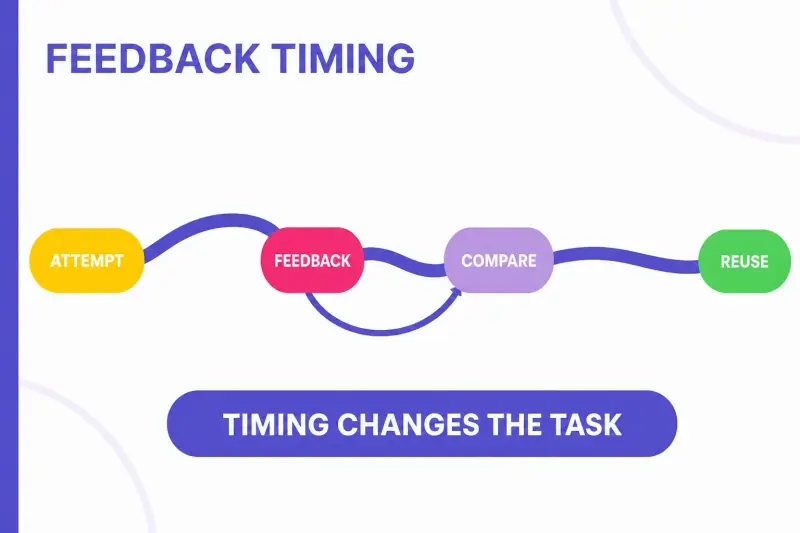
Sometimes, and the answer depends on where in the loop the feedback lands. Faster feedback can make Spanish practice more efficient at specific points in the practice loop, especially when a fix arrives while your original attempt is still fresh enough to compare and reuse, but faster is not better everywhere, and the research on feedback timing is more mixed than commonly assumed. The honest answer requires splitting "feedback" into the different moments it can arrive, because each moment does a different job.
One practice loop in Spanish looks like this: you attempt a sentence, something comes back, you understand what came back, and you use the fixed version again. The waiting time between those beats is what this article is about, and nothing else: not total study hours, not which tools to buy, not a daily plan.
What the timing research actually found
The research deserves a precise summary, because it gets quoted in both directions. In a 2016 classroom study of 120 middle-school EFL learners, Shaofeng Li and colleagues found that both immediate and delayed feedback produced gains on a grammaticality-judgment test, with some advantage for immediate feedback; neither feedback condition affected elicited-imitation scores.
But a lab study by Paul Quinn in 2014, on a similar English structure, found no significant difference between immediate and delayed correction. A 2025 approximate replication then added detail without settling the question: it found that interim feedback outperformed delayed feedback and task-only on the immediate grammaticality-judgment posttest, while interim and immediate feedback did not differ significantly.
The treatment groups did not differ significantly on the delayed posttest, and the elicited-imitation results showed no significant group differences. Meanwhile a 2010 meta-analysis by Roy Lyster and Kazuya Saito across 15 classroom studies, with 827 learners in total, found that oral corrective feedback worked and its effects lasted in those classrooms, with prompts that push the learner to self-correct outperforming recasts, where the teacher simply says the correct version, within that study set.
Two boundaries keep these results honest. The feedback-timing studies were run in classrooms and labs, mostly on English learners practicing one grammar target, so they license conclusions about that setting rather than a universal law covering all social language learning. And a recurring result in the reviewed classroom studies is not about speed at all: prompts that pushed learners to produce the fix outperformed recasts that handed it over, within those settings. The broader question of learning Spanish efficiently, beyond timing alone, has its own guide in the most efficient way to learn Spanish.
The five timing slots in a Spanish practice loop
Since "faster" only means something relative to a slot, the table below separates the five slots where feedback can land in a Spanish exchange, from mid-sentence to next-day review. For each slot it lists the errors and tasks it suits, what it does well, what it risks, and the best moment to reuse the fix. Find the slot you currently rely on, and check what the other rows are doing that yours cannot.
| Timing slot | Best suited for | Advantage | Risk | Best reuse point |
|---|---|---|---|---|
| In-turn clarification (mid-conversation, seconds) | Meaning failures: a word or sentence that did not land | Can keep the exchange moving; the fix arrives while the attempt is still fresh | Interrupts flow if used for every small slip | Immediately, in your very next sentence |
| End-of-turn correction (after you finish a thought) | Grammar and word-choice errors that did not block meaning | Compare your version and the fix side by side without derailing the topic | Feels like being graded if too frequent | Within the same conversation |
| Delayed review (hours to a day later) | Recurring patterns across a whole conversation | Groups repeated errors; calmer analysis; no social pressure | Original context fades; fixes feel abstract | Next conversation, deliberately planned |
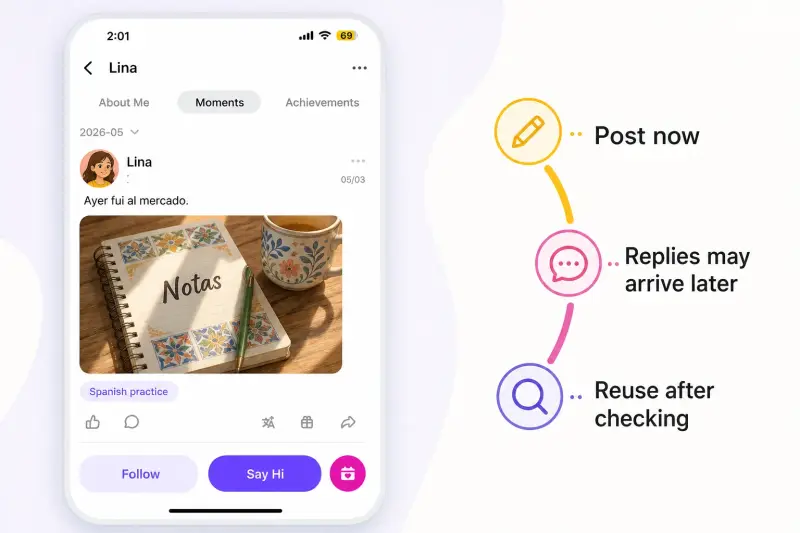
| Batch feedback on posted writing (whenever readers arrive) | Polished sentences you chose to publish | Multiple perspectives possible on one attempt | Timing is out of your control | When rewriting the same idea later |
| No feedback (fluency-focused stretches) | Building speed and confidence with known material | Trains retrieval under time pressure without interruption | Errors get rehearsed if this is the only mode | Not applicable; verification happens in other slots |
Meaning failures often benefit from prompt clarification, because a conversation that stops making sense cannot continue, and the in-turn repair lines that handle those moments in Spanish are scripted out in what to do when you run out of Spanish mid-conversation. The table's real message sits in the risk column: each slot has a failure mode when it becomes the only slot, and the next section turns that into a usable rule.
Faster where it counts, slower where it counts
The rule that falls out of the research and the table is a division, not a speed limit. On the other side of that division, form errors, wrong gender, wrong tense, unnatural word choice, tend to tolerate a short delay, and end-of-turn correction preserves flow while the comparison is still cheap.
Then comes the step speed cannot replace. As a practical inference rather than a finding of the timing studies, reuse may extend the value of a correction: reuse creates another retrieval opportunity with the fixed form, which makes the reuse point in the table's last column at least as important as the arrival time in its first. Delayed review earns its slot precisely by feeding reuse: grouping yesterday's corrections into a short queue for today's exchange is the method covered in letting real conversations decide what you study next.
And feedback overload is the quiet efficiency killer the table's risk column keeps pointing at, so agreeing with a partner on what to correct, meaning failures right away, form errors at turn ends, everything else weekly, is more balanced than requesting maximum-speed correction for every error. The foundation, that responsive people are a learning resource beginners can use, is the hub article on learning through conversation before you know much.
Where HelloTalk fits the timing slots
Feedback timing is one property of the human response layer in a Spanish setup, and the layer itself, what it provides that lessons cannot, is mapped in what a fast-start Spanish resource mix should include. A single conversation thread can only offer the timing slots its tools support, and HelloTalk happens to cover all five. HelloTalk's chat-based learning tools serve the two fast slots: in-chat translation offers a quick route through meaning failures, which is in-turn clarification, and the built-in correction tool lets a partner mark up your sentence right after a turn ends, keeping your version and the fix adjacent for comparison.
HelloTalk's AI learning tools add a private fast lane, since AI grammar correction offers a suggested fix with an explanation for sentences you have not sent yet, which may be available sooner than any human reply, and AI pronunciation scoring provides sound-level scores of a kind conversations tend not to make explicit, while human reactions add contextual evidence tied to the specific person you are talking with, and machine output still needs verification. HelloTalk's Moments feed is the batch slot: a posted Spanish paragraph is open to responses from native speakers as they happen to see it, with arrival time not guaranteed, which is exactly why it suits polished writing rather than urgent questions.
And HelloTalk's Voicerooms and Livestreams are a natural fit for the no-feedback fluency slot, group audio where you can speak for flow, or just listen, with no one assigned to correct you mid-sentence. HelloTalk received a global Google Play homepage feature in 2024, and most of HelloTalk's core features are available for free.
FAQ
Should I ask my Spanish partner to correct me immediately or later?
Split by error type: ask for immediate help when meaning breaks, and end-of-turn or end-of-chat correction for grammar and word choice. This keeps conversations moving while still catching the fixable errors, and agreeing on the split up front keeps corrections from flooding the exchange.
Is instant AI feedback better than waiting for a human?
It may be available sooner and is private, while human reactions provide contextual evidence tied to a specific interlocutor, and machine output still needs verification. A workable sequence is: run a sentence past AI grammar correction first, then, if human reactions arrive, use them as contextual evidence about how the corrected sentence lands.
Does delayed feedback still work if I forget the conversation?
Delay works when the original attempt is preserved, which is why saving the exchange verbatim matters more than reviewing quickly. Preserved context is what can make delayed review usable: a day-old correction with both versions in front of you remains workable material.
Can too much fast feedback hurt my Spanish?
It can, in two ways: constant interruption can disrupt fluency-focused practice, and a flood of simultaneous fixes can exceed what you absorb from one exchange. The overload risk is why fluency-focused stretches with no correction at all have a legitimate slot in the table.
Does the classroom research even apply to language exchange chats?
Apply it with care: the studies covered classroom and lab tasks, mostly in English, so their letter does not transfer, but one recurring classroom result, that prompts to self-correct outperformed recasts there, is worth trying carefully in a chat by asking partners to hint before correcting, without treating it as a proven rule outside the classroom.
What is the single highest-leverage change to my feedback timing?
Protect the reuse point. Whatever slot a fix arrives in, schedule its reuse, in the same chat if possible, in the next one otherwise, because reuse is one way to extend the value of feedback regardless of how quickly it arrived. If your real constraint is total time rather than timing, learning Spanish efficiently in 15 minutes a day is designed around that budget.
Faster feedback is a tool with a place, not a universal upgrade. Put each timing slot where it belongs, and let the reuse do the compounding, in real Spanish exchanges on HelloTalk.