
Is Access to Real Japanese Speakers a Missing Layer in a Beginner Resource Stack?

In many beginner stacks, yes, and the gap has a precise shape. Many self-directed Japanese beginner stacks contain a course or textbook, a flashcard system, listening input, and pronunciation tools, but no layer that can react to the learner's own Japanese: regular access to real speakers. The other four layers are prepared in advance and cannot respond to what you produced this morning, so without a human layer, some of what you produce may not receive a human reaction at all.
This article does not rebuild the stack. It starts from the symptoms a stalled learner can actually observe, traces them to one missing handoff, the moment where a draft you produced meets a situated human reaction, and ends with the smallest interaction that can test whether that handoff is really what is missing. Not every stalled learner is missing this layer, which is why the symptoms come first.
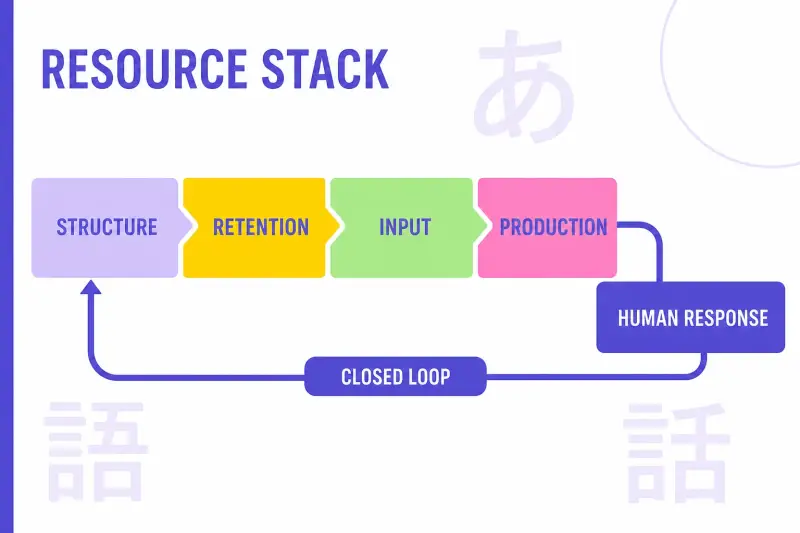
Reading the symptoms against a short map of the stack
The infographic above shows the usual five layers, structure, retention, input, production, and human response, and it serves one purpose in this article: locating the gap, not laying out a build order. How to choose and combine the prepared layers is covered elsewhere: the perfect Japanese learning stack for beginners goes deeper on layers one through four, and Japanese resources built for input and output practice covers the middle layers' tooling. Neither comparison is repeated here.
What this article builds instead is a diagnostic. The table below pairs symptoms a learner can observe in their own study log with what the prepared tools have already done, the human reaction that is missing, and the smallest test that would check for it. Read your recent weeks against the first column before concluding anything.
| Observed symptom | What prepared tools already did | Missing human reaction | Smallest test |
|---|---|---|---|
| Particles feel solid in drills, but you cannot tell whether your own sentences read naturally | The course taught the particles and the SRS kept them recallable | A reader reacting to your actual particle choices | A two-line post where Japanese speakers can see it |
| You choose between plain and polite form by rule, never by reaction | The textbook explained the register system | A real interlocutor whose replies show whether your register fit the moment | One short, politely opened exchange with a new partner |
| Pronunciation practice produces recordings that no person hears | Pronunciation tools scored your attempts and flagged sounds | A listener who did or did not understand you | A short voice note sent into a real exchange |
| Study is steady, but motivation is thinning | Every prepared layer ran as designed | Lived evidence that your Japanese lands with a person | Any of the tests above, as a low-cost starting point |
Two readings of this table matter. First, the second column shows that the prepared layers did their jobs; these symptoms are not evidence that your course or SRS failed.
Second, the pattern is a diagnostic signal, not a law that applies to every learner. A stack works when each layer does only its own job, and when a learner is stalled despite steady effort, the fifth layer is one useful item to check before adding more hours. The last column lists starting points rather than verdicts: a real response yields an observable clue, a single response does not prove the full diagnosis, and a test that draws no response is unfinished and worth repeating in another form or at another time.
What breaks when the fifth layer is missing
Without the human layer, the stack still runs, but it runs open-loop, and three gaps can remain. First, unchecked production: you can drill "watashi wa" sentences for months without discovering that the pronoun is usually dropped in natural speech, because textbook exercises rarely push back on that habit. Second, politeness in a vacuum: Japanese register choices, plain form with friends, desu and masu with strangers, are live social decisions, and reactions from actual people are a direct way to calibrate them. Third, motivation: a stack that does not touch a human offers little lived evidence that any of it works.
The human layer is not a luxury add-on to a Japanese stack; it is the stage where drafts produced by the other layers can meet reactions from real readers and listeners. That is the handoff this article is about: prepared materials generate input and drafts, and the human layer's only job is to react to those drafts in a real situation and send the newly exposed gaps back into your study queue.
Japanese is one of the languages the US Foreign Service Institute estimates at roughly 2,200 class hours for English speakers in its own intensive programs, among the longest of any language it teaches, and a project of that length can benefit from a feedback loop that can catch habits before they settle in. The signals the fifth layer sends back, missing words, misheard chunks, corrected drafts, become your study queue through the method in letting real conversations decide what you study next.
One boundary matters here: partners are not teachers, and the fifth layer does not do the first layer's job. A learner who deletes the course and keeps only chat risks developing disconnected fragments with no grammar spine. The stack argument cuts both ways. The general case for treating access to people as a resource category at all is the hub, learning through conversation before you know much.
The smallest interaction that tests the handoff
If the table's symptoms match your log, the check is one minimal interaction, not a new routine. Pick one draft your stack has already produced this week and give it exactly one of these destinations: a two-sentence public post built from that material, a short voice note sent to a partner, or, if posting feels like too much, time in a group audio room in listener mode followed by one brief spoken or typed contribution. Then record what happens.
Read the outcome carefully, because the two possible results are not symmetric. If a reaction arrives, a follow-up question, a rewording, or a misunderstanding signal, it can expose a concrete clue, such as a particle a reader stumbled on, though one reply is a lead to follow rather than proof of the full diagnosis. A minimal interaction is a test of the missing handoff, not a commitment to a schedule.
If no reaction arrives, the test has simply not completed yet, and the question stays open. Silence does not tell you whether the handoff was your gap, and it does not rule that gap out either; the reasonable next step is to repeat the small test in another form or at another time. Firmer conclusions need real responses, observed more than once.
How this differs from the "when can I start" question
This article answers a diagnostic question, whether a missing human reaction explains a specific stall, and deliberately not the timing question of how early interaction can begin when you cannot yet read. That timing question, including what romaji and transliteration aids are legitimate at each script stage and when each must be retired, has its own article: starting Japanese micro-conversations before mastering the writing systems. The short version relevant here is only this: the fifth layer can be installed early, in tiny aided doses, so "I will add people later" is a choice rather than a constraint.
Where HelloTalk fits as the fifth layer
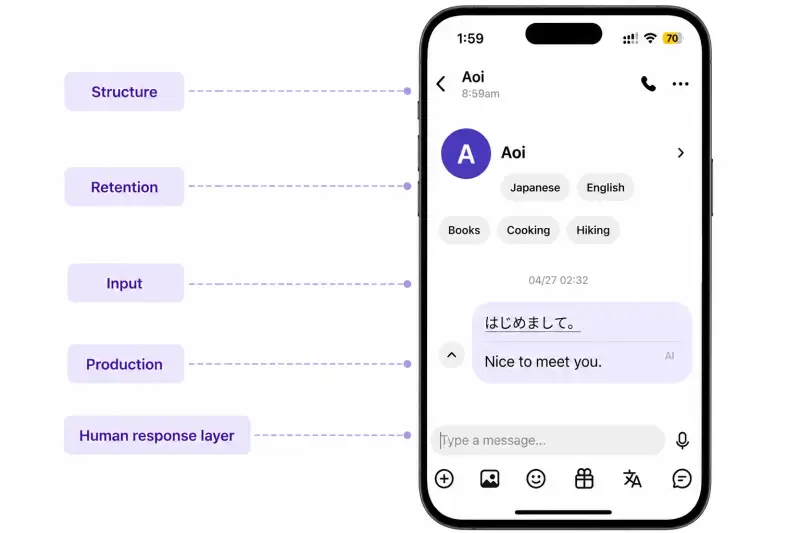
If the missing piece is a draft-to-reaction handoff, HelloTalk's feature set maps onto that handoff closely. HelloTalk's chat-based learning tools are the handoff's core mechanics for Japanese specifically: the correction tool keeps partner-supplied edits to your sentence visible in place, transliteration and read-aloud keep partners' mixed-script replies decodable while your reading grows, and in-chat translation offers a way forward when meaning fails mid-exchange.
HelloTalk's Moments feed gives drafts a public destination: a two-line Japanese post is visible to native speakers who can reword or correct it on their own schedule, which can turn the production layer's output into the human layer's input without booking anyone's time, and with no promise about which post gets answered. HelloTalk's Voicerooms and Livestreams carry the listener-first route from the minimal test above, since unscripted Japanese group conversation carries speed and pitch patterns beyond what graded material is designed to show, and you can join in listener mode before contributing anything.
HelloTalk's AI learning tools sit at the last checkpoint before the handoff, with AI grammar correction offering suggested fixes on a draft before a person sees it and AI pronunciation scoring providing scores and flags for sound-level review. The pool behind all this is large, with the HelloTalk platform hosting 70M+ registered users, a figure that describes potential reach rather than any guarantee of replies, and most of HelloTalk's core features are available for free.
FAQ
Which layer should a total beginner set up first?
Structure and retention first, in the same week: a textbook or course plus a flashcard habit. The human layer can be installed early as well, in tiny aided doses, but it needs the first two layers running to have material to react to.
How much time should the human layer get in a weekly schedule?
Two or three short exchanges of 10-15 minutes a week is a manageable starting cadence at beginner level, not a threshold. The layer's value is regularity of contact between your drafts and real readers, not volume, and small doses keep it sustainable next to the other four layers.
Can a tutor replace the human response layer?
A tutor is a different resource that overlaps it: tutors add structure and planned teaching, which partners do not provide, and tutoring is scheduled instruction rather than informal situated response. The fifth layer as described here is high-frequency, informal contact, and many learners run both.
Is one Japanese partner enough, or do I need several?
One recurring partner, if available, is a fine start, and adding more becomes worthwhile when you want a wider sample, because different speakers expose different phrasings, registers, and speeds. Treat additional partners and group audio as widening the sample, not as disloyalty.
Do apps with AI conversation practice count as the fifth layer?
They cover part of it: an AI can react to your drafts quickly, which is useful provisional machine feedback before human interaction. What AI practice does not carry is what reactions from a real interlocutor provide: situated responses from an actual person you are in contact with, social calibration, and genuine follow-up interest, so treat AI practice as a rehearsal space inside the layer rather than the layer itself.
What if I am too shy to message strangers in Japanese?
Start with the layer's passive modes: listen in group audio rooms and read other learners' public posts and their corrections. Keeping the first active step tiny keeps the barrier low, and a two-line self-introduction post is about as tiny as practice gets.
Four layers of your Japanese stack are probably already installed. One small interaction is a low-cost place to start checking the fifth, though firm conclusions need real responses and repeated observation, and HelloTalk is where to run that first check.