Can Japanese Beginners Start Real Micro-Conversations Before Mastering the Writing Systems?

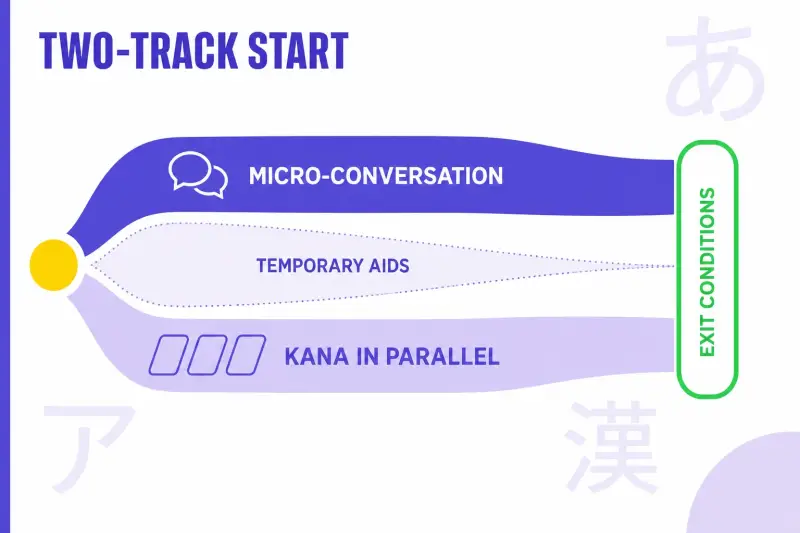
Yes, with two non-negotiables attached. A Japanese beginner can start tiny, aided micro-conversations before mastering the writing systems, but kana cannot be skipped, and romaji and other aids must be treated as temporary scaffolding with planned exit conditions. The writing systems are a real mountain, and waiting at its base in silence is a choice, not a requirement: a first exchange of two or three aided lines is possible from the start, while hiragana study runs in parallel.
The rest of this article defines what "aided" and "tiny" mean at each stage of script ability, and, just as importantly, when each aid has to go.
Why the mountain is real, and why it should not block speaking
The mountain is real because Japanese reading runs on three scripts with three different jobs, and it should not block speaking because speaking and listening need none of them at the start. The honest numbers first: 46 basic hiragana characters, 46 basic katakana characters, and a government-designated list of 2,136 joyo kanji, set in its current form in 2010. The US Foreign Service Institute places Japanese in its hardest tier for English speakers.
If those scripts feel like a wall, that is an accurate perception about reading. How the three scripts divide their jobs, and which resources teach each one, is covered in three writing systems, three jobs, and this article leans on that division rather than repeating it.
But the wall stands between you and reading, not between you and all interaction. Speaking and listening in Japanese do not require kanji, and a micro-conversation of greetings, a self-introduction, and one question can run entirely on sound, with no reading involved. The mistake is not starting early; the mistake is letting the early aids become permanent, which is why every stage below comes with an exit condition. The general case for starting interaction early is the hub on learning through conversation before you know much.
The stage table: what is safe to try, with which aids, until when
Because the honest answer changes as your script ability grows, the table below is staged. The stages are sequential, not ranked: there are four, each defined by what you can currently read, and each row lists the interactions that are safe to attempt at that stage, the aids that are legitimate there, and the condition that tells you the aid has expired. Find your current row and read across.
| Stage (what you can read) | Safe interactions to attempt | Legitimate aids | Exit condition for the aids |
|---|---|---|---|
| Stage 1: no kana yet | Voice-first micro-exchanges: greeting, name, one memorized question; listening in group audio | Romaji for reading replies, transliteration, translation | Expires as basic hiragana becomes readable; from that point primary reliance on romaji tapers off |
| Stage 2: hiragana, partial | Short text exchanges written in kana; simple self-introduction posts | Furigana-style transliteration for unknown words, read-aloud for anything you cannot sound out | Expires when you can sound out full hiragana sentences unaided |
| Stage 3: hiragana and katakana | Normal beginner text chats; asking partners to write in kana; katakana loanword practice | Translation for meaning only, not for reading; dictionary lookups | Translation of whole messages ends; look up words, not sentences |
| Stage 4: kana plus first few hundred kanji | Broader beginner exchanges; reading partners' natural mixed-script messages with per-word lookups | Per-word kanji lookups, handwriting input for unknown characters | No expiry; per-word lookup is a normal aid at this level |
The table sets boundaries; the reason the exit conditions are strict is what happens when they are ignored, and that failure mode deserves its own section before the practical setup. For where these micro-exchanges sit inside a complete beginner setup of courses, flashcards, input, and people, the stack-level view is the real-speaker layer in a Japanese beginner resource stack.
The romaji trap, and what "not skipping kana" means
Romaji is a loan you take out against your future reading ability, and the interest compounds quietly. A learner who chats in romaji for months is practicing a writing system Japanese itself does not use for everyday communication, is learning little about how Japanese is actually written, and can end up anchoring pronunciation to English spelling habits. Romaji works as a transitional aid that lets a Stage 1 learner interact before hiragana is readable, and it needs an exit condition rather than a permanent place in the routine: primary reliance on romaji should taper as kana reading becomes more functional, even if it occasionally helps with an unknown word later.
"Not skipping kana" therefore means running two tracks at once: micro-conversations for contact with real Japanese, and a parallel kana habit, with 15-20 minutes daily as one manageable starting cadence, that makes the aids in the table progressively unnecessary. The two tracks feed each other, because words a partner uses become kana reading material, and each kana you learn shrinks the aided portion of your next exchange. What micro-conversations should contain also stays deliberately small: one greeting, one sentence about yourself, one question, one thank-you-and-goodbye line. The sound side, which micro-conversations lean on heavily, has its own guide in Japanese pronunciation practice methods.
Where HelloTalk fits the staged approach
The stage table above works because modern exchange tools can provide temporary support and let you reduce it over time. HelloTalk covers all four stages.
During Stages 1 and 2, HelloTalk's chat-based learning tools act as the main scaffolding. Transliteration makes a partner's Japanese readable, read-aloud helps with sentences you cannot yet sound out, and in-chat translation supports meaning while your reading catches up. The correction tool can then show suggested or partner-supplied edits alongside your original attempt.
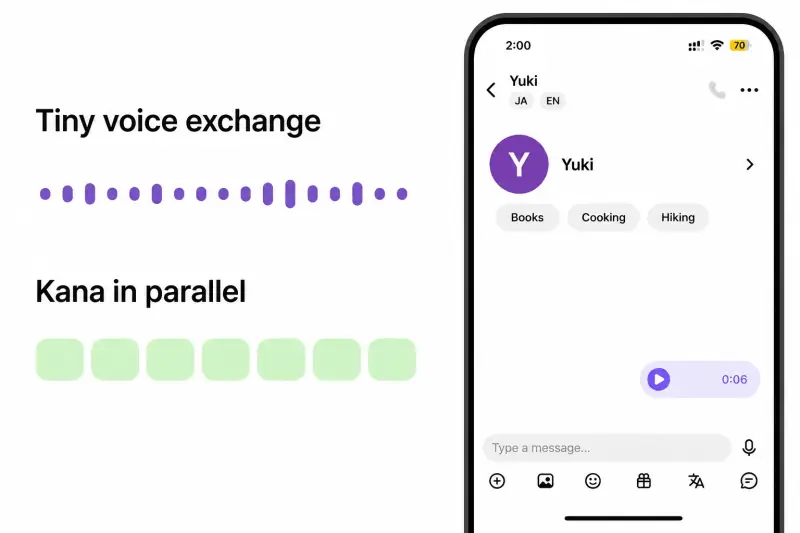
HelloTalk's Voicerooms and Livestreams add a listening route at Stage 1. You can enter a Japanese-language group audio session as a listener and hear real voices while your kana study continues in parallel.
From Stage 2 onward, HelloTalk's Moments feed provides a low-pressure place for short kana-only posts. Native speakers who see a post may respond or correct it on their own time, although there is no guarantee about who will reply or when.
As you begin removing support, HelloTalk's AI learning tools can help you review the gaps that remain. AI pronunciation scoring can highlight patterns influenced by romaji, while AI grammar correction can suggest fixes for kana sentences before you share them with another person. Each exchange can reveal missing words or misheard chunks, and the routing system for those signals is the same one described in letting real conversations decide what you study next.
The HelloTalk platform supports 260+ languages, including Japanese, and the HelloTalk app has been featured in the iOS App Store's Today section in Japan. Most of HelloTalk's core features are available for free.
FAQ
How long does it take to learn hiragana well enough to drop romaji?
It varies by person and practice time, so the exit is defined by ability rather than by a calendar: you drop romaji when you can sound sentences out, even slowly. The 46 basic characters are a bounded task, and steady daily practice keeps it moving.
Can I really have a conversation knowing only sounds and no writing?
A micro-conversation, yes: greetings, your name, one question, and a goodbye can all run on memorized sound alone, especially in voice formats. What you cannot do without scripts is read replies, which is what the Stage 1 aids are for.
Should I learn katakana at the same time as hiragana?
Hiragana first, katakana immediately after, is the common and sensible order, since hiragana carries beginner grammar and katakana mostly carries loanwords. The two syllabaries share their sound inventory, so the second one builds on work already done.
Is it disrespectful to message Japanese speakers using romaji?
On a language exchange, using romaji while you are just starting is normal, and saying you are a beginner sets expectations fine. Being transparent about your current level, and gradually switching your messages to hiragana as your reading grows, is a sensible trajectory.
When should kanji enter the picture?
After kana is comfortable, starting with the few hundred most common characters. Kanji is a reading project that runs for years, and the stage table's point is that it must not postpone interaction that needs no kanji at all.
Do voice conversations count as real practice if I cannot read yet?
Completely. Listening and speaking are the skills micro-conversations train, and the reading track catches up in parallel. Vocabulary you learn by ear becomes material for that track: words you already know by sound are easier to recognize when you meet them in kana.
The scripts are a long climb, and the first conversation is not at the top. It sits at the bottom, three aided lines long, and HelloTalk offers formats that can support that size of exchange.