Korean Made Easy: Which Apps Actually Live Up to the Claim?

Search "learn Korean easy" and every app swears it is the one that finally makes it simple. Some help a lot. Some make the easy part easy and quietly leave out the hard part. This is a straight comparison of the popular options, judged on what a beginner actually needs, not on marketing.
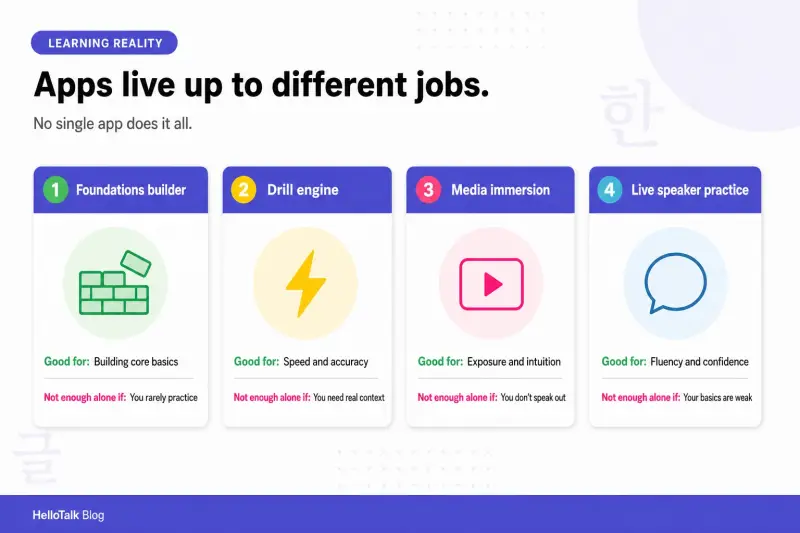
No single app makes Korean "easy" on its own; the ones that come closest pair structured lessons with real speaking practice, because speaking is the skill apps most often skip. Keep that in mind as we go through each.
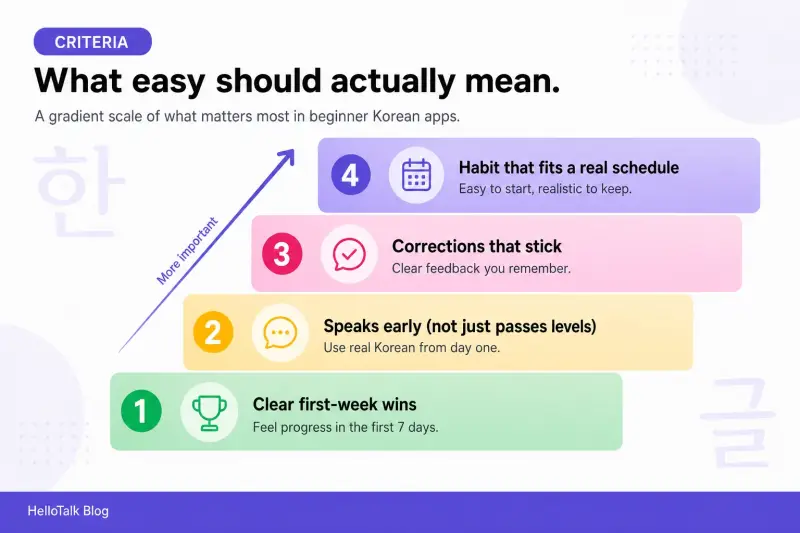
Before the table, let us define the job. A good beginner Korean app should teach Hangul quickly, drill high-frequency phrases, train your ear, and give you a way to actually speak and get corrected. Most apps nail the first two and stop there.
That last piece matters more than any streak counter. Recognition and production are different skills, and only responsive speaking practice builds the second one.
| App | Best for | Honest limits | Speaking with natives | Free access |
|---|---|---|---|---|
| Duolingo | Daily habit, Hangul basics | Gamified, little real conversation | No | Yes, with ads |
| Busuu | Structured lessons, grammar path | Peer feedback is asynchronous and limited | Partial (feedback, not live) | Limited free tier |
| Speaky | Finding language partners | Fewer built-in learning tools | Yes | Yes |
| HelloTalk | Real conversation plus built-in tools | Not a rigid A-to-Z curriculum | Yes, direct and live | most core features available for free |
Duolingo is the easiest on-ramp for building a daily habit and getting through Hangul. It is genuinely useful for the first few weeks. Its weakness is real conversation: you can finish the Korean tree and still freeze when a person replies to you.
Busuu offers a more structured path with clearer grammar explanations, which many learners prefer once past the basics. It has community feedback, but it is asynchronous and thinner than talking to someone in real time.
Speaky is built around finding language partners, so it is strong on the human side, but it carries fewer built-in learning tools, so beginners often need a second app for structure and drills.
HelloTalk puts real conversation first and wraps learning tools around it. You message native Korean speakers directly, and the chat includes translation, transcription, pronunciation readouts, and real-time grammar correction, so you can write, get fixed, and send a voice note without switching apps. AI tools add pronunciation scoring that points out the specific sound you missed, plus AI grammar correction with explanations. With 70M+ registered users and 260+ languages, matching with a Korean speaker who is also learning your language is fast.
Want a gentle daily habit and Hangul basics: start with Duolingo.
Want structured grammar once you are past the alphabet: add Busuu.
Want the actual speaking practice that most beginners skip: use HelloTalk, where free conversation with native speakers is the core, not an add-on.
Most successful learners stack two: one for structure, one for real speaking. The app that makes Korean genuinely easier is the one that gets you talking to a real person early, because that is the practice that transfers to real life.
Once you have a shortlist, use this process for how to audit a Korean resource in one week.
Choosing the app with the most badges instead of the most speaking.
Assuming a finished course equals conversational ability.
Sticking to romanization mode instead of learning Hangul.
Never posting anything for a native speaker to correct.
On HelloTalk, the Moments feed lets you post a short Korean sentence and collect corrections from several native speakers at once, and Voicerooms and Livestreams let you listen to and join real Korean conversations at any hour, which is the missing "hard part" other apps skip.
Which app is easiest for a complete Korean beginner? Duolingo is the gentlest start for Hangul and habit. But pair it early with a speaking app so you do not stall at recognition.
Can one app make me conversational in Korean? Rarely. Lesson apps build vocabulary and grammar recognition; conversation grows from responsive practice with real people. Combining a structured app with live speaking is the reliable path.
Is HelloTalk free for learning Korean? Yes, most core features are available for free, including direct chat with native speakers, translation, corrections, Moments, and Voicerooms.
Do these apps teach Hangul? Most do. Hangul has only 24 basic letters and is very logical, so any of them can get you reading within days. Prioritize apps that keep you in Hangul rather than romanization.
I only have short bursts of time. Which fits? Any of them work in short bursts. For a schedule-first approach, see our method for learning Korean quickly as a busy person.
What about learning through K-pop or dramas via an app? That can supplement structure and speaking. See what actually works in our guide to learning Korean through K-pop and K-drama, and for a full schedule try our realistic 30-day Korean plan.
Pick the app that gets you speaking soonest, and treat lessons as support around that. Structure plus real conversation is what turns "easy Korean" from a promise into progress. Try free conversation with native Korean speakers on HelloTalk and see the difference for yourself.