
Learn Korean in 30 Days: A Realistic Plan That Gets You Speaking
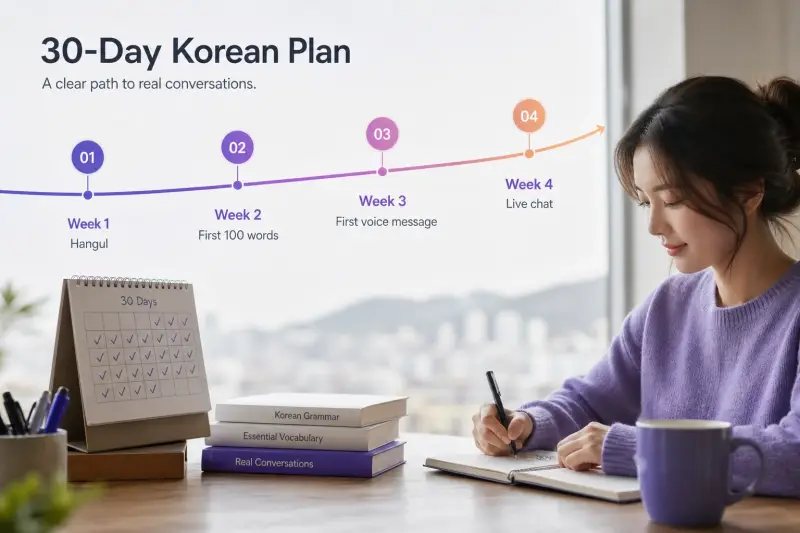
You cannot become fluent in Korean in 30 days, and any plan that promises that is lying. But you can go from zero to holding short, real conversations in a month, and that is a genuinely satisfying place to reach. This is that plan, week by week, with clear daily actions.
Let us be precise about the destination.
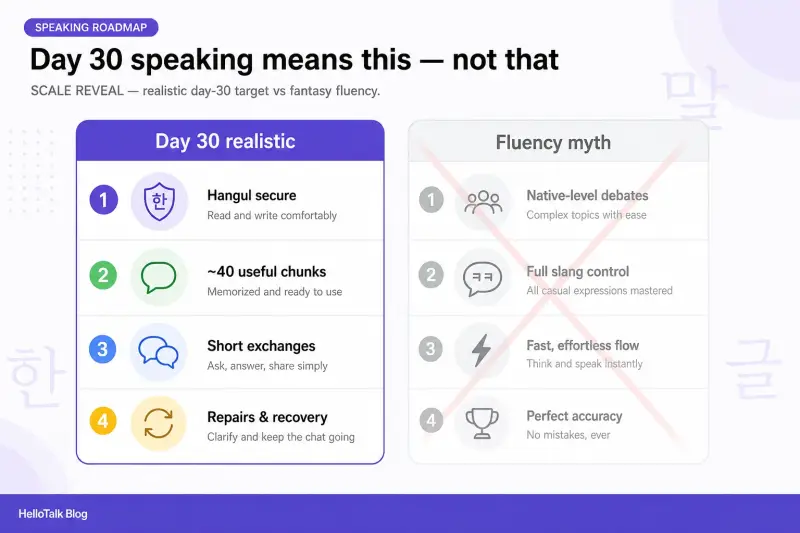
In 30 days of focused daily practice you can realistically read Hangul, use a few hundred phrases, and hold simple spoken conversations; you will not reach fluency, which the FSI estimates takes around 2,200 hours for Korean. Knowing the honest target keeps you motivated instead of disappointed.
By the end you should be able to greet people, introduce yourself, order food, ask basic questions, and understand simple replies, all out loud, with a real person. That is a beginner speaker, and it is exactly what this plan aims at. Anything you have heard about "fluent in a month" is marketing.
The plan assumes 30-45 minutes a day. Less works too, it just stretches the timeline.
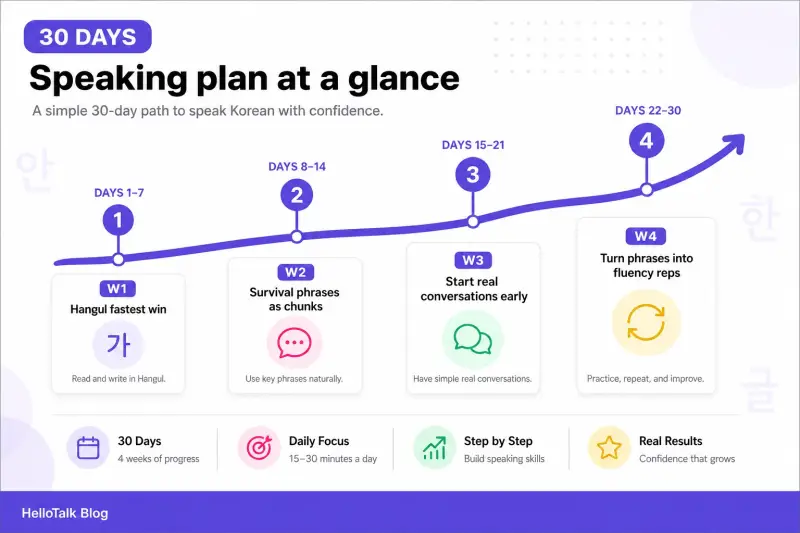
| Week | Focus | Daily actions | Speaking goal |
|---|---|---|---|
| Week 1 | Hangul and sounds | Learn letter blocks, read words aloud | Say your name and a greeting |
| Week 2 | Survival phrases | 100 high-frequency phrases as chunks | Order food, ask a simple question |
| Week 3 | Real conversation | Daily message plus one Voiceroom | Hold a 2-minute chat with a native |
| Week 4 | Fluency reps | Shadowing plus themed conversations | Talk about yourself for 5 minutes |
Hangul has only 24 basic letters and is famously logical, so this is the week you feel fast progress. Learn it in blocks: vowels one day, basic consonants the next, then combine. Learning Hangul in your first week is the highest-return step in any 30-day Korean plan, because it fixes pronunciation and unlocks reading everything else.
This first milestone is also where the gap that opens up right after Hangul begins to matter.
Daily: 10 minutes of new letters, 10 minutes reading real Korean words aloud, and 5 minutes writing your name and a greeting. Skip romanization entirely.
Do not study grammar tables yet. Learn about 100 high-frequency phrases as whole chunks, greetings, ordering, asking prices, saying you do not understand. Memorizing phrases as complete units, not grammar rules, is what gets a beginner speaking within a month. The grammar sinks in later, on its own.
Daily: 10 new phrases, 10 minutes reviewing old ones out loud, and start reading Hangul signs or menus in shows and games.
This is the week most self-taught learners skip, and it is why they stall. You start talking to real people now, not at the end. It will feel uncomfortable and that is normal.
On HelloTalk you can message native Korean speakers directly and get real-time correction in the chat, with built-in translation, transcription, and pronunciation readouts, so a beginner sentence gets fixed instantly. With 70M+ registered users across 200+ countries, you can find a Korean speaker who is also learning your language and trade practice fairly. Drop into a Korean Voiceroom as a silent listener first, then say one line when ready.
Daily: send at least one voice or text message to a native speaker, spend 5 minutes in a Voiceroom, and post one Korean sentence to Moments for corrections from several native speakers at once.
Now you combine everything into smoother speech. Shadow short clips to fix rhythm, and hold longer themed conversations, your hobbies, your job, your weekend. The AI pronunciation scoring flags the specific sound you keep missing, and Livestreams offer short interactive lessons to fill gaps. By week four the goal shifts from learning new words to reusing what you know until it comes out automatically.
Daily: 10 minutes shadowing, one 5-minute conversation on a set topic, and review any corrections you received.
Delaying speaking until "later," so it never happens.
Grinding grammar in week 1 instead of learning to read and say things.
Using romanization and building a weak accent.
Studying in rare long sessions instead of short daily ones.
Expecting fluency and quitting when it does not arrive.
If your schedule is tight, adapt the pacing with our busy-person method for learning Korean quickly, and to pick your tools see which Korean learning apps live up to the "easy" claim.
Can I really speak Korean after 30 days? Yes, at a beginner level: greetings, introductions, ordering, and simple questions and answers. Not fluently. That honest target is what makes 30 days work.
How much time per day does this plan need? About 30-45 minutes. Less is fine and simply stretches the timeline; consistency matters more than duration.
When should I start speaking to real people? Week 3 at the latest, and earlier if you can. Speaking is a separate skill from studying, and it only grows through responsive practice.
Do I need to pay for an app to follow this plan? No. On HelloTalk, most core features are available for free, including chat with native speakers, corrections, Voicerooms, and Moments.
How do I keep going after 30 days? Keep the daily conversation habit and add motivating input. Our guide to learning Korean through K-pop and K-drama shows how to use content actively for the long haul.
Thirty days is enough to read Hangul, stockpile phrases, and hold your first real conversations, if you start speaking early and practice daily. Begin week 1 today and line up a native speaker for week 3. Practice free with real Korean speakers on HelloTalk and make your 30 days count.