Korean Learning Websites Compared: Which Ones Help With Vocabulary, Speech Levels, and Real Conversation?
You have a row of Korean learning sites open in tabs, and every homepage promises the same three things: vocabulary, grammar, and speaking. Not one of them tells you which site fixes the thing blocking you this week: words you keep forgetting, grammar that will not stack, verb endings that change with every listener, or the simple fact that you have never said any of it to a real person.
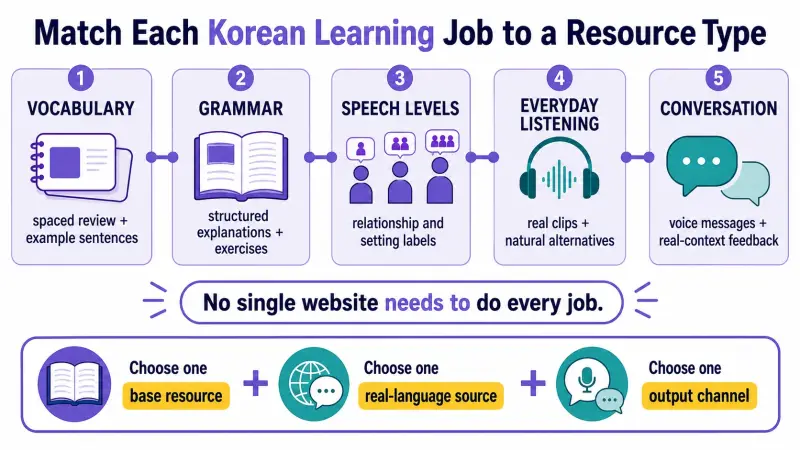
So this comparison sorts sites by task, not by hype. A Korean learning website earns its place in your routine by being clearly better than the alternatives at one specific task: vocabulary, grammar, speech levels, everyday input, or real conversation.
Match the Website to the Learning Job, Not the Other Way Around
Korean punishes the "collect ten apps and hope" approach because the total workload is real. The US Foreign Service Institute groups Korean with its most demanding languages for English speakers, estimating roughly 2,200 classroom hours to reach professional working proficiency. If you want to see how that stacks up against Japanese or Mandarin, the guide to how the hardest languages compare for English speakers walks through the same FSI numbers.
Here is the part that should relax you: almost none of those hours go to the script. Hangul is built from 24 basic letters, 14 consonants and 10 vowels, so reading Korean is a far smaller task than the grammar and register system behind it. The alphabet dates to 1446 under King Sejong the Great, and most learners read syllables comfortably within their first stretch of study.
Before picking anything, name your blocked task. Then use the table below, which maps each named site to the task it handles most reliably. Find your row, skip the rest.
| Website | Core learning job | What you actually do there | Access |
|---|---|---|---|
| Talk To Me In Korean (TTMIK) | Grammar foundations, situational lessons | Work through leveled audio lessons with PDFs | Free and paid courses |
| How to Study Korean | Grammar depth and reference | Read sequential unit lessons packed with example sentences | Free lessons |
| Online King Sejong Institute | Structured curriculum with cultural context | Take self-paced or teacher-supported courses | Free |
| Naver Korean-English Dictionary | Vocabulary lookup and example sentences | Check meanings, audio, and real usage examples | Free |
| HelloTalk | Real conversation and current usage | Message and speak with native Korean speakers | Free core features, optional paid plan |
No site on this list replaces the others, and none of them, HelloTalk included, is the automatic answer for every row.
Named Websites for Building Korean Vocabulary That Sticks
Here is the vocabulary failure most learners hit first. You drill 사다 as "to buy," feel confident, then freeze when a partner writes 샀어요, past tense, casual polite, one syllable left of the word you memorized. Words learned as isolated pairs collapse the moment a particle or ending touches them.
The fix is learning words inside sentences, and the Naver Korean-English Dictionary is the tool most learners end up living in for that. Every lookup comes with audio and real example sentences from actual usage. Reading two or three of those sentences per lookup does more for retention than doubling your flashcard count, because you are storing the word with the company it keeps.
TTMIK covers the same task from the course side. Its word builder and vocabulary lessons introduce new words already attached to grammar you just studied, so nothing arrives naked. Memrise adds native-speaker video clips to review, useful for connecting the written form to how the word sounds at full speed.
One lookup tool, one review tool. Adding a third vocabulary site is usually procrastination wearing a productive face.
Named Websites for Grammar Foundations and Structured Progression
Vocabulary gives you pieces. Grammar is what lets you build with them, and Korean grammar builds in a strict order, so the site you choose needs a visible path from lesson one onward, not a searchable pile.
Talk To Me In Korean is the best-known path. The core grammar track runs nine levels of roughly 30 lessons each, and the platform as a whole now counts over 1,700 lessons across free and paid courses. The audio-plus-PDF format works if you want a teacher's voice walking you through each pattern before you see it on paper.
How to Study Korean is the opposite shape: long, dense, free written units with an unusual number of example sentences per grammar point. Keep it open as the reference you check when a TTMIK lesson moves faster than you can absorb.
The Online King Sejong Institute is the option most lists skip, and it should not be. Run by the foundation the Korean government set up in 2007, with 248 institutes across 85 countries as of February 2024, its online arm gives you free structured courses built on the standard Korean curriculum, some with actual teacher feedback. A government-backed curriculum at zero cost is a hard offer to beat.
Websites That Teach Speech Levels Through Real Situations
Any grammar site will show you the speech-level chart. The chart is not the problem. The problem arrives the first time you type 뭐 해? to someone you met yesterday and only realize afterward that you spoke to them like a childhood friend.
The sites that actually teach register anchor every ending in a situation: ordering food, texting a friend, answering a manager. TTMIK's situational content, including its IYAGI listening series built around everyday scenarios, shows the same intention expressed at different politeness levels in context. That situational framing is the single feature to check for before trusting any site's speech-level lessons.
Hearing the switches happen live is a different kind of input, and it is one thing a conversation platform gives you that no course can script. HelloTalk's Voicerooms run as live group audio around the clock, and HelloTalk lets you join purely as a listener, so you can hear native speakers slide between polite and casual endings depending on who just spoke. HelloTalk's livestreams add hosts responding to the room in real time, which surfaces register choices textbook dialogues never show.
This page stays at the overview so the deep version has room to breathe. For which sites handle 해요체, 합쇼체, and casual speech well, and how to drill the switches, go to the comparison of websites that teach Korean speech levels.
Where to Find Everyday Korean Instead of Textbook-Only Dialogues
Register is half of sounding natural. The other half is the everyday phrasing textbooks quietly avoid, because course dialogues exist to demonstrate grammar, and grammar demonstrations drift toward a careful Korean nobody texts in.
You close that gap by adding one source of Korean that native speakers made for each other, not for you. TTMIK's IYAGI episodes are a good bridge, since they are unscripted conversations rather than drills. Past that, the richest free source is a feed of native speakers just posting about their day, which is exactly what HelloTalk's Moments is: a public community feed where Korean speakers write casual, current Korean for other Koreans, and where posting your own attempt can draw corrections from several native speakers at once.
Which feeds and sites give the most usable everyday Korean, and how to mine them without drowning, has its own tradeoffs. The support article on where to find everyday Korean online goes deep on exactly that.
Resources for Real Conversation: Where HelloTalk and Language Partners Fit
Everything above is input. At some point the task flips to output, saying Korean at a live human and adapting to whatever comes back, and no lesson site can do that for you. Two resources can, and they are not the same resource.
HelloTalk is the platform. HelloTalk connects a community of 70M+ registered users across 200+ countries and matches you with native Korean speakers for text and voice exchange. HelloTalk's chat keeps the learning tools inside the conversation: built-in translation, transliteration, read-aloud playback, and grammar correction, so checking a word never means leaving the chat. HelloTalk's AI tools go further, with pronunciation scoring that names the specific sounds you missed and grammar correction that explains the fix instead of just making it. HelloTalk was named the 2017 Google Play Best Social App, and HelloTalk has been featured on the App Store's Today tab in the Korean, Japanese, and Chinese regions, which is worth something when the featuring market speaks the language you are learning.
HelloTalk's concrete role in a Korean study stack is real conversation, contextual feedback, and exposure to current usage after a structured resource has taught the pattern, not the structured teaching itself. It is one named resource in this comparison, strong at its task and not the winner of the other four rows.
The language partner is the separate human resource. A partner gives you what no feature can: open-ended response, a gut sense of what sounds off, and the register that fits your specific relationship. One caution saves a lot of confusion here. When your partner says "we never say it that way," you have learned how one speaker of one age from one city talks, not a rule of Korean. When two partners disagree, that is variation, not an error.
Building a Weekly Stack That Combines Two or Three Sites by Job
If each site above handles one task, the practical question is how to combine them without turning your week into app-hopping. Most learners get further by pairing two or three websites with clearly different tasks than by rotating through many sites that all repeat the same beginner material.
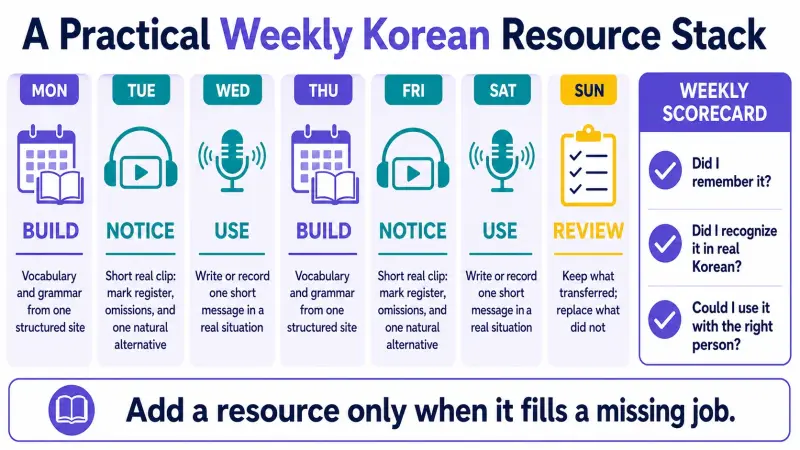
The stack has to repeat weekly because the tasks feed each other in a loop: a pattern from a grammar site only settles once it survives a real conversation, and the gaps that conversation exposes tell you what to look up next. Here is one balanced week built from the sites above. Treat each row as a slot you can refill with the same-task alternative from earlier sections.
| Weekly slot | Learning job | Named site | What you produce |
|---|---|---|---|
| 2 short sessions | Grammar foundations | TTMIK or Online King Sejong Institute | One new pattern, notes in your own words |
| Daily, minutes | Vocabulary | Naver Korean-English Dictionary | Lookups saved with one example sentence each |
| 1 session | Everyday input | Moments feed or IYAGI episode | Three phrases you did not know were common |
| 2 sessions | Real conversation | HelloTalk chat or Voiceroom | Messages or voice notes using this week's pattern |
Two or three sites, one task each, cycling weekly. That is the whole system, and it stays real, immersive, and interactive in a way no single all-in-one site manages.
Do I need a paid website to learn Korean online?
No. How to Study Korean's lessons and the Online King Sejong Institute's courses are free, and TTMIK offers a solid set of free courses beside its paid tracks. Paying buys convenience and structure, but every task in this comparison can be done at no cost.
Which website should a complete beginner open first?
One structured grammar site, TTMIK or the Online King Sejong Institute, and learn Hangul there before anything else. With 24 basic letters, the script takes days to weeks and unlocks everything else on this page.
How many websites should I use at the same time?
Two or three, each covering a different row of the table above. A fourth site usually means two of them now overlap, and overlapping sites are where study time leaks.
Can HelloTalk replace a structured Korean course?
No, and it is not trying to. HelloTalk's task is real conversation, contextual feedback, and current usage. A course's task is sequenced grammar. Run them as a pair: the course supplies the pattern, the conversation tests it.
How can I tell whether a site teaches speech levels well?
Check whether it shows the same sentence in multiple registers tied to a concrete situation, instead of listing endings in a chart. That one signal predicts almost everything, and it is the main test in the speech-level comparison linked above.
The fastest way to find out which task your current stack is missing is to have one real Korean conversation and notice where it breaks. You can start that conversation today at HelloTalk.