Why Millions Are Choosing Korean in 2026: Is It the Right Language for You?
The episode ends. You sit with the credits rolling and realize you've watched six hours without moving. The emotions felt real. The humor landed. And somewhere around episode four, you started noticing the same words repeating — jinja (really?), aigoo (oh no), saranghae (I love you).
You think: I want to actually understand this.
That feeling — a mix of cultural pull, genuine curiosity, and a little impulsiveness — is exactly how millions of Korean language learners begin. And in 2026, that number keeps growing. The question isn't whether Korean is worth learning. It's whether it's the right language for you. (If you eventually want to practice with native speakers, HelloTalk is where many Korean learners land — but more on that later.)
Why Korean Is Having a Moment (That Doesn't Look Like It's Ending)
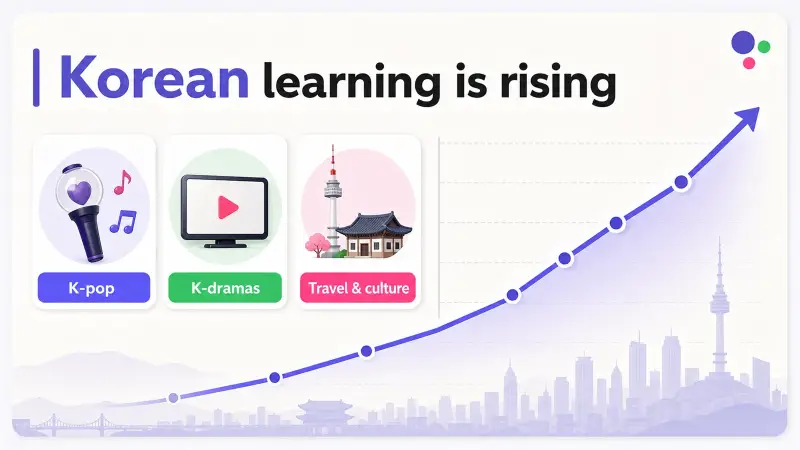
Korean language learning has grown by more than 40% on major learning platforms in recent years — and the drivers behind that growth are genuinely cultural, not just trendy.
K-dramas went global. Netflix made Korean content available worldwide, and shows like Squid Game, Crash Landing on You, and My Mister didn't just find audiences — they built devoted ones. People who'd never encountered Korean before found themselves emotionally invested in stories told in another language.
K-pop created a different kind of fan. BTS, BLACKPINK, STRAY KIDS, and hundreds of other acts built fanbases that actively want to engage with the language — to understand lyrics without waiting for translations, to communicate with artists in their own words.
Korean food has gone global. Korean BBQ, tteokbokki, kimchi, and Korean fried chicken are no longer niche. As Korean restaurants spread, people develop a natural curiosity about the culture behind the food.
Korean gaming is a powerhouse. South Korea is one of the world's top gaming nations — both in terms of game development and esports culture. For gamers, learning Korean opens doors to communities, games, and tournaments that don't always translate quickly into English.
K-beauty changed the beauty industry. The global influence of Korean skincare and cosmetics has brought millions of people into a broader interest in Korean culture and lifestyle.
When this many doors into a culture open at once, language follows. That's not hype — it's how cultural transmission has always worked.
The Honest Difficulty Picture
Before you commit, you deserve a clear look at what you're getting into.
The U.S. Foreign Service Institute (FSI) classifies Korean as a Category IV language — the hardest tier for native English speakers. Their estimate: approximately 2,200 hours to reach professional working proficiency. That's more than French, Spanish, or even Arabic.
The main reasons:
- Grammar is fundamentally different. Korean is SOV — Subject-Object-Verb — which means sentences are structured in reverse order from English. "I Korean study" instead of "I study Korean." It takes genuine adjustment, especially at first.
- Verb endings carry enormous weight. In Korean, the ending of a verb tells you the tense, the mood, the formality level, and often who's being spoken to. This is powerful once you understand it, but it can feel overwhelming when you're starting out.
- Honorific speech levels are real. Korean has multiple speech registers — formal, informal, polite — and using the wrong one in the wrong context is socially significant. You'll spend time learning not just what to say, but how formally to say it.
- Vocabulary shares little with English. Unlike French or Spanish, Korean has almost no cognates with English. Every word is new.
This isn't meant to discourage you. It's meant to give you a realistic picture so that if you do commit, you go in with your eyes open — and you don't quit at month two because "it's harder than I expected."
For more on how Korean compares to other challenging languages, see our guide to the hardest languages to learn.
What's Surprisingly Approachable About Korean
Here's the flip side — and this part genuinely surprises people.
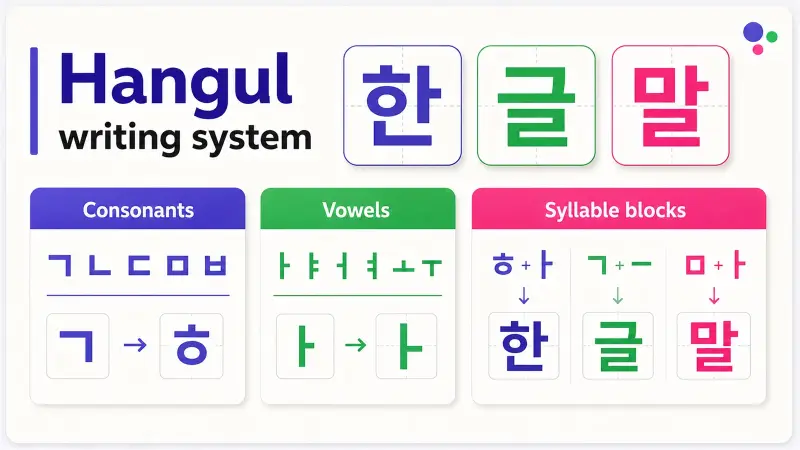
Hangul is one of the fastest writing systems to learn in the world. The Korean alphabet was deliberately designed in the 15th century by King Sejong to be learnable quickly. It's phonetic, systematic, and logical. Most people can read Hangul within a weekend — not fluently, but well enough to sound out words. That's a genuinely encouraging start.
- Korean grammar is consistent. The rules, once you internalize them, apply reliably. Korean doesn't have the irregularities and exceptions that plague English or French. If you understand the pattern, it works.
- No tones. Unlike Mandarin or Vietnamese, Korean pronunciation doesn't rely on pitch to distinguish meaning. You can mispronounce something without accidentally saying an entirely different word.
- No grammatical gender. Unlike French, Spanish, German, or Russian, Korean doesn't assign masculine or feminine categories to nouns. One less layer to track.
- The learner community is enormous. On Reddit, YouTube, Discord, language exchange apps — Korean has one of the most active, welcoming learner communities of any language. Resources, free content, and fellow learners are everywhere.
Why Your K-Wave Motivation Matters More Than You Think
A lot of people dismiss their K-drama or K-pop motivation as "not serious enough." They wonder: is loving Korean content a real reason to learn a language?
The research says yes — and strongly.
Intrinsic motivation — the kind that comes from genuine personal interest rather than external pressure — is one of the strongest predictors of long-term language learning success. People who learn a language because they genuinely love something about the culture consistently outperform people who learn for purely practical reasons but feel no connection to it.
This makes intuitive sense. Language learning is a long game. It happens across months and years, not weeks. The learners who make it are the ones who keep showing up even when progress feels slow — and they keep showing up because they have a reason that's personal to them.
If you watch Korean dramas and feel something, if you've listened to Korean music and found yourself trying to pick out words — that's not a shallow motivation. That's exactly the kind of authentic pull that sustains long-term learning.
Who Korean Suits Best
Korean is genuinely well-suited for certain types of learners.
- K-drama and K-pop fans. If you consume Korean content and want to experience it without the filter of subtitles or translations, Korean language learning will feel rewarding almost immediately. You'll start catching words you know. That feedback loop is powerful.
- People with a real interest in Korean culture. Whether it's food, fashion, history, or the general vibe of contemporary Korean life, cultural affinity creates natural motivation and context for vocabulary.
- Anyone planning to visit or live in Korea. South Korea is a major travel destination and a hub for international business and technology. Functional Korean makes navigation, connection, and experience significantly richer.
- Gamers and esports fans. Korea's gaming culture is deeply embedded in the language. If you're embedded in that world, learning Korean opens up a layer of community and content that English doesn't fully access.
- Learners who want a challenge. Some people want to learn something genuinely difficult — not because it's the easiest path, but because the difficulty is part of the point. Korean rewards that kind of learner.
Who Might Think Twice
Korean isn't the right choice for everyone, and it's worth being honest about this.
If your primary goal is career utility in Asian business markets with no particular cultural connection to Korea, you might get more return on investment from Mandarin (1.4 billion speakers, the world's second-largest economy) or Japanese (a major regional business language with significant cultural output). Both are also Category IV languages, so the difficulty is comparable — but their professional reach is different.
Korean's global speaker count is around 80 million. It's influential in specific industries (entertainment, beauty, gaming, tech) but not a widely-used international business language in the same way.
None of this makes Korean a "lesser" choice. It just means the decision should be driven by genuine interest, not vague notions of career practicality.
For a broader look at how Korean stacks up against other options, see our guide to the best languages to learn.
Realistic Timeline: What to Actually Expect
One of the most useful things you can know before starting is what real progress looks like.
| Milestone | What it looks like | Approximate time (45 min/day) |
|---|---|---|
| Read Hangul | Decode text, read menus | 1-2 weeks |
| Basic phrases | Greet, order food, simple questions | 2 — months |
| Casual conversation | Chat with friends, follow simple K-dramas | 9-12 months |
| Comfortable drama watching | Follow shows without subtitles | 2-3 years |
| Professional level | Business meetings, presentations | 4+ years |
The honest truth: most people won't reach the top. But most people don't need to. "Watching K-dramas without subtitles" and "having real conversations with Korean friends" are goals you can realistically hit well before professional proficiency — and they're deeply rewarding milestones.
How to Start Learning Korean (And Where HelloTalk Fits In)
The best first step is Hangul — the Korean writing system. Spend a focused weekend on it. Once you can sound out Korean text, everything else clicks faster: flashcard apps, subtitled dramas, and language exchange conversations all become more accessible.
After Hangul, build vocabulary and basic grammar with apps or structured content. Then, as early as month two or three, start practicing with real Korean speakers. That's where things accelerate.
HelloTalk has one of the largest Korean user bases of any language exchange platform. Korean native speakers are consistently among the most active communities on the app — they post frequently to Moments, offer corrections willingly, and tend to be genuinely interested in helping learners improve.
Picture this: you've just learned how to introduce yourself in Korean. You open HelloTalk, send a short voice message to a Korean partner, and within an hour you've got a reply — with a gentle correction on your pronunciation and a follow-up question in English. They're learning from you; you're learning from them. That back-and-forth, happening in real time with a real person, is what moves you from studying Korean to actually using it.
If you're at the early stages and feeling nervous — HelloTalk's text-based exchange features let you ease in at your own pace before you jump to voice or video.
Frequently Asked Questions About Learning Korean
Is Korean hard to learn for English speakers? Yes — the U.S. Foreign Service Institute rates Korean as a Category IV language, the hardest tier for English speakers, estimating around 2,200 hours to professional proficiency. The grammar structure, verb endings, and honorific speech levels are the main challenges. That said, Hangul (the writing system) is remarkably easy to learn, and many aspects of Korean grammar are highly consistent once you grasp the patterns.
How long does it take to learn to read Korean (Hangul)? Most learners can read Hangul — sound out Korean text correctly — within one to two weeks of focused study, sometimes faster. Learning to read is not the same as understanding what you're reading, but being able to decode the script is a genuinely quick win that opens up a huge range of learning resources.
Do I need to learn formal and informal Korean separately? Korean has multiple speech levels — formal, polite-informal, and casual — and knowing which to use matters socially. In practice, beginners usually start with the standard polite form (頃挫殧觳?, which is safe in most contexts. Casual speech comes naturally as you spend more time with the language and build relationships with Korean speakers.
Is learning Korean worth it if I'm not going to Korea? Absolutely. Korean is the language of one of the world's most globally influential cultures — K-dramas, K-pop, K-beauty, and Korean gaming reach hundreds of millions of people worldwide. Many learners never set foot in Korea but build rich connections with Korean speakers, enjoy media without subtitles, and participate in online communities that span the globe.
How has K-pop and K-drama affected Korean language learning worldwide? The impact has been dramatic. Korean language learning grew by more than 40% on major platforms in recent years, driven almost entirely by cultural enthusiasm rather than career necessity. The Korean Wave (Hallyu) created a global learner community with shared references, shared motivation, and an enormous amount of free learning content — reaction videos, lyric breakdowns, drama analysis — that didn't exist a decade ago.
Where can I find Korean native speakers to practice with? Language exchange platforms are the most accessible option. HelloTalk, in particular, has one of the largest and most active Korean speaker communities of any app — Korean users are known for being generous with corrections and genuinely interested in exchange. Language learning subreddits, Discord servers, and local Korean cultural organizations are also good places to find conversation partners.
Ready to Find Out?
Korean might be the most rewarding language decision you ever make — or it might not be the right fit right now. The honest answer depends on you: your motivation, your goals, and whether Korean culture genuinely pulls at you.
If it does, that pull is worth following.
Start with Hangul. It'll take you a weekend. From there, you'll know if you want to go further.
If Korean is already your answer and you want to know which specific platform features actually build speaking ability, What Premium Korean Learning Website Features Actually Get You Speaking? breaks down the tools worth your attention.
Download HelloTalk and find a Korean language partner today.