German Language Learning in 2026: Is German the Right Choice for You?
You've almost started German three times now.
Maybe it was when you got interested in German engineering — the precision, the process, the way German companies seem to build things that last. Or maybe it was a particular piece of music: Bach, Beethoven, Schubert, and you realized you wanted to understand what the lyrics actually said. Or there's a person — a partner, a colleague, a friend — whose first language is German, and you want to meet them there.
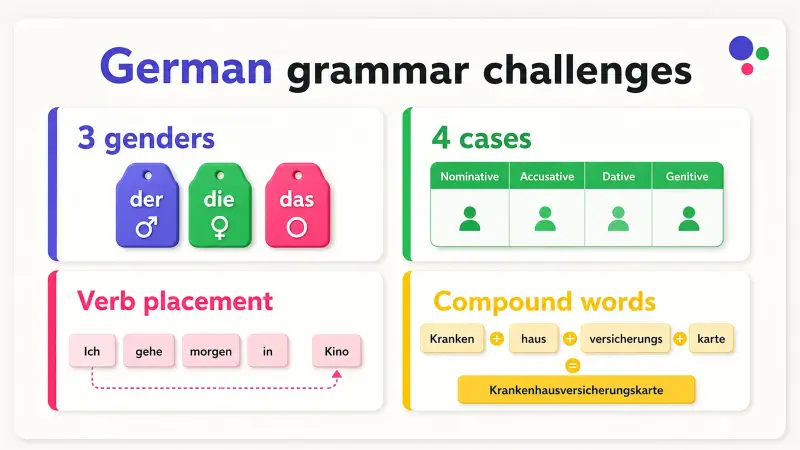
And then someone tells you: "Oh, German is impossible." Three genders. Four cases. Sentences where the verb goes at the end. You picture a blackboard covered in declension tables and quietly shelve the idea again.
Here's the honest version: German is harder than Spanish or French for most English speakers. But "impossible" is not just wrong — it's the kind of exaggeration that keeps people from one of the most rewarding languages they could learn. For learners who want native conversation practice while they work through the grammar, tools like HelloTalk are worth knowing about — but let's first look at what German actually involves.
The Real Difficulty Level — No Spin
The U.S. Foreign Service Institute rates German as a Category II language for English speakers, estimating around 750 class hours to reach professional working proficiency. For comparison, Spanish and French sit at around 600 hours; Mandarin and Arabic — the truly hard ones — are 2,200 hours. German is meaningfully harder than the Romance languages, but it's nowhere near the extreme end.
The FSI estimate also reflects classroom learning. Self-directed learners who are motivated and consistent regularly reach conversational German in 18-24 months of daily practice. Some get there faster. It depends heavily on how much time you put in and how much of that time involves real conversation rather than passive review.
The grammar reputation is partly earned. But here's what experienced German learners often say: once you understand the system, it becomes logical. German grammar is complex but not chaotic. There are rules, and the rules actually hold. That's different from a language where the exceptions multiply until there are no real rules left.
What Actually Makes German Hard
Let's be specific, because vague warnings aren't useful.
Grammatical gender with three options. German nouns are masculine (der), feminine (die), or neuter (das). Unlike French, which has two genders, German has three, and the patterns for predicting gender are less reliable. Das M盲dchen (the girl) is neuter. Der Stuhl (the chair) is masculine. You largely have to learn the gender with every new noun.
Four grammatical cases. German marks the grammatical role of nouns through case: nominative (subject), accusative (direct object), dative (indirect object), and genitive (possession). Each case can change the article and sometimes the noun ending. Der Mann becomes den Mann in the accusative, dem Mann in the dative. This feels overwhelming at first. After a few months of exposure, your brain starts to pattern-match it without conscious effort.
Verb placement. In German subordinate clauses, the verb moves to the end of the sentence. Ich weiß, dass er morgen kommt — "I know that he tomorrow comes." Not natural to an English speaker's brain. It requires rewiring, and that rewiring takes time.
Compound words. German stacks nouns together into single words with no spaces. Donaudampfschifffahrtsgesellschaft (Danube steamship company) is the famous joke example. In everyday use, compounds are shorter, but they're still everywhere and can be disorienting at first. The flip side: once you learn the component words, you can often decode the compound.
These are real challenges. Knowing them in advance means you can plan for them instead of being caught off guard.
Why German Is Easier Than Its Reputation Suggests
For all that difficulty, German has something most hard languages don't: a shared family tree with English.
Both languages are Germanic. That means thousands of words that are recognizably related — not just similar, but obviously connected once you see them:
- Wasser — water
- Haus — house
- Buch — book
- Garten — garden
- Finger — finger
- Arm — arm
- Kalt — cold
- Grün — green
The shared vocabulary runs deep, into prepositions, conjunctions, and core verbs. This gives English speakers an underlying scaffold that learners of, say, Japanese or Hungarian don't have.
Pronunciation is consistent once learned. German spelling maps to sound far more reliably than English. Once you know how each letter combination is pronounced, you can read a new word aloud and be correct. There's no German equivalent of the English chaos where "though," "through," "cough," "bough," and "rough" all end in "ough" but sound completely different.
Resources are everywhere. German is one of the most studied languages in the world. You'll never lack for textbooks, apps, podcasts, YouTube channels, graded readers, or exchange partners. The infrastructure around German language learning is enormous, and a significant portion of it is free.
Why German Is Seriously Worth It
Once you move past the difficulty question, the case for German gets genuinely interesting.
Germany is Europe's largest economy. It's a global leader in engineering, manufacturing, automotive, chemicals, and finance. German companies — Siemens, BMW, Volkswagen, SAP, Bosch, Bayer — operate across every sector, on every continent. Fluency in German is a real differentiator in sectors where these companies hire.
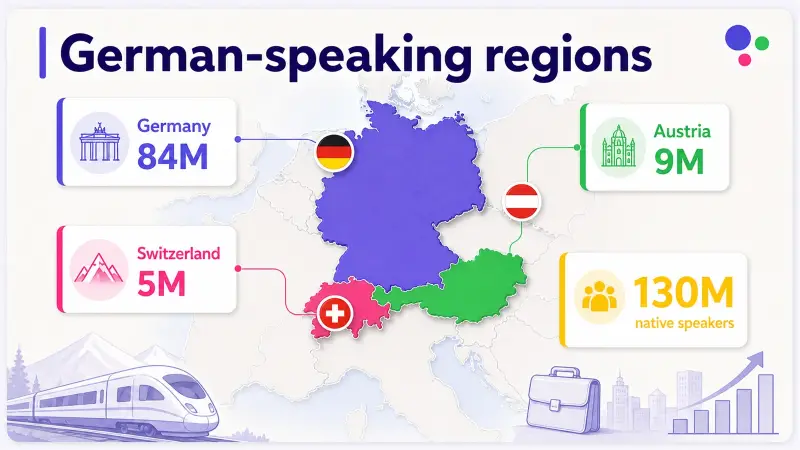
German is official in four countries, with roughly 130 million native speakers across them. Swiss German and Austrian German have regional characteristics, but standard German (Hochdeutsch) is understood everywhere.
Scientific and academic heritage. For most of the nineteenth and early twentieth centuries, German was the language of science. An enormous proportion of foundational papers in physics, chemistry, mathematics, and philosophy were written in German. If you work in academia or the history of science, reading primary sources in German changes what's available to you.
Philosophy and music. If you've ever wanted to read Kant, Hegel, Nietzsche, or Heidegger without relying on a translator's interpretation, German is the only way. Classical music's European tradition runs heavily through German — lieder, opera libretti, music theory texts. The language opens a different kind of depth.
German speakers tend to respect the effort. This is anecdotal but widely reported: Germans, Austrians, and Swiss people tend to be genuinely appreciative when a foreigner makes a real effort to learn their language. The stereotype of Germans switching immediately to English is real — but it often dissolves when they see you're committed to actually learning rather than just getting by.
German-Speaking Countries at a Glance
| Country | Official Language | Notable Context |
|---|---|---|
| Germany | Yes | Europe's largest economy, ~83M people |
| Austria | Yes | Strong cultural and music heritage |
| Switzerland | Yes (one of 4) | Finance, international organizations |
| Liechtenstein | Yes | Smallest German-speaking country |
| Total native speakers | ~130 million | 4th most spoken in Europe |
Who German Suits Best
German isn't for everyone — and that's fine. It tends to be a great match if you:
- Work in engineering, science, or manufacturing. The professional relevance is direct and measurable.
- Are planning to live or work in Germany, Austria, or Switzerland. Quality of life there for non-German speakers is manageable but limited. Speaking German transforms the experience.
- Love classical music or opera. The German repertoire is vast, and understanding what you're hearing changes the relationship to the music.
- Are drawn to German philosophy or intellectual history. Some concepts simply don't translate cleanly; reading the originals is the only real alternative.
- Enjoy language for its structural logic. Some people genuinely find German's rule-bound grammar satisfying rather than frustrating. If you're the type who likes understanding systems, German rewards that instinct.
- Already speak Dutch or a Scandinavian language. The family connections are strong, and the transition to German will be faster than for most learners.
German sits in an interesting middle ground — harder than the Romance languages, but nowhere near the extreme end. That context lands differently once you look at the full range of options side by side.
A Realistic Timeline for German
With daily practice of 30-60 minutes:
- 6 months: Basic conversations, simple questions, travel situations handled reasonably well. You'll make a lot of grammatical errors but communicate.
- 12-18 months: Comfortable in common everyday situations. Reading news articles with dictionary support. Following slower podcasts and TV.
- 2-3 years: Working proficiency. Can handle professional conversations, read books, follow native-speed media with effort.
- 3+ years: Fluency — the language starts to feel like a tool rather than a task.
Inconsistency is the real enemy of language learning, not complexity. A daily 30-minute practice habit over two years outperforms an intensive week once a month, every time.
The grammar hurdle is front-loaded. Most learners report that the case system, which seems overwhelming at first, starts to feel natural after about six months of regular conversation practice. Your brain begins to anticipate the correct form before your conscious mind works through the logic.
Practicing German with Real Speakers
Reading grammar explanations and drilling exercises will only take you so far. At some point, you need actual Germans (or Austrians, or Swiss people) to talk to — people who will respond naturally, correct you when you're wrong, and show you how the language actually lives.
That's where HelloTalk changes things. HelloTalk connects you with native German speakers who are looking for language exchange partners — you help them with English, they help you with German. The exchange format means you're practicing in real context, not in the artificial bubble of a classroom exercise.
Take someone like James, who'd been studying German grammar for a year but had never had a real conversation. He matched with a speaker from Vienna on HelloTalk and started with ten-minute text exchanges three times a week. By month three, the case endings he'd been drilling in isolation started clicking — because he was seeing them used naturally, and getting corrected in context rather than in a workbook.
The built-in correction features are particularly useful for German learners. When a native speaker corrects your message in real time — adjusting your case endings, fixing your word order in a subordinate clause — you're getting targeted, contextual feedback that most textbooks can't replicate. The Moments community also lets you write short posts in German and get responses from native speakers, which builds writing fluency alongside speaking practice.
HelloTalk has 70M+ users across 260+ languages, was named Google Play's Best Social App, and is 90% free. German is one of the most active language communities on the platform — the exchange partners are there, and many are keen to help learners who are genuinely trying. The other half of the challenge — keeping conversations in German when your partner's English is better than your German — is its own skill, and one worth thinking about before you start.
Frequently Asked Questions About Learning German
Is German really as hard as people say? German is harder than Spanish or French for English speakers — the U.S. Foreign Service Institute rates it Category II, estimating about 750 hours to professional proficiency. But "impossible" overstates it significantly. The grammar is complex but rule-bound, and the deep vocabulary overlap with English gives learners a useful head start. Most determined learners reach conversational level in 18-24 months.
How long does it take to learn German to B2 level? B2 (upper intermediate — comfortable in most everyday and professional situations) typically takes 18-24 months of consistent daily practice for an English speaker. This assumes 30-60 minutes daily and regular conversation practice, not just grammar drills. Learners who supplement textbook work with real German speakers tend to progress faster, particularly on speaking and listening.
Do I need to learn all four German cases? Yes — but not all at once, and not as perfectly as you might fear. Nominative and accusative cover the vast majority of everyday speech and are straightforward to learn first. Dative becomes familiar with regular conversation practice, usually within six months. Genitive is the least common in spoken German and can be learned progressively. The cases seem overwhelming on paper but become intuitive faster than most learners expect once they're used in real sentences.
Is German useful outside of Germany? Very much so. German is official in Austria, Switzerland, and Liechtenstein — together around 130 million native speakers. Switzerland's German-speaking population is central to its finance and international-organization sectors. Beyond the German-speaking world, German is one of the most studied second languages in Europe and is widely understood across much of Central and Eastern Europe.
Is German or French more useful for business in Europe? It depends on the sector and geography. German is dominant in engineering, manufacturing, automotive, and finance in Central Europe. French is stronger in diplomacy, international organizations, luxury goods, and has significant reach across Africa. For purely European business, German edges ahead due to Germany's economic size. For international careers with a multilateral or African dimension, French often provides more reach.
Where can I practice German with native speakers online for free? HelloTalk (hellotalk.com) is one of the most active platforms for German language exchange — 90% of features are free, and the German-speaking community is large and engaged. For structured listening practice, Deutsche Welle produces free German lessons and slow-speed news broadcasts at multiple levels. The combination of a language exchange partner for speaking and DW for listening covers the two areas where most learners plateau.
So: Is German Right for You?
German is harder than Spanish. It's harder than French. It will ask more of you upfront, particularly around grammar.
But "harder" is not "not worth it." For the right person, German is one of the most rewarding languages an English speaker can learn — because the professional opportunities are real, the cultural depth is genuine, and the shared Germanic roots mean you're not starting from zero.
If you've been almost starting German for a while, consider that the hesitation itself is useful information. It usually means the interest is real. The difficulty is real too — but it's the kind you can plan around, not the kind that makes success unlikely.
Start. Make it daily. Find real people to practice with.
Ready to start talking with native German speakers? Join HelloTalk for free and take the first real step today.